By continuing, you agree to LoansJagat's Credit Report Terms of Use, Terms and Conditions, Privacy Policy, and authorize contact via Call, SMS, Email, or WhatsApp
Disclaimer: The information published on LoansJagat is intended for general informational and educational purposes only and should not be considered financial, legal, or investment advice. Interest rates, loan terms, statistics, and other data may change over time and may vary by lender or source. Please verify the latest information and consult a qualified financial advisor or the respective Bank/NBFC before making any financial decisions.
Apply for Loans Fast and Hassle-Free
Subscribe Now
About the author

LoansJagat Team
‘Simplify Finance for Everyone.’ This is the common goal of our team, as we try to explain any topic with relatable examples. From personal to business finance, managing EMIs to becoming debt-free, we do extensive research on each and every parameter, so you don’t have to. Scroll up and have a look at what 15+ years of experience in the BFSI sector looks like.
Related Blog Post
Simplify All Your Loans Into One Affordable EMI

Customers Served

Debt Consolidated

1200+ Reviews

Locations in India
Club all Loans & Credit Card Bills into Single EMI

Quick Apply Loan
Consolidate your debts into one easy EMI.

Takes less than 2 minutes. No paperwork.

10 Lakhs+
Trusted Customers

2000 Cr+
Loans Disbursed

4.7/5
Google Reviews

50+
Banks & NBFCs Offers
Other services mentioned in this article
Key Takeaways
Ghar kharidna ek bada decision hota hai, aur tax ka confusion usse aur bada bana deta hai. Let’s ease this confusion by using a home loan tax benefit calculator!
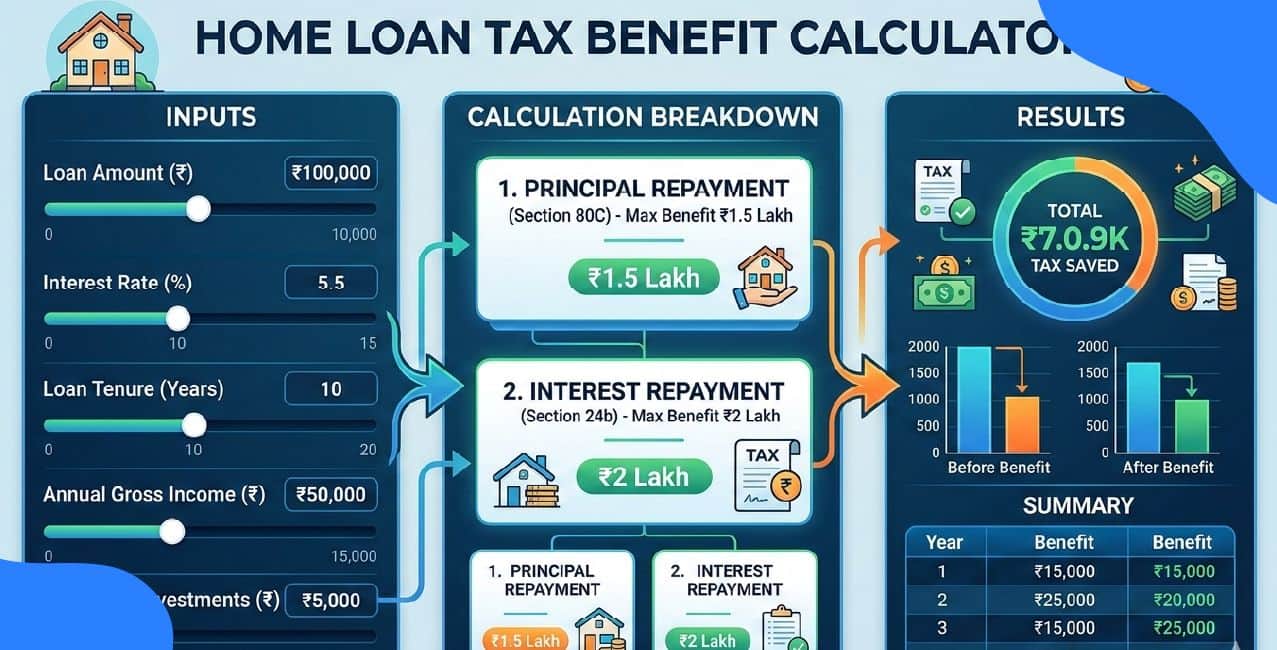
A home loan tax benefit calculator is an online tool that estimates the amount of income tax a borrower can legally save by taking out a home loan. The calculator converts loan details into tax savings by applying limits defined by the Income Tax Act. This makes tax planning easier and more accurate for borrowers when using a home loan tax benefit calculator India.
I paid ₹3,00,000 as home loan interest during the year, but I claimed only ₹2,00,000 under Section 24(b) as allowed. The remaining ₹1,00,000 was spread over future years as pre-construction interest.
This made it a direct home loan tax benefit which section limits apply, and helped me avoid over-claiming.
The tax benefit depends on two major components defined by law.
Read More - Home Loan Tax Exemption
First, the annual interest paid on a self-occupied house is checked. Only ₹2,00,000 is allowed even if the interest is higher. Then, the principal repayment is treated as part of the overall Section 80C limit of ₹1,50,000.
This answers the home loan tax benefit which section applies to each part. People verify these figures using tools like a home loan tax benefit calculator axis bank or a custom home loan tax benefit calculator Excel to avoid mistakes.
Bonus Tip: Budget 2026 clarifies that pre-construction home loan interest now qualifies for deduction under Section 24.
These are some people who utilised a home loan tax benefit calculator in different situations to understand their tax benefits:
A salaried professional earning ₹9,00,000 annually buys a self-occupied flat using a home loan. The purpose is to understand yearly tax savings.
The borrower avoids assuming full interest deduction and plans taxes accurately by using the home loan tax benefit calculator.
An investor purchases a second house and rents it out. The focus is on maximising interest deduction.
Section 80C
*T&C Apply
There is no ₹2,00,000 limit on interest since the house is let out. The calculator helps reflect this correctly and prevents under-claiming.
A married couple takes a joint loan and jointly owns the property. Both want equal tax benefits.
Also Read - Sections 80C and 24(b) Help Indian Borrowers
Both co-owners correctly calculate individual benefits instead of assuming automatic sharing, using a joint home loan tax benefit calculator.
People verify this using a home loan tax benefit calculator Axis Bank, or prepare a shared home loan tax benefit calculator Excel for better understanding.
These personal experiences show how the home loan tax benefit calculator creates real and measurable value.
1. I avoided over-claiming deductions
I assumed the entire ₹2,40,000 interest paid was deductible earlier. The calculator highlighted the ₹2,00,000 limit under Section 24(b), which helps me avoid a potential tax notice and penalty.
2. I chose the right tax regime
The calculator showed that the old tax regime reduced my taxable income by ₹3,20,000 after entering my loan details. This translated into a tax saving of over ₹42,000 at the 30% slab.
3. I planned joint ownership better
The calculator showed that each co-owner could separately claim up to ₹3,50,000 in deductions in a joint loan. This helped us legally double our tax benefit while also comparing outcomes using HRA and home loan tax benefit calculator cases.
These examples highlight how using a home loan tax benefit calculator leads to informed decisions and better long-term financial results.
A home loan tax benefit calculator removes confusion from tax planning, shows exact savings, and prevents costly mistakes. The calculator helps people take informed financial decisions, whether they are salaried, self-employed, or joint owners.
1. Is it worth taking a home loan just for tax benefits?
A home loan should not be taken only for tax savings. Tax benefits only reduce the cost of borrowing. The real value comes from owning property, long-term appreciation, and better cash flow planning.
2. What tax benefits are available on a home loan?
Interest paid on a home loan is deductible under Section 24 under the old tax regime, and principal repayment is deductible under Section 80C. First-time buyers may also get additional interest benefits under specific sections if conditions are met.
3. Is a home loan an efficient way to save tax for high-income earners?
A home loan can be tax-efficient if the borrower is in a higher tax slab and uses the old tax regime. However, tax efficiency depends on rental income, interest cost, and alternative investment returns. It should always be evaluated holistically.
4. How do tax benefits work for a rented house bought using a home loan?
The full interest paid on the home loan is deductible under Section 24 for a rented property. However, the loss that can be adjusted against other income is limited to ₹2,00,000 per year. Any remaining loss is carried forward to future years.
5. What tax benefits can a self-occupied home buyer claim on a home loan?
A self-occupied home buyer can claim up to ₹2,00,000 on interest under Section 24 and up to ₹1,50,000 on principal under Section 80C. First-time buyers may claim additional interest deductions if they meet eligibility rules. These benefits apply only under the old tax regime.