By continuing, you agree to LoansJagat's Credit Report Terms of Use, Terms and Conditions, Privacy Policy, and authorize contact via Call, SMS, Email, or WhatsApp
Disclaimer: The information published on LoansJagat is intended for general informational and educational purposes only and should not be considered financial, legal, or investment advice. Interest rates, loan terms, statistics, and other data may change over time and may vary by lender or source. Please verify the latest information and consult a qualified financial advisor or the respective Bank/NBFC before making any financial decisions.
Subscribe Now
About the author

LoansJagat Team
‘Simplify Finance for Everyone.’ This is the common goal of our team, as we try to explain any topic with relatable examples. From personal to business finance, managing EMIs to becoming debt-free, we do extensive research on each and every parameter, so you don’t have to. Scroll up and have a look at what 15+ years of experience in the BFSI sector looks like.
Related News
Simplify All Your Loans Into One Affordable EMI

Customers Served

Debt Consolidated

1200+ Reviews

Locations in India
Club all Loans & Credit Card Bills into Single EMI

Quick Apply Loan
Consolidate your debts into one easy EMI.

Takes less than 2 minutes. No paperwork.

10 Lakhs+
Trusted Customers

2000 Cr+
Loans Disbursed

4.7/5
Google Reviews

50+
Banks & NBFCs Offers
Other services mentioned in this article
For 2026 trips, Indian travellers can save big with the right travel credit card, but only if they track lounge rule changes and forex costs.
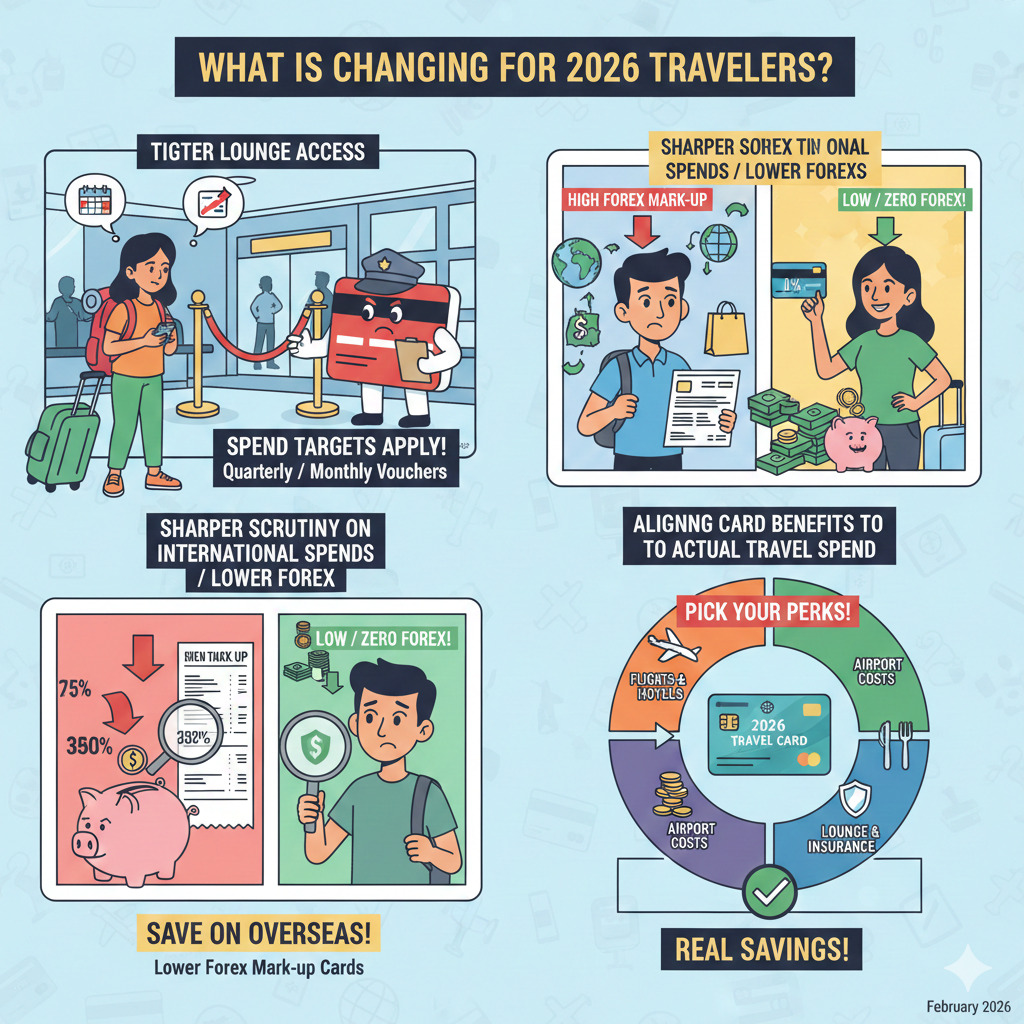
Travel credit cards in India are being repositioned as “savings tools”, not just lifestyle add-ons. The shift is driven by 2 trends: tighter airport lounge entry rules and sharper scrutiny on international spends.
Several issuers are linking lounge entry to quarterly or monthly spend targets, often through digital vouchers. At the same time, banks are promoting lower forex mark-up or even 0% forex options for frequent flyers. For anyone planning a 2026 vacation, the real win is in aligning card benefits to actual travel spend.
The largest savings usually come from 3 buckets: miles value, forex savings, and airport costs.
Axis Bank’s ATLAS is marketed as an “airlines agnostic” travel card. Its rewards page lists 5 EDGE Miles per ₹100 on airlines and hotels, and 2 EDGE Miles per ₹100 on other spends. For travellers who book flights and hotels on card, this can build a usable miles pool faster than flat reward cards.
Forex is the silent leakage on international trips. SBI Card ELITE explicitly lists a 1.99% foreign currency mark-up on international usage. Over a high-spend trip, that gap versus higher mark-up cards becomes a direct rupee saving.
The market is also moving towards “0% forex” propositions. IDFC FIRST Bank’s Diamond Reserve product page states ZERO forex markup, with lounge access tied to monthly spend thresholds.
Before picking a travel card, travellers should compare benefits by cost head, not by marketing taglines.
After shortlisting, a second step is checking redemption flexibility. Paisabazaar’s ATLAS page (updated 9 January 2026) says miles can be redeemed across 20+ travel partners and also mentions a 1:2 ratio in its partner redemption context.
LoansJagat’s ATLAS explainer (dated 10 February 2025) also highlights lounge visit counts and milestone-linked EDGE Miles as part of the card’s positioning.
For overseas spends, DCC is a repeat trap. HSBC India advises that paying in local currency often gets a better rate than letting a merchant convert to rupees.
Airport lounge access has seen the biggest rule churn. HDFC’s official Tata Neu milestone PDF states that from 10 June 2025, domestic lounge access becomes voucher-based and depends on ₹50,000 spend in a calendar quarter, with Tata Neu Infinity users eligible for 2 vouchers on meeting the criterion. Another HDFC lounge PDF notes that direct swipe lounge access is discontinued from the night of 9 June 2025, reinforcing the voucher-first model.
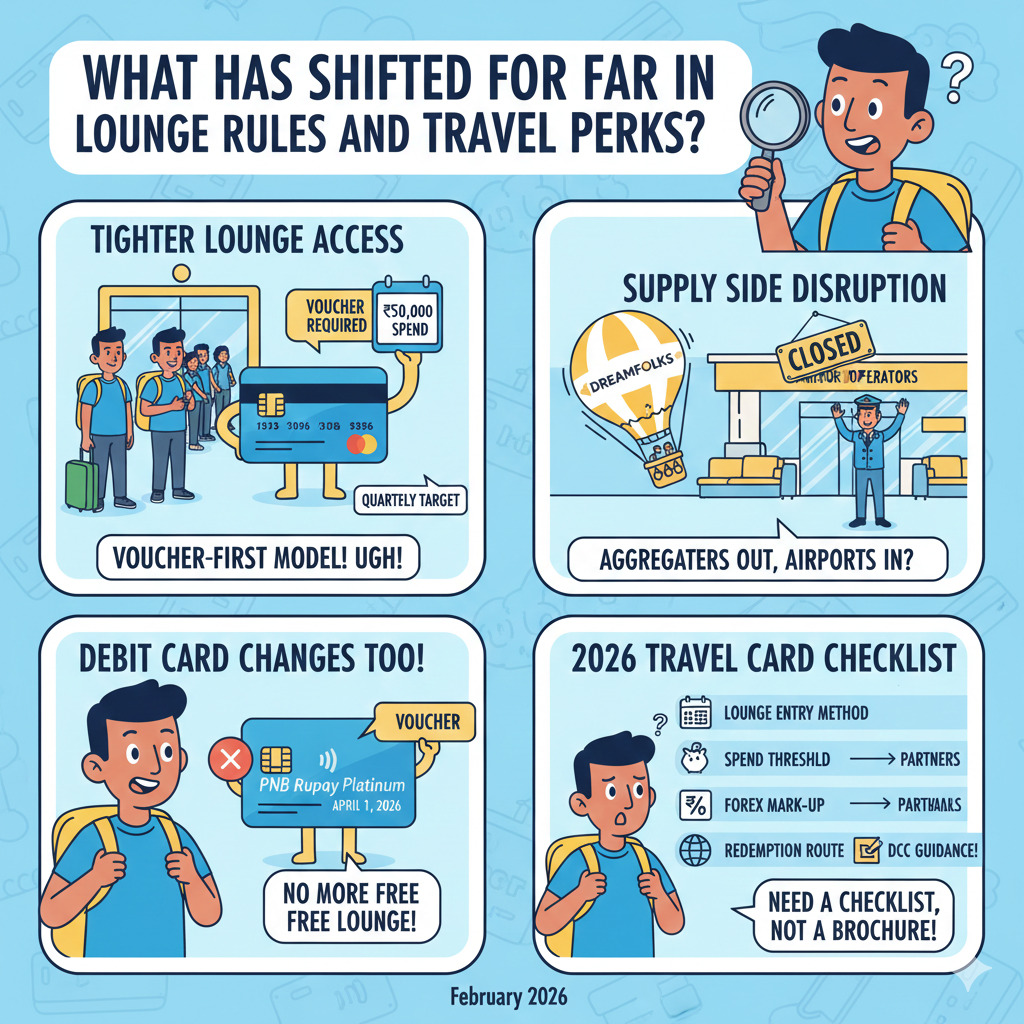
The voucher approach is expanding beyond credit cards. HDFC Bank’s debit-card lounge access page says the voucher-based facility applies from 10 January 2026, and physical card-based access will not work without the voucher.
Business Standard also reported on 12 January 2026 that vouchers are mandatory and customers need to track quarterly spend and claim vouchers on time.
There is also disruption on the lounge supply side. Reuters reported on 16 September 2025 that Dreamfolks stopped domestic airport lounge services, while continuing global lounge operations and other services. The report adds that Dreamfolks stock fell 65% in 2025, and notes contract terminations and competition from airport operators offering lounge access directly.
More rule changes are lined up for 2026. Economic Times reported that Punjab National Bank will discontinue complimentary domestic lounge access for RuPay Platinum debit cardholders from 1 April 2026, and revise eligibility criteria.
*T&C Apply
This is why travellers now need a checklist, not a brochure.
To reduce DCC-related leakage, Worldline’s DCC whitepaper dated 8 December 2025 notes a survey where over 30% of travellers prefer paying in home currency abroad, even though DCC can cost more depending on rates.
Banks are pitching travel cards as targeted products for frequent travellers. A Times of India report dated 6 January 2026says IDFC FIRST Bank launched a “Zero-Forex” Diamond Reserve card positioned for frequent international travellers, with 0% foreign exchange mark-up.
HDFC, through its official Tata Neu documents, frames lounge access changes as a revised programme linked to spends and vouchers. On the ecosystem side, Reuters points to airport operators offering lounge access directly, raising competitive pressure on aggregators and card-linked programmes.
For 2026 vacations, travel cards still save money, but the savings come from miles and forex control, not “free lounge” assumptions. Travellers who track vouchers, mark-up % and redemption rules will keep more rupees in hand.









.png&w=3840&q=75)



