
By continuing, you agree to LoansJagat's Credit Report Terms of Use, Terms and Conditions, Privacy Policy, and authorize contact via Call, SMS, Email, or WhatsApp
Disclaimer: The information published on LoansJagat is intended for general informational and educational purposes only and should not be considered financial, legal, or investment advice. Interest rates, loan terms, statistics, and other data may change over time and may vary by lender or source. Please verify the latest information and consult a qualified financial advisor or the respective Bank/NBFC before making any financial decisions.
Subscribe Now
About the author

LoansJagat Team
‘Simplify Finance for Everyone.’ This is the common goal of our team, as we try to explain any topic with relatable examples. From personal to business finance, managing EMIs to becoming debt-free, we do extensive research on each and every parameter, so you don’t have to. Scroll up and have a look at what 15+ years of experience in the BFSI sector looks like.
Related Blog Post
Simplify All Your Loans Into One Affordable EMI

Customers Served

Debt Consolidated

1200+ Reviews

Locations in India
Club all Loans & Credit Card Bills into Single EMI

Quick Apply Loan
Consolidate your debts into one easy EMI.

Takes less than 2 minutes. No paperwork.

10 Lakhs+
Trusted Customers

2000 Cr+
Loans Disbursed

4.7/5
Google Reviews

50+
Banks & NBFCs Offers
Other services mentioned in this article
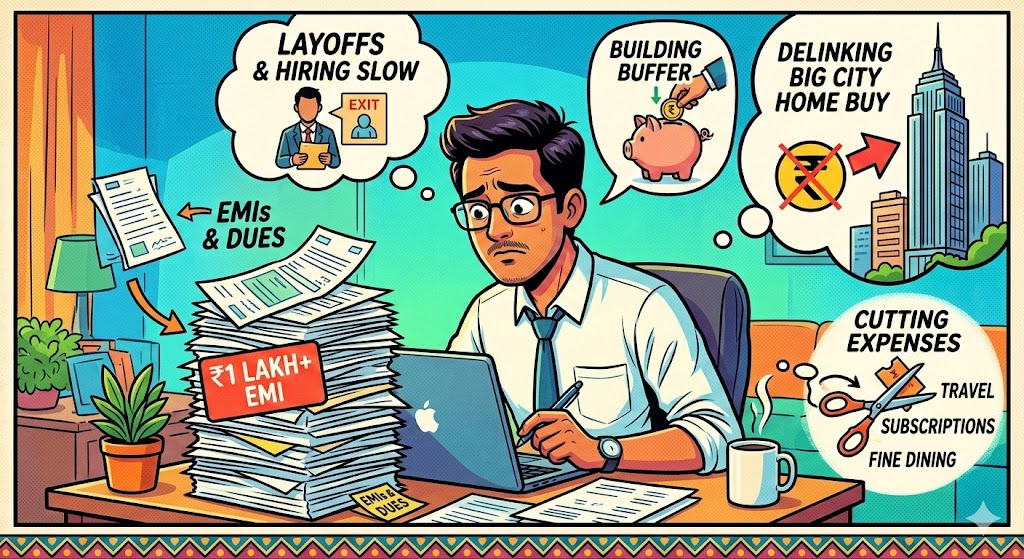
As layoffs return and hiring slows, many tech professionals with ₹1 lakh+ EMIs are cutting expenses, building buffers, and rethinking big-city home buys.
The fear is showing up in everyday conversations across India’s tech hubs. A viral post amplified by Hindustan Times captured the question many borrowers avoid asking: what happens if the salary stops tomorrow.
The stress is sharpest for professionals carrying large home-loan EMIs, often ₹1 lakh or more, along with car loans, schooling bills, rent, and rising lifestyle costs. Even if interest rates do not jump overnight, the monthly outgo stays fixed. A short job-search window can push families into missed payments and forced asset sales.
The data points below explain why this worry is spreading beyond a few isolated stories.
The immediate issue is fixed monthly liability versus uncertain job timelines. Borrowers can cut dining, travel, and shopping, but they cannot “skip” EMIs without consequences. In the HT report, YouTuber Akshay Saini described a “silent tension” among software engineers: layoffs are scary, but the bigger worry is the lifestyle and debt stack built around a stable pay cheque.
Read More : Techies Worried About Job Loss
Financial expert Suresh Sadopan warned that EMIs cannot be deferred at will and defaults can invite harsh bank action.
What is changing is not just the job market, but borrower behaviour. Professionals are quietly shifting from “max loan eligibility” to “max survival months”. One reason is the speed of downside. The Economic Times case study described a Bengaluru professional who lost his job and, after missing 3 EMIs, saw a ₹1.2 crore flat auctioned for ₹95 lakh, with ₹80 lakh still outstanding on the loan. The point that travelled fast online was not the city or the price. It was how quickly the situation turned irreversible.
On the EMI side, LoansJagat noted that when benchmark rates are steady, repo-linked borrowers often do not see an automatic EMI reset unless the lender tweaks the spread or the loan hits a reset date. The EMI may not rise, but it does not shrink either.
The backdrop is a long stretch of cautious hiring and visible job cuts. Reuters reported in July 2025 that TCS planned a 2% workforce reduction in FY2026, affecting roughly 12,200 roles, mainly in middle and senior management. That story landed hard because TCS has historically been seen as a stable employer.
In parallel, Economic Times reported that Indian startups laid off over 4,500 employees since July, citing data from executive search firm Longhouse Consulting. This keeps pressure on mid-career professionals who may otherwise jump to startups during downturns.
Also Read : AI Will Not Kill India Outsourcing Jobs As FY26
Outside India, high-profile cuts also shape sentiment. Times of India reported Block’s workforce falling from 10,000+ to just under 6,000 in a single round, with CEO Jack Dorsey arguing repeated layoffs damage morale.
Below is how the recent cycle looks in dates and numbers.
*T&C Apply
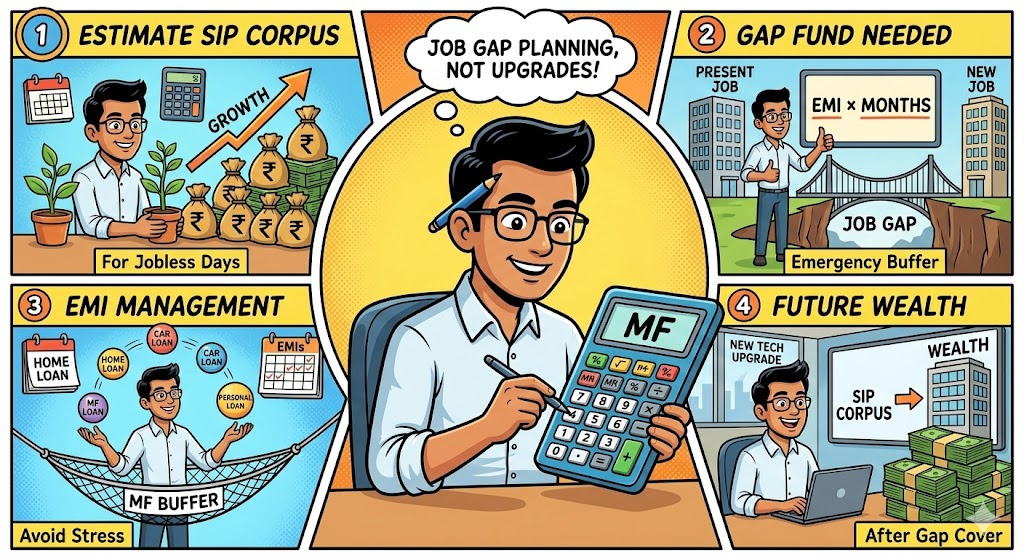
This is a cashflow story, not a headline scare. Tech borrowers with big EMIs are now planning for job gaps first, upgrades later.
Related Financial News | |||









.png&w=3840&q=75)



