By continuing, you agree to LoansJagat's Credit Report Terms of Use, Terms and Conditions, Privacy Policy, and authorize contact via Call, SMS, Email, or WhatsApp
Disclaimer: The information published on LoansJagat is intended for general informational and educational purposes only and should not be considered financial, legal, or investment advice. Interest rates, loan terms, statistics, and other data may change over time and may vary by lender or source. Please verify the latest information and consult a qualified financial advisor or the respective Bank/NBFC before making any financial decisions.
Apply for Loans Fast and Hassle-Free
Subscribe Now
About the author

LoansJagat Team
‘Simplify Finance for Everyone.’ This is the common goal of our team, as we try to explain any topic with relatable examples. From personal to business finance, managing EMIs to becoming debt-free, we do extensive research on each and every parameter, so you don’t have to. Scroll up and have a look at what 15+ years of experience in the BFSI sector looks like.
Related Blog Post
Simplify All Your Loans Into One Affordable EMI

Customers Served

Debt Consolidated

1200+ Reviews

Locations in India
Club all Loans & Credit Card Bills into Single EMI

Quick Apply Loan
Consolidate your debts into one easy EMI.

Takes less than 2 minutes. No paperwork.

10 Lakhs+
Trusted Customers

2000 Cr+
Loans Disbursed

4.7/5
Google Reviews

50+
Banks & NBFCs Offers
Other services mentioned in this article
Key takeaways:
Bonus tip:
In a recent judgment of the Supreme Court of India, it was stated that offence under section 138 of the NI Act is quasi criminal in nature. This is done with an intent to ensure the payment of money and promote credibility of the cheques.
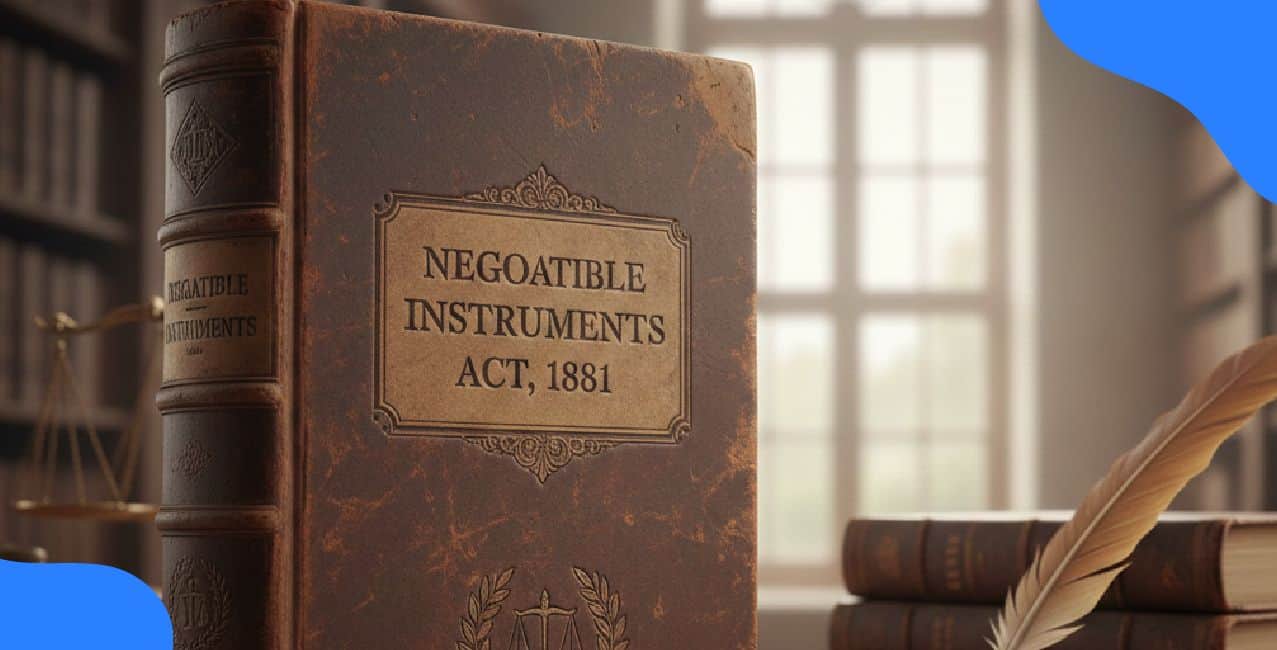
The Negotiable Instruments Act, 1881 was enacted with the purpose of giving legal recognition to instruments like Bill Of Exchange, cheques and promissory notes. The only intent behind this is to make business payments work smoothly.
A negotiable instrument is like a passport. Just like a passport helps you to move from one country to another freely. Bills and cheques (negotiable instruments) allow money to move freely from one person to the other.
For example, you bought some goods worth ₹50,000 from Aman and the mode of payment was cheque. If the cheques bounced because of some reason like insufficient balance. Aman has a legal right to send a notice and file a case under the NI Act if payment is not made within 15 days.
Before the enactment of the Negotiable Instrument Act, 1881, the english nNegotiable Instrument Act provisions were applicable in India. According to section 13(A) of the act Negotiable Instrument means a promissory note, bill of exchange or cheque payable either to order or to bearer whether the order or bearer appears on the instrument or not.
In simple words Negotiable Instrument means a written document which creates a right in favour of some person and which is freely transferable. A Negotiable Instrument does not just give possession of the instrument but right to property also which can be transferred without any formality.
According to section 13(1) a negotiable instrument includes a promissory note, cheques, Bill Of Exchange. In simple words, a negotiable instrument is a document that is transferable from one person to another.
For an instrument to be negotiable, it has to fulfill certain condition like:
Under section 13 of Negotiable Instrument Act, types of negotiable instrument are stated which are:- Promissory Notes, Bill of exchange, Cheques. Refer the below table for more details:
The above negotiable instruments are considered written contracts.
The objective behind Negotiable Instrument Act, 1881 is to:
There are 2 modes in which an instrument can be negotiates:
Cheques
*T&C Apply
Above are the two simple modes to negotiate the instrument.
The NEGOTIABLE INSTRUMENTS ACT, 1881 is a legal framework which has provisions that deal with every aspect of the negotiable instruments ranging from their creation to their enforcement. In the cheque bounce matters, the NI act is considered an important legislation because of its governance over negotiable instruments in the Indian territory.
1- What is section 138 of the Negotiable Instruments Act, 1881?
According to section 138 of the NI Act, 1881, if any cheque is bounced in the bank for the reasons of insufficient balance or any reason, punishment is mentioned for two years or fine of twice the cheque amount.
2-what are negotiable instruments and why are they called negotiable?
Negotiable instruments include bills of exchange, cheques and promissory notes. They are called negotiable because it is transferable from one person to another by the way of delivery or endorsement.
3- Is a currency note a promissory note?
No, a currency note is not a promissory note. According to section 4, promissory note does not include bank note or currency note.
4- within how many days should notice be issued after the dishonour of a cheque?
Within 15 days notice should be issued after the dishonour of a cheque.
5- Is cheque bounce a criminal offence or civil case under the NI Act?
Any case of a cheque bounce because of insufficient balance, closed account or payment stopped comes under section 138 of the Negotiable Instrument Act, 1881. It is the case which is under NI Act and is a criminal offence with civil objective. Cheque bounce is quasi criminal in nature.