
By continuing, you agree to LoansJagat's Credit Report Terms of Use, Terms and Conditions, Privacy Policy, and authorize contact via Call, SMS, Email, or WhatsApp
Disclaimer: The information published on LoansJagat is intended for general informational and educational purposes only and should not be considered financial, legal, or investment advice. Interest rates, loan terms, statistics, and other data may change over time and may vary by lender or source. Please verify the latest information and consult a qualified financial advisor or the respective Bank/NBFC before making any financial decisions.
Apply for Loans Fast and Hassle-Free
Subscribe Now
About the author

LoansJagat Team
‘Simplify Finance for Everyone.’ This is the common goal of our team, as we try to explain any topic with relatable examples. From personal to business finance, managing EMIs to becoming debt-free, we do extensive research on each and every parameter, so you don’t have to. Scroll up and have a look at what 15+ years of experience in the BFSI sector looks like.
Related Blog Post
Simplify All Your Loans Into One Affordable EMI

Customers Served

Debt Consolidated

1200+ Reviews

Locations in India
Club all Loans & Credit Card Bills into Single EMI

Quick Apply Loan
Consolidate your debts into one easy EMI.

Takes less than 2 minutes. No paperwork.

10 Lakhs+
Trusted Customers

2000 Cr+
Loans Disbursed

4.7/5
Google Reviews

50+
Banks & NBFCs Offers
Other services mentioned in this article
Key Takeaways
Bonus Tip: CCI has regional offices in cities like Kolkata, Mumbai, and Chennai to expand competition advocacy across India.
One day, while debugging at a café in Koramangala, Aarti wondered why tech prices soar without choice. She stumbled upon the India Competition Law. It is a rulebook that ensures markets stay fair and competitive, especially in booming sectors like IT in Bengaluru. Aarti noticed how fair competition rules prevent banks from fixing credit card fees, keeping attractive rewards, and offering competitive interest rates. They were the result of the Credit Card Competition Act.
Think of the India Competition Act like the rules of cricket (Don’t bowl beamers!). It keeps everyone playing fairly. Just as cricket rules ensure fun on the pitch, this law ensures businesses compete without unfair tricks. Laws like the Consumer and Competition Act balance business freedom with consumer protection, ensuring markets stay fair and transparent.
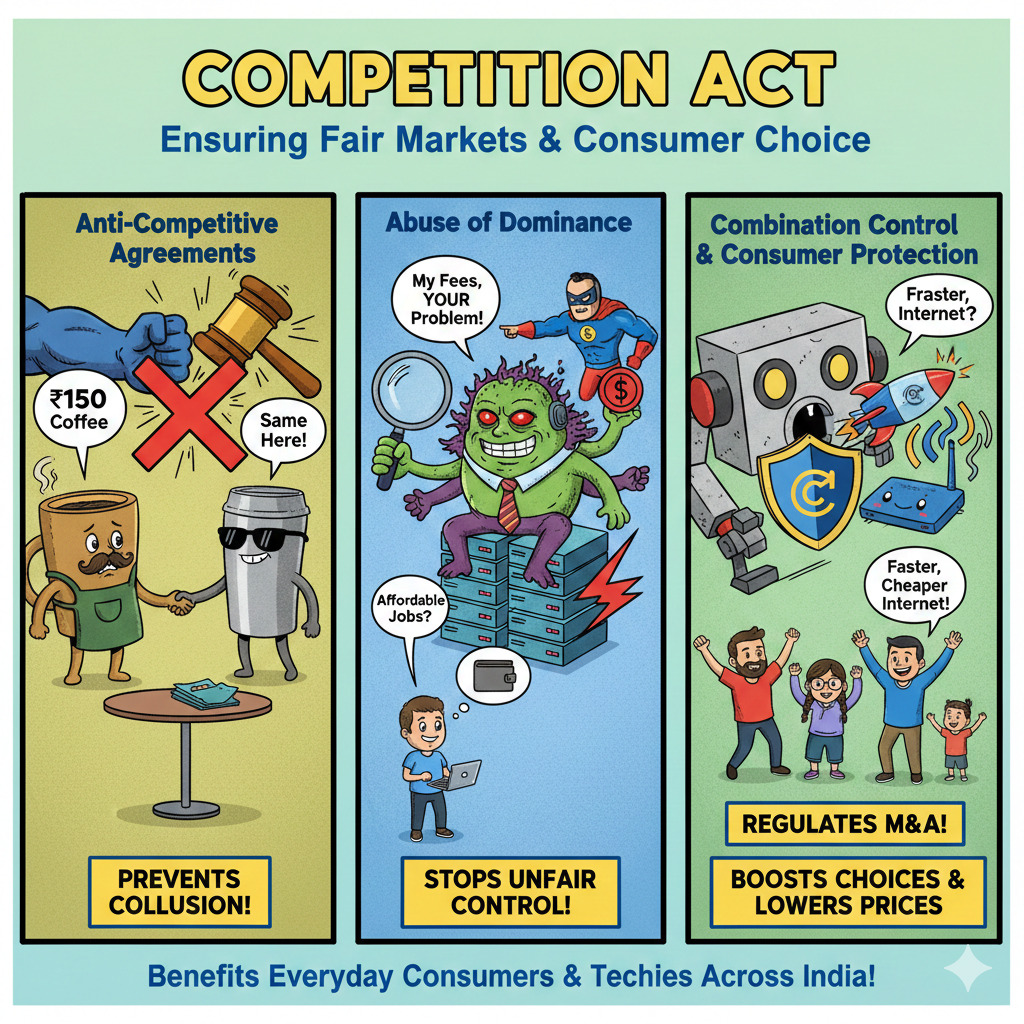
If two fintech startups in Bengaluru collude to fix UPI gateway fees, the Competition Act 2002 would step in and stop them, ensuring consumers and smaller rivals get a fair shot. Globally, the Competition and Consumer Act framework inspires India to strengthen consumer choice and healthy market rivalry.
To apply the India Competition Law in real business scenarios, follow these steps:
It is advisable to use the Competition Act 2013 framework wisely to make markets fairer and encourage innovation.
Why It Was Introduced & Latest Changes:
Post liberalisation, India needed a modern law to replace the limited MRTP Act. The Competition Act was enacted to curb unfair practices, protect consumers, and allow free trade.
The Competition Act has evolved into a robust framework that promotes fair competition, protects consumers, and adapts to India’s changing digital economy.
Why Does the 2023 Amendment Matter?
This latest overhaul strengthens merger review, introduces settlement systems, expands definitions, and fine-tunes enforcement for high-growth sectors like tech. It’s especially relevant for Bengaluru’s IT startups, which face global competition.
The Competition Act continues evolving to protect fair trade and tech innovation.
Long before Bangalore’s startup boom, India’s markets were regulated under the Monopolies and Restrictive Trade Practices Act, 1969. This law aimed to control the market power but was outdated for modern business.
In 2000, a committee recommended modern competition legislation. Thus, the Competition Act 2002 replaced the MRTP Act to promote competitive markets, protect consumers, and curb anti-competitive conduct.
*T&C Apply
With the advancements in the Competition Act, the unfair practices were curbed, consumers were protected, and free trade was allowed.
The table below uses fictional fun examples to explain traits:
These features ensure healthy competition that benefits everyday consumers like Aarti and techies across India.
From Aarti’s chai break in Bengaluru to Boardrooms in Delhi, the Competition Act keeps India’s markets fair. By prohibiting collusion, regulating mergers, and preventing abuse of dominance, the law ensures startups and consumers have a level playing field. Its evolution through amendments reflects changing business realities, especially in digital spaces. For IT pros like Aarti, understanding India Competition Law isn’t just legal know-how, it’s a competitive advantage. Keep learning, stay compliant, and play fair!
What is the main purpose of the Competition Act?
It ensures fair competition by banning anti-competitive agreements and abuse of dominance under India’s competition law.
How does merger review work under this law?
Companies must notify the CCI of deals over certain thresholds to prevent market dominance.
Can individuals file complaints with CCI?
Yes, individuals and businesses can complain about anti-competitive practices to the CCI which investigates them.
Why is competition compliance important?
Compliance protects a company’s reputation, avoids penalties, and facilitates smoother deals in the markets.
Does the Competition Act include consumer rights?
Yes, it protects consumer interests by promoting choice and fair pricing.
Can the Credit Card Competition Act actually benefit everyday consumers despite worries on discussion forums?
Yes, many users believe that if the Credit Card Competition Act lowers the swipe fees that merchants pay, those savings could eventually help reduce the retail prices consumers pay at checkout.
If two companies secretly plan which one will quote lower to win a tender, is that a violation under Indian competition law?
Yes, under Section 3 of the Competition Act, any agreement that results in the rigging of a bid or collusive pricing is presumed to hurt competition and is prohibited in India. This reflects the general legal principle that pre-arranged bidding agreements (even informal “shadow tenders”) could be considered anti-competitive and actionable.
If a company like Motorola launches exclusively on one e-commerce platform, but then sells elsewhere later, does it automatically violate the Competition Act in India?
Not necessarily, under Section 3(4) of the Competition Act, exclusive supply or distribution clauses are assessed only if they cause appreciable adverse effect on competition (AAEC) in India; short-term or limited exclusivity that doesn’t foreclose rivals may not be anti-competitive. Exclusivity arrangements are examined based on their actual impact on market competition. Just having a business understanding does not automatically make an arrangement anti-competitive.