By continuing, you agree to LoansJagat's Credit Report Terms of Use, Terms and Conditions, Privacy Policy, and authorize contact via Call, SMS, Email, or WhatsApp
Disclaimer: The information published on LoansJagat is intended for general informational and educational purposes only and should not be considered financial, legal, or investment advice. Interest rates, loan terms, statistics, and other data may change over time and may vary by lender or source. Please verify the latest information and consult a qualified financial advisor or the respective Bank/NBFC before making any financial decisions.
Subscribe Now
About the author

LoansJagat Team
‘Simplify Finance for Everyone.’ This is the common goal of our team, as we try to explain any topic with relatable examples. From personal to business finance, managing EMIs to becoming debt-free, we do extensive research on each and every parameter, so you don’t have to. Scroll up and have a look at what 15+ years of experience in the BFSI sector looks like.
Related News
Simplify All Your Loans Into One Affordable EMI

Customers Served

Debt Consolidated

1200+ Reviews

Locations in India
Club all Loans & Credit Card Bills into Single EMI

Quick Apply Loan
Consolidate your debts into one easy EMI.

Takes less than 2 minutes. No paperwork.

10 Lakhs+
Trusted Customers

2000 Cr+
Loans Disbursed

4.7/5
Google Reviews

50+
Banks & NBFCs Offers
Other services mentioned in this article
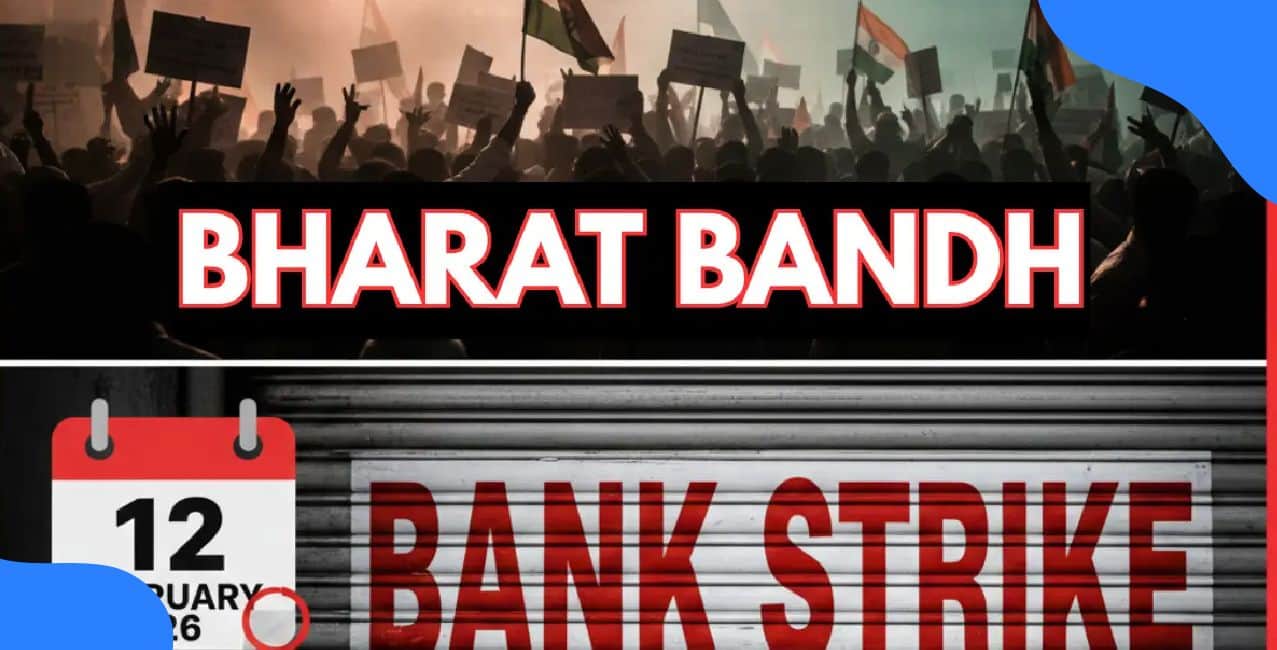
Banks were not on an official holiday on February 12, 2026, but the Bharat Bandh call triggered branch-wise disruption risks across several cities.
Confusion around “bank holiday” vs “bank strike” peaked on February 12, 2026, when a nationwide Bharat Bandh was observed in parts of India. Several customers assumed banks would shut fully, but reports clarified that there was no nationwide bank holiday declaration for that date. Instead, services depended on staff participation and local conditions.
SBI, Bank of Baroda and UCO Bank issued alerts about possible disruption, and similar warnings were reported for other public sector banks. The overall impact varied across states, with some regions reporting limited disruption and others seeing sharper slowdowns.
The issue is simple: February 12, 2026 was not a scheduled bank holiday, but a bandh-linked strike meant branch operations could be affected. Customers needing cash withdrawals, cheque-related work, account updates and branch approvals were most exposed to delays.
Digital channels were expected to continue, but branch counters and back-office functions could slow down where participation was high. Several reports linked the bandh to protests led by 10 central trade unions and supported by other groups, which is why banking was flagged as a possible pressure point.
Before deciding whether to step out, customers mainly needed to understand the difference between “holiday closure” and “disruption risk”.
That distinction is why many branches stayed open, but customers still reported delays in certain locations.
The main trigger for customer alerts was that SBI, Bank of Baroda and UCO Bank cautioned about possible service disruption due to the strike, with updates carried in mainstream coverage. Business Standard also reported that public sector banks including SBI, PNB, Bank of Baroda and UCO Bank flagged potential disruptions. ABP Live framed it as a practical question for customers: banks were not “officially closed”, but access could be uneven across branches.
On-ground impact was mixed. Hindustan Times’ live coverage noted little impact in Gujarat, with services largely functioning, showing how state-wise participation shaped outcomes.
Moneycontrol’s live blog also repeated the core takeaway: banks were not officially closed, but disruptions were possible, especially at public sector branches, depending on union participation.
Customers planning urgent branch work were advised across reports to check branch-level updates and use digital options where possible.
To make it actionable, here is what typically got affected first during partial participation days.
*T&C Apply
Customer support at branches
So, the day was less about a blanket shutdown and more about location-specific disruption.
The bandh call built up through the week as multiple outlets reported that a joint forum of trade unions planned a nationwide strike, and banking unions were also expected to participate.
A Times of India report, updated on February 12, 2026, stated that 30 crore workers were expected to join the nationwide strike, adding to public anxiety around transport and banking access.
Economic Times published multiple explainers in the run-up, including a February 11 update highlighting that a nationwide bank strike could affect services, with banks alerting customers about disruption risk.
Another reason confusion spread was February’s usual closure pattern. LoansJagat, in a post dated February 2, 2026, said banks would be closed for 9 days in February 2026 due to Sundays, 2nd and 4th Saturdays, plus 3 regional holidays. That backdrop made many customers assume February 12 was also a holiday, even though it was linked to bandh action, not the regular holiday calendar.
Separately, some reports tracked state-wise disruptions. Economic Times noted the bandh’s expected impact could vary, with certain states anticipated to see stronger participation than others.
Banks communicated caution. The Economic Times Reports said SBI, Bank of Baroda and UCO Bank alerted customers about possible service disruption due to the strike. Business Standard added that other public sector banks, including PNB, also flagged possible disruption.
Trade unions, as cited across coverage, positioned the bandh as a protest against labour reforms and related demands, while news live blogs advised customers to plan ahead and rely on digital options.
February 12, 2026 was not a nationwide bank holiday, but Bharat Bandh participation created real branch-level disruption risk.
Customers were better off confirming local branch status and using digital banking for time-sensitive transactions.









.png&w=3840&q=75)



