By continuing, you agree to LoansJagat's Credit Report Terms of Use, Terms and Conditions, Privacy Policy, and authorize contact via Call, SMS, Email, or WhatsApp
Disclaimer: The information published on LoansJagat is intended for general informational and educational purposes only and should not be considered financial, legal, or investment advice. Interest rates, loan terms, statistics, and other data may change over time and may vary by lender or source. Please verify the latest information and consult a qualified financial advisor or the respective Bank/NBFC before making any financial decisions.
Apply for Loans Fast and Hassle-Free
Subscribe Now
About the author

LoansJagat Team
‘Simplify Finance for Everyone.’ This is the common goal of our team, as we try to explain any topic with relatable examples. From personal to business finance, managing EMIs to becoming debt-free, we do extensive research on each and every parameter, so you don’t have to. Scroll up and have a look at what 15+ years of experience in the BFSI sector looks like.
Related Blog Post
Simplify All Your Loans Into One Affordable EMI

Customers Served

Debt Consolidated

1200+ Reviews

Locations in India
Club all Loans & Credit Card Bills into Single EMI

Quick Apply Loan
Consolidate your debts into one easy EMI.

Takes less than 2 minutes. No paperwork.

10 Lakhs+
Trusted Customers

2000 Cr+
Loans Disbursed

4.7/5
Google Reviews

50+
Banks & NBFCs Offers
Other services mentioned in this article
Key Takeaways
Bonus Point: The Labour Ministry and EPFO clarified that the new EPF–EPS rules are meant to make withdrawals simpler and allow limited pension access when needed. They also ensure that long-term retirement savings remain protected and that no “theft” is involved.
An EPS in PF acts as a safety net, paying you a monthly pension after retirement rather than a one-time amount. It quietly builds in the background while you work, ensuring steady income support when your salary stops.
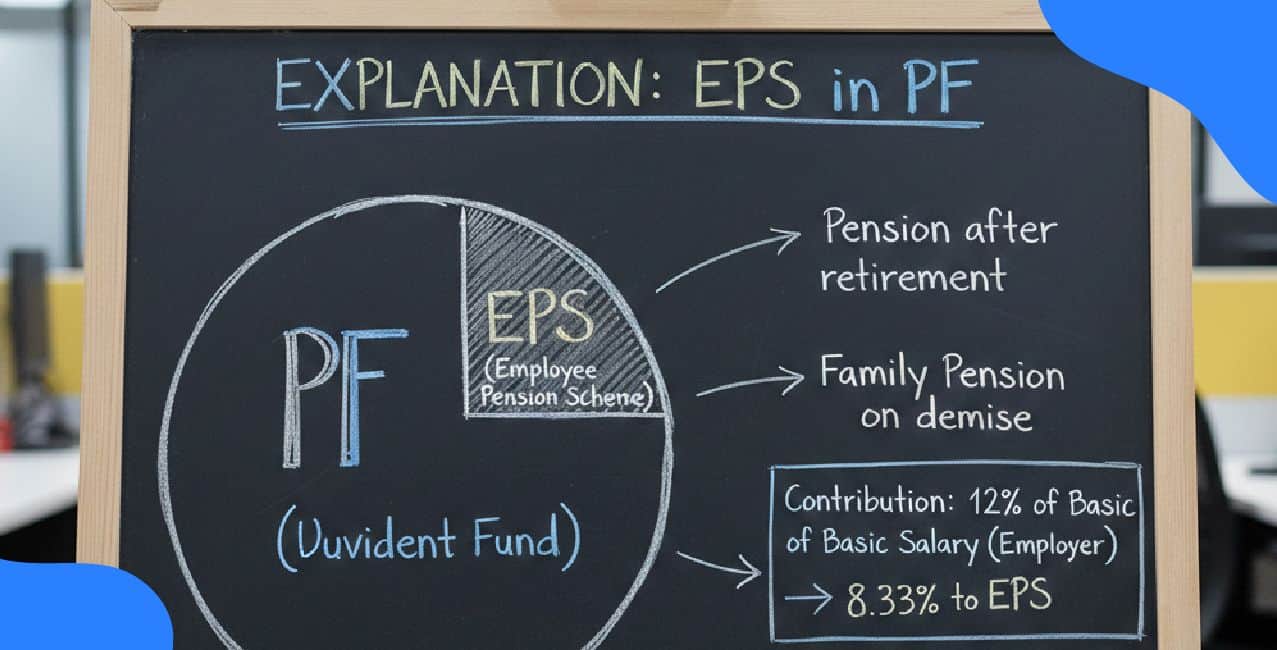
EPS, or Employees’ Pension Scheme, is the pension part of your PF, funded entirely by your employer. Think of it like a slow-filling pension tank. You don’t see interest grow, but it pays you a monthly income after retirement.
Let’s say Ramesh has worked for 25 years with a pensionable salary of ₹15,000. His employer contributes ₹1,250 monthly to EPS. After retirement at 58, he receives around ₹5,357 every month as a lifelong pension support under EPS.
The Employees’ Pension Scheme (EPS), 1995, gives monthly pension support to eligible employees after retirement. It also covers early retirement, disability, and family pension in case of death. Employers contribute 8.33% of wages, and the government adds 1.16%. Employees need at least 10 years of service to receive a pension; otherwise, they can withdraw benefits or take a scheme certificate.
EPS is a compulsory part of the Provident Fund where a portion of the employer’s contribution is set aside for pension. Employees do not pay anything directly into EPS. A simple example makes this clear.
Let’s assume an employee’s Basic + DA is ₹15,000 per month (EPS wage ceiling).
Let’s look at the table below to know how the PF contribution is split:
Read More - EPF Calculator
This shows that EPS is funded entirely by the employer, with a maximum of ₹1,250 per month, while the employee’s full share builds EPF savings.
To qualify for the Employee Pension Scheme (EPS) in India, a person must be an EPFO member with at least 10 years of service and should be 58 years old for a full pension, or 50 years for a reduced pension. EPS is mandatory for EPF members working in establishments with 20 or more employees, and the pensionable salary is capped at ₹15,000 per month.
How To Calculate Your Pension Under EPS?
The EPS pension is calculated using a simple formula that links your salary and years of service. Think of it as a reward for how long and how steadily you contributed.
EPS Pension Formula: (Pensionable Salary × Pensionable Service) ÷ 70
Before looking at numbers, remember: pensionable salary is the average of the last 60 months’ basic + DA, capped at ₹15,000, and you need at least 10 years of service.
The table below shows how your EPS pension amount changes based on your pensionable salary and total years of service:
As you can see, staying in service longer and earning closer to the salary cap helps you receive a higher monthly EPS pension.
This shows that a higher salary (up to the cap) and longer service directly increase your monthly EPS pension.
Below is a clear comparison table explaining the difference between EPF and EPS in simple terms:
Also Read - What is Pension Contribution in PF
EPF only
*T&C Apply
This table highlights how EPF focuses on wealth accumulation, while EPS ensures a regular income after retirement.
Below is a simple table explaining the types of pensions available under the Employees’ Pension Scheme (EPS), as highlighted in the EPFO newsletter (April–June 2024):
These pensions ensure income security for employees and their families under different life situations.
EPS in PF plays a vital role in retirement planning by offering a predictable monthly income. While EPF builds savings, EPS protects against longevity and income risks. Clear awareness of EPS eligibility, contribution flow, and pension calculation helps employees plan careers and retirement wisely. This clarity ensures a stable monthly income after retirement, giving families long-term financial security and peace of mind.
Q. Can I withdraw EPS if I leave my job before completing 10 years of service?
Yes, if you leave before completing 10 years, you cannot get a pension, but you can withdraw EPS benefits or apply for a Scheme Certificate.
Q. What should I know about EPS before choosing it for retirement planning?
EPS is a government-backed pension under EPF that pays a fixed monthly pension after the age of 58. It is funded by employer contributions and suits long-term employees who want a stable retirement income instead of market-linked returns.
Q. In India, how does the Employees’ Pension Scheme (EPS) work?
EPS is a government-run pension scheme under EPF where part of the employer contribution funds is allocated to the pension. It provides a monthly income after retirement or to dependents and is managed by EPFO centrally.
Q. How do I know if I am a member of the Employees’ Pension Scheme (EPS), 1995?
Check the EPF passbook or salary slip for the employer pension contribution. If 8.33% goes to EPS, you are an EPFO member
Q. Is the government cheating us through EPF/EPS compared to PPF or FD returns?
EPS isn’t an investment like PPF or FD; it’s a security pension funded by employers. It provides guaranteed lifelong income, survivor benefits, and inflation protection, not higher market-linked returns seeking.





.png&w=3840&q=75)
.png&w=3840&q=75)