By continuing, you agree to LoansJagat's Credit Report Terms of Use, Terms and Conditions, Privacy Policy, and authorize contact via Call, SMS, Email, or WhatsApp
Disclaimer: The information published on LoansJagat is intended for general informational and educational purposes only and should not be considered financial, legal, or investment advice. Interest rates, loan terms, statistics, and other data may change over time and may vary by lender or source. Please verify the latest information and consult a qualified financial advisor or the respective Bank/NBFC before making any financial decisions.
Apply for Loans Fast and Hassle-Free
Subscribe Now
About the author

LoansJagat Team
‘Simplify Finance for Everyone.’ This is the common goal of our team, as we try to explain any topic with relatable examples. From personal to business finance, managing EMIs to becoming debt-free, we do extensive research on each and every parameter, so you don’t have to. Scroll up and have a look at what 15+ years of experience in the BFSI sector looks like.
Related Blog Post
Simplify All Your Loans Into One Affordable EMI

Customers Served

Debt Consolidated

1200+ Reviews

Locations in India
Club all Loans & Credit Card Bills into Single EMI

Quick Apply Loan
Consolidate your debts into one easy EMI.

Takes less than 2 minutes. No paperwork.

10 Lakhs+
Trusted Customers

2000 Cr+
Loans Disbursed

4.7/5
Google Reviews

50+
Banks & NBFCs Offers
Other services mentioned in this article
Key Takeaways
Bonus Point: From April 1, 2025, the TDS threshold under Section 194J rises from ₹30,000 to ₹50,000 annually, easing compliance for smaller professional and technical service payments.
Section 194J works like a toll gate for professional payments. Before the money reaches the service provider, tax is collected at this checkpoint. So, whether you pay a lawyer, consultant, or director, TDS is deducted first, and the final tax is settled later when returns are filed.
Suppose a company pays ₹60,000 to a chartered accountant in FY 2025–26. Since the amount crosses ₹50,000, TDS applies. The company deducts 10% as TDS at the time of credit or payment, whichever happens first, and pays the balance to the CA.
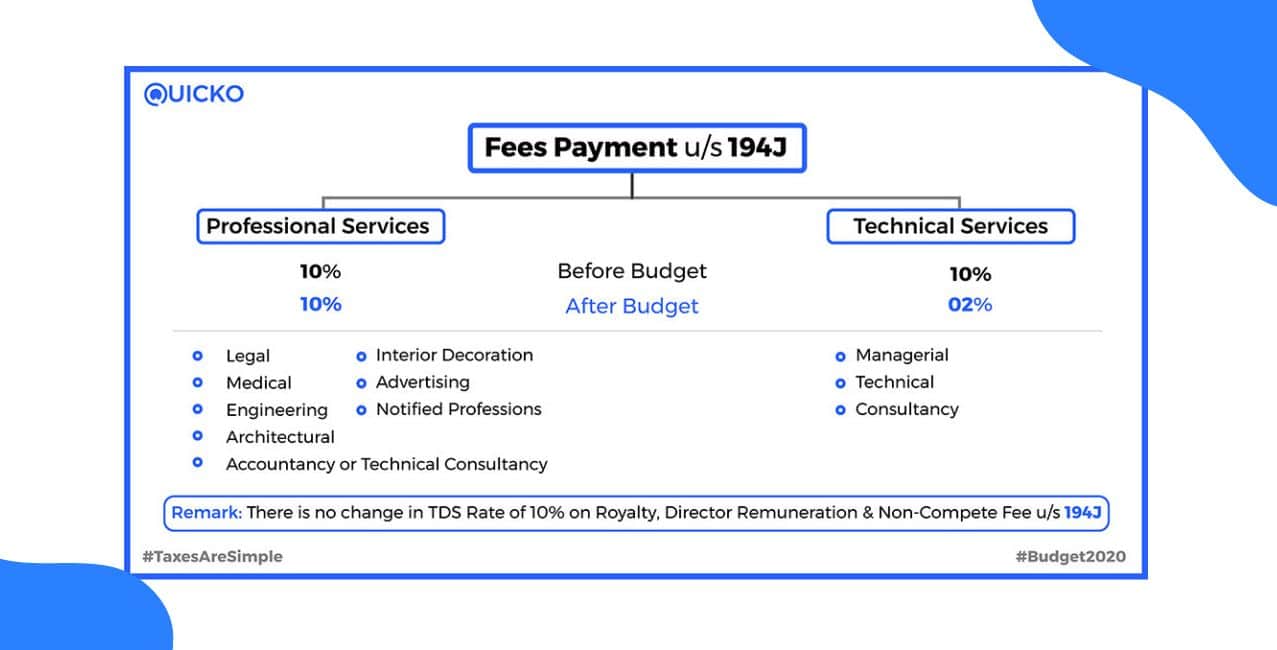
Section 194J applies when you make payments for professional services, technical services, royalties, non-compete fees, or fees paid to directors. In these cases, tax is deducted before the payment is made. The TDS rate is 10% on professional fees, royalty, and directors’ fees, and 2% on technical services. If the recipient does not give their PAN, TDS is deducted at a higher rate of 20%. Payments made only for personal use are not covered under Section 194J.
Section 194J explains which types of payments attract TDS when made to residents. Instead of legal jargon, think of it as a checklist for payments linked to skills, expertise, rights, or business restrictions. If the payment fits into any of the categories below, Section 194J steps in.
Section 194J covers specific professional and technical payments where TDS must be deducted, depending on the nature of services or rights involved.
Section 194J covers payments linked to expertise, intellectual property, management advice, and business restrictions. If the payment rewards skill, knowledge, or exclusive rights, it is likely to fall under this section.
Section 194J not only tells you when TDS applies, but also how much tax to deduct and when it becomes mandatory. The rate depends on the nature of the service, while the limit decides whether TDS is required at all.
Important note: If the recipient does not provide PAN, TDS is deducted at 20%, regardless of the payment type.
Once payments cross ₹30,000 in a financial year, Section 194J kicks in. Always identify the service correctly, because a small classification mistake can double the TDS rate.
TDS under Section 194J is deducted at the earlier of two events:
This applies to professional fees, technical services, royalty, non-compete fees, and directors’ remuneration (excluding salary).
*T&C Apply
Director’s fees have no threshold; TDS applies even on ₹1.
Example:
If a company credits ₹55,000 as legal fees in FY 2025–26, TDS applies immediately, because the limit is crossed, even if payment is made later.
Sections 194JA and 194JB are not separate laws but rate-based classifications created within Section 194J to clearly identify how much TDS should be deducted for different types of services.
Section 194J is the umbrella provision, while 194JA and 194JB help the tax department separate 2% and 10% TDS payments during reporting, avoiding confusion and mismatch in TDS returns.
Section 194J is a key TDS provision for payments linked to professional skill, technical expertise, intellectual property, and directors’ services. A clear understanding of covered payments, applicable TDS rates, threshold limits, deduction timing, and reporting under Sections 194JA or 194JB helps prevent excess tax, penalties, and compliance mistakes. Correct classification and PAN details ensure smooth deductions, accurate returns, and stress-free tax compliance.
Q: What expenses and deduction percentage apply under Section 194J?
Section 194J does not allow expense claims; it only requires TDS deduction at 2% or 10%, while actual expenses are claimed later by the recipient in their income tax return.
Q: If TDS is deducted under Section 194J, is filing a return under Section 44AD compulsory?
No, TDS under Section 194J does not make Section 44AD compulsory; opting for 44AD depends on eligibility and choice, not on TDS deduction.
Q: Why is 10% TDS being deducted under Section 194J for an intern earning ₹12,500 per month, even though their income is below the taxable limits?
This happens because the intern is treated as a professional/consultant (not an employee) under Section 194J, where TDS at 10% is mandatory regardless of income level, and the only way to get it back is by filing an ITR and claiming a refund.
Q: Why am I being asked to pay extra tax on internship income with 194J TDS? Is skipping it correct, and which ITR should I file?
Internship income under Section 194J must be reported separately (TDS is only advance tax), skipping it is incorrect even if others got refunds, and you should file ITR-1 if total income is salary + other income, or ITR-3 if treated as professional income.
Q: Is TDS deducted under Section 194J from the final tax liability?
No, TDS under Section 194J is only an advance tax, final tax is calculated while filing the ITR, where you can pay the balance tax or claim a refund.