By continuing, you agree to LoansJagat's Credit Report Terms of Use, Terms and Conditions, Privacy Policy, and authorize contact via Call, SMS, Email, or WhatsApp
Disclaimer: The information published on LoansJagat is intended for general informational and educational purposes only and should not be considered financial, legal, or investment advice. Interest rates, loan terms, statistics, and other data may change over time and may vary by lender or source. Please verify the latest information and consult a qualified financial advisor or the respective Bank/NBFC before making any financial decisions.
Subscribe Now
About the author

Diwaker Sharma
Diwaker Sharma is a finance content specialist with expertise in banking, personal finance, credit cards, loans, fintech, and financial news. An MBA in Finance with prior experience in the banking sector, he combines industry knowledge with SEO and content strategy to produce insightful, research-backed articles. Passionate about making finance accessible, he transforms complex financial concepts into clear, engaging content that empowers readers to make smarter financial decisions with confidence.
Related Blog Post
Simplify All Your Loans Into One Affordable EMI

Customers Served

Debt Consolidated

1200+ Reviews

Locations in India
Club all Loans & Credit Card Bills into Single EMI

Quick Apply Loan
Consolidate your debts into one easy EMI.

Takes less than 2 minutes. No paperwork.

10 Lakhs+
Trusted Customers

2000 Cr+
Loans Disbursed

4.7/5
Google Reviews

50+
Banks & NBFCs Offers
Other services mentioned in this article
Deflation refers to actual price decreases, not just slower growth in prices that are still rising. India's Wholesale Price Index actually dipped into deflation more than once through 2025, turning negative at -0.13% in June, easing further to -0.58% in July, then swinging back to positive territory in August and September, before dipping negative again in October and November.
Watching grocery prices, or just following the economy in the news, and sooner or later deflation comes up, leaving you wondering what is deflation actually, and how it's any different from prices just growing slower. This is for anyone in India who wants a real answer, how deflation actually works, what causes it, whether India's genuinely seen it lately, and what it does to the wider economy. We'll cover the mechanics, real numbers from official data, and how this stacks up against plain old inflation.
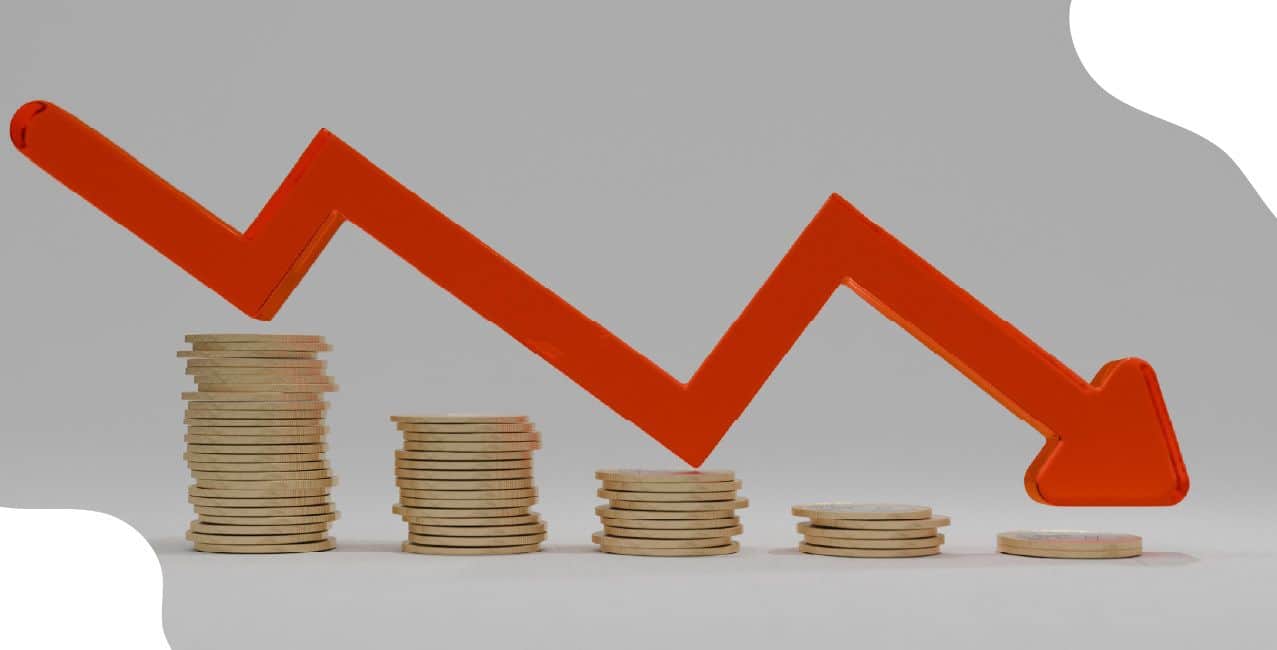
It's a broad, sustained drop in prices across an economy, meaning your money's actually buying more as time goes on, not less.
Deflation means prices are genuinely falling, in real terms. The Ministry of Statistics and Programme Implementation tracks this through the Consumer Price Index, measuring how retail prices shift over time for whatever households actually buy. Once that index turns negative year on year, that's deflation showing up in black and white.
Usually comes down to demand dropping sharply, supply outpacing what the market can absorb, or last year's unusually high prices making today's numbers look artificially low by comparison.
Common drivers here:
India's own vegetable price story shows the base effect clearly enough, MoSPI's own provisional CPI release for May 2026 puts potato prices down 23.71% year-on-year, mostly because last year's bumper harvest flooded the market and pushed prices well below where they'd been the year before.
Yes, actually, in specific pockets, wholesale prices and certain food categories, even while overall retail inflation stayed in positive territory.
Per Business Standard's reporting on official Ministry of Commerce and Industry data, the Wholesale Price Index turned negative in June and July 2025, recovered to positive territory in August and September, then dipped into deflation again in October and November, food and fuel prices easing off at the wholesale level through much of the year.
On the retail side specifically, MoSPI's own official CPI press release for November 2025 confirms food inflation itself went negative, at -3.91%, meaning food as a category was genuinely cheaper than the same month a year earlier. This happened even as overall Consumer Price Inflation stayed within the 2% to 6% comfort range the Reserve Bank of India tracks, showing that deflation in specific categories can coexist with moderate overall inflation.
This sounds good in theory, price decreases, but normally it means weak demand and can actually be damaging to producers, employees, and people with debts.
Here's who feels it and how:
The very fact that this may happen makes it a greater issue for the policy makers to have deflation continue rather than a certain amount of inflation, because the situation can become a vicious cycle of decreasing demand resulting in decreased prices which lead to decreasing demand once again.
Inflation's prices climbing over time. Deflation's prices are actually dropping. The same official indices track both, just showing opposite directions.
*T&C Apply
Ramesh grows potatoes in Uttar Pradesh, and the 2025-26 season gave him a strong harvest. Trouble was, the whole region had a similarly good year before that too, so supply piled up and prices dropped hard, right in line with the 23.71% deflation MoSPI's own provisional CPI release logged for May 2026. He sold his crop for well below what he'd gotten the year prior, and even though he'd actually grown more, his total earnings still came in lower.
That's deflation hitting a producer directly, even as shoppers at the market enjoyed cheaper vegetables because of it. Dealing with a dip in income, deflation driven or just a rough patch of cash flow, and something like LoansJagat is worth a look for borrowing options that might help bridge the gap.
Yes, the Wholesale Price Index became negative in June 2025 and food price became negative in November 2025.
Oversupply in relation to less demand, high base effect of the previous year, less consumer spending, or low input cost.
Deflation refers to declining price level while disinflation refers to slow rising price level.
Deflation is not good in the long run as it affects producers, workers, and debtors, despite being favorable to consumers due to falling prices.
Their real burden goes up, since money's effectively worth more while prices around it keep dropping.
The RBI's mandated inflation comfort range is 2% to 6%, with a target of 4%. Check official limits on the Reserve Bank of India website.
Potatoes dropped 23.71%, peas dropped 11.47%, both in May 2026, per MoSPI's own numbers.
The Ministry of Statistics and Programme Implementation uses the Consumer Price Index.
Yes, it is possible for inflation to be positive on the whole whereas some of the components witness actual deflation.