By continuing, you agree to LoansJagat's Credit Report Terms of Use, Terms and Conditions, Privacy Policy, and authorize contact via Call, SMS, Email, or WhatsApp
Disclaimer: The information published on LoansJagat is intended for general informational and educational purposes only and should not be considered financial, legal, or investment advice. Interest rates, loan terms, statistics, and other data may change over time and may vary by lender or source. Please verify the latest information and consult a qualified financial advisor or the respective Bank/NBFC before making any financial decisions.
Subscribe Now
About the author

LoansJagat Team
‘Simplify Finance for Everyone.’ This is the common goal of our team, as we try to explain any topic with relatable examples. From personal to business finance, managing EMIs to becoming debt-free, we do extensive research on each and every parameter, so you don’t have to. Scroll up and have a look at what 15+ years of experience in the BFSI sector looks like.
Related News
Simplify All Your Loans Into One Affordable EMI

Customers Served

Debt Consolidated

1200+ Reviews

Locations in India
Club all Loans & Credit Card Bills into Single EMI

Quick Apply Loan
Consolidate your debts into one easy EMI.

Takes less than 2 minutes. No paperwork.

10 Lakhs+
Trusted Customers

2000 Cr+
Loans Disbursed

4.7/5
Google Reviews

50+
Banks & NBFCs Offers
Other services mentioned in this article
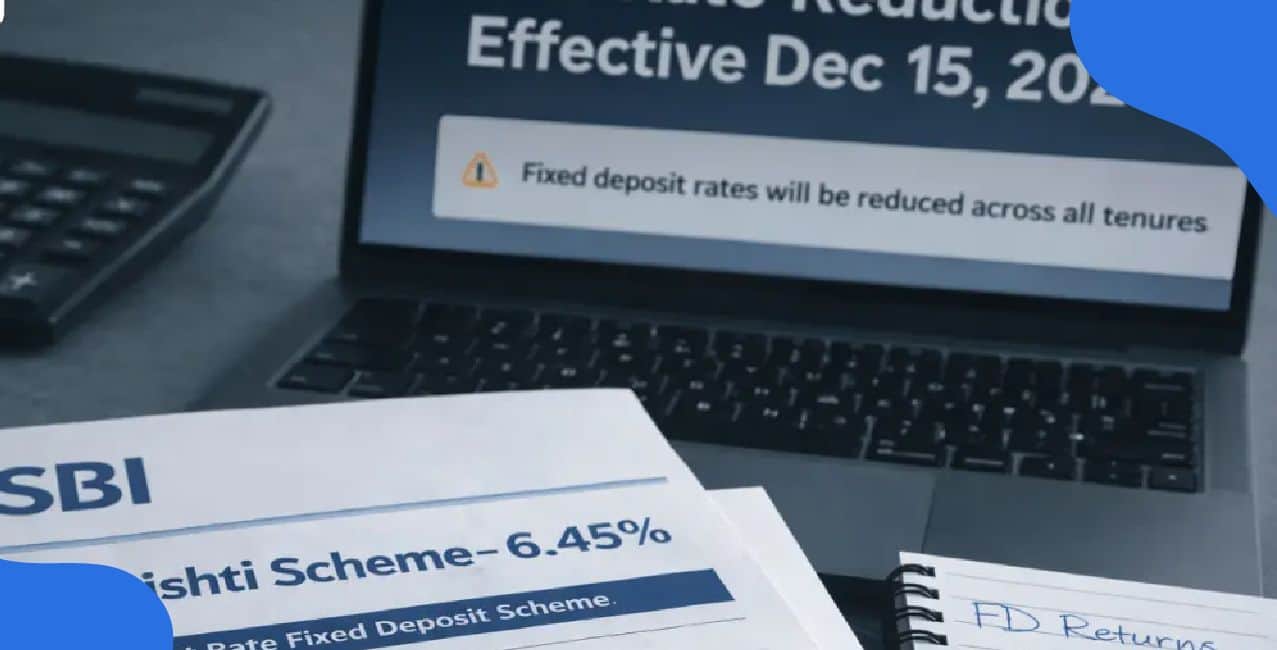
This article examines State Bank of India’s (SBI) recent decision to lower home-loan and other lending rates while also trimming interest on select fixed deposits, effective December 15, 2025. We explain what changed, why it matters for borrowers and savers, how RBI policy plays a role, and what the impacts look like in simple tables and analysis.
The discussion also includes how these rate changes affect EMIs, deposit returns, and overall personal finance decisions, especially amid the ongoing trend of RBI policy easing and how that shapes bank behaviour.
India’s largest lender, SBI, which holds roughly a fifth of the country’s banking assets and liabilities, has reduced lending rates and cut select fixed deposit rates starting 15 December 2025. The key changes were announced against the backdrop of latest RBI policy rate cuts, aimed at stimulating credit growth by making loans cheaper.
For borrowers, especially those with home loans and other retail credit, this is welcome news, as it translates into lower EMIs and reduced interest outgo. At the same time, savers with certain FDs will see slightly reduced returns, highlighting the trade-offs between monetary easing and deposit yields in the current economic cycle.
A transition from falling deposit returns to cheaper credit emphasises how banks balance borrower relief with deposit-holder interests, particularly in softening interest environments following RBI actions.
SBI has slashed key benchmark lending rates, including its External Benchmark Linked Rate (EBLR), Repo Linked Lending Rate (RLLR), and Marginal Cost of Funds-based Lending Rate (MCLR), effective mid-December 2025.
Below is an introductory snapshot of the lending rate changes at SBI, which will impact home loans, personal loans, vehicle loans, and other retail credit:
CRP = Credit Risk Premium; BSP = Bank Spread.
The sharpest cuts are visible in external benchmark and repo-linked loan pricing — which benefit most borrowers on floating-rate loans, including the majority of new home loans. The MCLR reduction is smaller but still contributes to marginally lower loans where applicable.
This means EMIs on existing and future loans should decline, easing pressure on household budgets.
The SBI rate revisions aren’t happening in isolation, central bank policy dynamics are central. The Reserve Bank of India has been progressively reducing the policy repo rate to support economic growth, most recently cutting it by 25 basis points, bringing the repo rate down further.
This loosening allows banks to borrow funds at cheaper costs, which they can then pass on to borrowers. SBI’s rate cuts reflect this ongoing transmission of RBI policy into retail credit products.
At the same time, banks are trimming selected FD rates to reflect depressed long-term funding costs and subdued inflation expectations, but have kept most retail FD rates unchanged, a balance between attracting deposits and maintaining profitability.
Lower lending rates on home loans and other credit segments directly translate into reduced EMIs for borrowers. For example, a homeowner with a floating-rate loan pegged to EBLR or RLLR will see a lower interest rate applied from mid-December, reducing monthly outflows.
*Approximate; depends on exact CRP & BSP added per borrower. Based on typical home loan amortisation.
This reduction improves affordability — particularly for first-time homebuyers — as smaller monthly payments leave more disposable income for savings or other expenses.
While borrowers benefit, some savers may see a slight dip in returns on specific fixed deposit tenures. SBI has trimmed interest rates on select FD categories, notably Amrit Vrishti (444-day) and 2–3-year deposits:
*T&C Apply
Rates apply to deposits under ₹3 crore.
Summary of Table / Impact:
Cutting FD rates helps banks manage their cost of funds as lending yields fall. However, this reduces returns for fixed-income savers — especially those who value deposits for safe returns. Senior citizens still enjoy slightly higher rates but also see a marginal decline.
SBI’s changes reflect a broader trend: banks across India are adjusting lending and deposit rates in response to monetary easing. This has been reported across multiple lenders, with marginal rate adjustments following RBI repo cuts.
The policy aim is clear: stimulate credit demand and growth by making borrowing more affordable while balancing deposit costs amid subdued inflation and slower deposit rate growth.
For Borrowers:
For Savers:
SBI’s decision to lower home loan and other lending rates while trimming select fixed deposits illustrates the classic monetary policy transmission curve: cheaper credit, lower deposit returns. This benefits borrowers through reduced EMIs amid ongoing economic support measures, but poses a modest trade-off for savers reliant on FDs for stable income streams.
Given the RBI’s continued easing stance and broader banking trends, individuals should proactively review their borrowing and investment strategies, making informed decisions that balance affordability with long-term financial goals.
Related Financial News | |||









.png&w=3840&q=75)



