By continuing, you agree to LoansJagat's Credit Report Terms of Use, Terms and Conditions, Privacy Policy, and authorize contact via Call, SMS, Email, or WhatsApp
Disclaimer: The information published on LoansJagat is intended for general informational and educational purposes only and should not be considered financial, legal, or investment advice. Interest rates, loan terms, statistics, and other data may change over time and may vary by lender or source. Please verify the latest information and consult a qualified financial advisor or the respective Bank/NBFC before making any financial decisions.
Subscribe Now
About the author

LoansJagat Team
‘Simplify Finance for Everyone.’ This is the common goal of our team, as we try to explain any topic with relatable examples. From personal to business finance, managing EMIs to becoming debt-free, we do extensive research on each and every parameter, so you don’t have to. Scroll up and have a look at what 15+ years of experience in the BFSI sector looks like.
Related Blog Post
Simplify All Your Loans Into One Affordable EMI

Customers Served

Debt Consolidated

1200+ Reviews

Locations in India
Club all Loans & Credit Card Bills into Single EMI

Quick Apply Loan
Consolidate your debts into one easy EMI.

Takes less than 2 minutes. No paperwork.

10 Lakhs+
Trusted Customers

2000 Cr+
Loans Disbursed

4.7/5
Google Reviews

50+
Banks & NBFCs Offers
Other services mentioned in this article
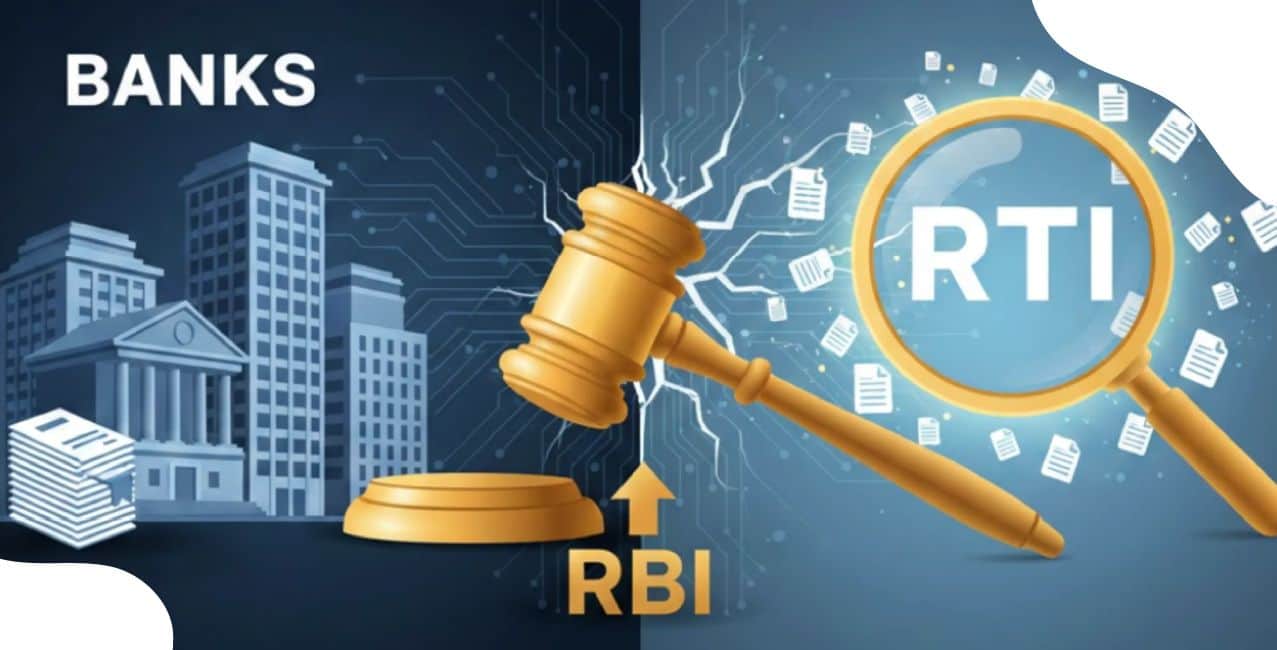
India’s banking transparency framework has come under renewed scrutiny after four major lenders, Bank of Baroda, RBL Bank, Yes Bank and State Bank of India, approached the Central Information Commission (CIC) against the Reserve Bank of India’s decision to allow disclosure of sensitive supervisory data under the RTI Act.
As banks move CIC against RBI, the case has reopened the long-standing conflict between public accountability and commercial confidentiality in the financial sector. The RBI’s position is rooted in the Supreme Court’s 2015 Jayantilal N. Mistry judgment, which held that regulatory information cannot be withheld under fiduciary grounds.
Acting on this principle, the central bank recently told the CIC that details related to NPAs, penalties and inspection reports are “liable to be disclosed”. This triggered a strong pushback from the lenders.
The timing of this dispute is significant. According to LoansJagat, India’s banking system has seen a sharp improvement in asset quality, with the gross NPA ratio of public sector banks falling from 9.11 percent in March 2021 to 2.58 percent in March 2025, while the overall GNPA ratio across 46 major banks stood at 2.30 percent as of June 30, 2025.
The controversy stems from four RTI applications filed by Dheeraj Mishra, Vathiraj, Girish Mittal and Radha Raman Tiwari with the RBI. The applicants sought information ranging from the top 100 NPAs and willful defaulters of Yes Bank to inspection reports of SBI and RBL Bank, and documents linked to a ₹4.34 crore penalty imposed on Bank of Baroda following statutory inspection findings.
The RBI examined these applications and concluded that the information could be disclosed under the RTI Act. However, the banks appealed before the CIC, arguing that releasing such regulatory data could harm their commercial interests, affect market confidence and compromise supervisory confidentiality.
As banks moved CIC against RBI, Information Commissioner Khushwant Singh Sethi referred the matter to a larger bench of the Commission for a final ruling.
Source
While headline NPA ratios have improved, legacy stress remains substantial. The Finance Ministry informed Parliament in 2025 that 1,629 willful defaulters owe ₹1.62 lakh crore to public sector banks, and that PSU banks have written off ₹12.08 lakh crore in loans over the last ten years.
This is precisely why transparency advocates argue that disclosure of large defaulters and regulatory actions serves public interest. On the other hand, banks maintain that supervisory data is not meant for public dissemination.
The Economic Times report RBI has maintained before the CIC that the requested information falls within the scope of the RTI Act and is supported by Supreme Court precedent.
The banks, however, have argued that forced disclosure could undermine regulatory trust and damage their competitive position. The CIC has not granted a blanket stay but has referred the issue to a larger bench, indicating the matter’s legal and systemic importance.
*T&C Apply
With ₹1.62 lakh crore stuck with willful defaulters despite improved NPA ratios, the verdict will shape the future balance between transparency and financial stability.
Related Financial News | |||
Delhi High Court Rules on Security Cheques After Loan Default | |||









.png&w=3840&q=75)



