By continuing, you agree to LoansJagat's Credit Report Terms of Use, Terms and Conditions, Privacy Policy, and authorize contact via Call, SMS, Email, or WhatsApp
Disclaimer: The information published on LoansJagat is intended for general informational and educational purposes only and should not be considered financial, legal, or investment advice. Interest rates, loan terms, statistics, and other data may change over time and may vary by lender or source. Please verify the latest information and consult a qualified financial advisor or the respective Bank/NBFC before making any financial decisions.
Subscribe Now
About the author

‘Simplify Finance for Everyone.’ This is the common goal of our team, as we try to explain any topic with relatable examples. From personal to business finance, managing EMIs to becoming debt-free, we do extensive research on each and every parameter, so you don’t have to. Scroll up and have a look at what 15+ years of experience in the BFSI sector looks like.
Related News
Simplify All Your Loans Into One Affordable EMI

Customers Served

Debt Consolidated

1200+ Reviews

Locations in India
Club all Loans & Credit Card Bills into Single EMI

Quick Apply Loan
Consolidate your debts into one easy EMI.

Takes less than 2 minutes. No paperwork.

10 Lakhs+
Trusted Customers

2000 Cr+
Loans Disbursed

4.7/5
Google Reviews

50+
Banks & NBFCs Offers
Other services mentioned in this article
In the evolving world of finance, a significant disruption is underway as crypto-native payment cards built around the Solana (SOL) blockchain begin to challenge conventional banking paradigms. What once was a realm reserved for fiat transfers, bank-issued cards and intermediaries is now opening to Web3-enabled cards that allow direct use of blockchain assets for everyday spending.
This article explores how Solana-based payment cards are reshaping the banking landscape, examining how they work, why they matter, their advantages and challenges, and what this might mean for the future of banking.
At the heart of this shift is Solana, a high‐performance blockchain that supports fast, low-cost transactions. By integrating Solana wallets with payment cards (physical or virtual), users can transact with crypto assets (like SOL, or stablecoins issued on Solana) and spend at traditional merchant terminals or online merchants just as they would with a bank card.
One example: a Solana wallet linked to a card can convert SOL or a Solana-stablecoin into fiat at the point of payment, making merchant acceptance seamless.
In practice, the user experience often works like this: you hold SOL (or a Solana-compatible stablecoin) in your wallet; you connect this wallet to a payment card provider; at checkout, the card provider converts the crypto into the required fiat currency in real-time or near-real time, and the merchant receives the payment in fiat. Because Solana supports rapid transactions and high throughput, the friction and cost of conversion and settlement can be substantially lower than alternative crypto railings.
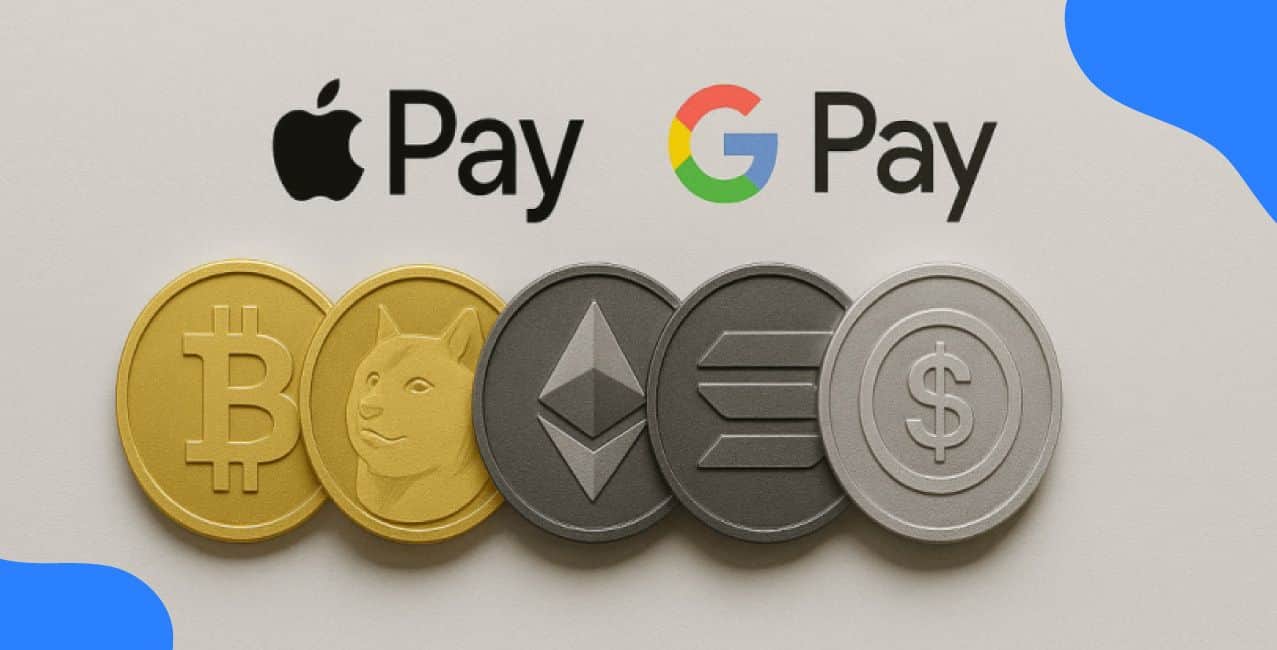
Furthermore, many Solana payment card solutions integrate with mobile wallets (Apple Pay, Google Pay) and virtual card issuance, enabling both digital and physical spending. For example, one provider announced support for Apple Pay/Google Pay and 90 million+ merchant locations globally via a Solana-based card.
Because of this architecture, Solana payment cards operate as a bridge between Web3 and traditional payments, facilitating crypto holdings to be used for everyday purchases without the user needing to first sell on an exchange and transfer fiat separately.
Read More – Pay With Crypto Currency from Google Pay and Apple Pay
Why These Cards Represent a Disruption to Traditional Banking
Traditional banking is built on fiat currency, credit/debit rails (Visa, Mastercard, etc.), and intermediaries (banks, processors). In contrast, Solana-based payment cards bring the following disruptive elements:
To illustrate some of the main shifts, consider the following comparison table:
Below is a summarised comparison showing how key features differ between conventional bank-issued cards and Solana-based payment cards:
After reviewing the table, one can appreciate that while Solana payment cards still require conversion mechanisms and regulatory layers, they offer a fundamentally different model of value transfer and spending.
The impact is that users can increasingly treat crypto assets as spendable money rather than requiring complex off-ramps, and banks may face pressure to adapt to more efficient rails or risk disintermediation.
One of the major benefits is enabling crypto assets to be used like fiat for real-world purchases — at shops, online, travel bookings and so forth. By linking Solana wallets to payment cards, users can leverage their crypto holdings rather than going through separate liquidation processes or facing limited merchant acceptance. This increases crypto utility and accelerates mass-adoption.
Because Solana has relatively low transaction fees and high throughput compared to many legacy chains, payment cards leveraging Solana can reduce costs associated with conversion and settlement. Moreover, the blockchain’s speed helps make the payment experience more seamless, aligning more closely with expectations from card payments rather than lengthy crypto transfers.
Traditional banking cards face limitations and costs when used across borders (foreign exchange, cross-border settlement delays, banking regulation). Solana-based payment cards don’t require all these intermediaries, so they can offer borderless spending with fewer hurdles. This is especially valuable for global travellers, remote workers, crypto-native users and forex sensitive users.
In the Web3 era, holding different assets (stablecoins, tokens) and interacting with DeFi are common. A Solana payment card ties these asset holdings into practical spending. For example, users might stake certain tokens, earn rewards, and then spend via the card — blurring lines between investment, holding and consumption.
Beyond consumers, businesses operating in Web3 or international markets can use Solana payment cards for corporate expenses, global vendor payments, payroll in crypto then spend globally, and other use-cases where standard bank cards may be inefficient or restrictive.
Despite the promise, several obstacles remain for Solana payment cards to fully disrupt traditional banking.
Payment cards tied to crypto must navigate banking regulations, KYC/AML requirements, card-network rules (Visa/Mastercard), tax and reporting obligations. The integration of crypto assets into spending raises regulatory scrutiny, and some jurisdictions may impose restrictions on conversion, custody or merchant acceptance.
While card networks are widely accepted, the layer that converts crypto to fiat must be efficient, transparent and robust. If conversion delays or costs are high, then user experience suffers. Additionally, some merchants may still resist crypto-linked spending or view it as higher risk.
Crypto-assets (including SOL) can be volatile. While many payment card solutions use stablecoins (e.g., USDC) to reduce volatility risk, if the underlying wallet asset fluctuates significantly or conversion processes are inefficient, user experience could be impacted. Also, if the asset’s value drops between transaction initiation and settlement, there may be complications.
Users holding crypto in wallets bear more direct responsibility for security (private keys, wallet access) versus traditional bank accounts protected by deposit insurance in many jurisdictions. Payment cards linking wallets must implement strong security and backup systems.
Traditional banks and payment networks may adapt quickly — introducing their own crypto-friendly cards, partnerships, or evolving rails to remain competitive. This raises the bar for pure crypto‐native offerings and may blur the “disruption” narrative if incumbents evolve.
*T&C Apply
The rise of Solana payment cards prompts traditional banking and card-network players to rethink their models. Banks may face margin pressure as cheaper, faster rails emerge, and payment networks may need to evolve to support crypto asset flows.
Additionally, as users increasingly expect seamless asset conversion and spending across fiat/crypto boundaries, banks must adopt more flexible, programmable infrastructures.
We can summarise some of these key impacts and banking responses in the table below:
Learn More - GST on Crypto – Updated Guide to Taxation in India
Banking Industry Response to Solana-Style Payment Cards
Here is a table laying out potential implications for banks and how they might respond:
After reviewing the table, it becomes clear that banks are at a crossroads: adapt their business models or risk being squeezed out of certain payment flows. The impact is that the banking industry may fragment into specialised rails (crypto-native, fiat-native, hybrid) rather than a one-size-fits-all model.
As the underpinning infrastructure (blockchains like Solana) matures and payment card providers scale, we can expect several developments. First, broader merchant adoption will make crypto-linked payment cards more commonplace. Partnerships between card networks (Visa/Mastercard) and crypto/chain providers will increase, making spending crypto as easy as tapping a smartphone.
Second, we may see more issuer banks and fintechs offering hybrid cards, where funds can automatically switch between fiat and crypto or combine balances, giving users choice of asset to spend. Third, regulation will mature. As authorities clarify how crypto spending integrates with banking oversight, more users and institutions will feel comfortable adopting these rails.
Fourth, programmability and token-based rewards may become built into spending behaviour, making payment more than just transaction: users might earn token rewards for loyalty, spend undiscounted fiat, or convert holding assets dynamically.
Finally, the boundaries between banking, exchanges, wallets and cards will blur. Users may onboard via wallet, link a card, manage assets and spend all in a unified ecosystem, reducing reliance on legacy bank accounts.
The emergence of Solana-based payment cards marks a meaningful shift in how money works. By enabling crypto and stablecoins to power everyday spending via card rails, these solutions challenge traditional banking models built on fiat, intermediaries and slower settlement.
While significant challenges remain, regulation, merchant infrastructure, volatility and custody concerns, the direction is clear: payments are becoming more global, more programmable, more asset-agnostic and more integrated with blockchain rails.
For banks, this moment is a call to evolution rather than disruption: those that adapt will remain relevant; those that remain anchored in legacy rails risk marginalisation. For users and businesses, the advantage lies in flexibility, lower cost, global reach and integration of their asset holdings with real-world spending. Ultimately, as Solana payment cards scale, the distinction between “crypto money” and “traditional money” will blur, and we may be entering an era where spending your tokens is as ordinary as swiping a debit card.









.png&w=3840&q=75)



