By continuing, you agree to LoansJagat's Credit Report Terms of Use, Terms and Conditions, Privacy Policy, and authorize contact via Call, SMS, Email, or WhatsApp
Disclaimer: The information published on LoansJagat is intended for general informational and educational purposes only and should not be considered financial, legal, or investment advice. Interest rates, loan terms, statistics, and other data may change over time and may vary by lender or source. Please verify the latest information and consult a qualified financial advisor or the respective Bank/NBFC before making any financial decisions.
Subscribe Now
About the author

LoansJagat Team
‘Simplify Finance for Everyone.’ This is the common goal of our team, as we try to explain any topic with relatable examples. From personal to business finance, managing EMIs to becoming debt-free, we do extensive research on each and every parameter, so you don’t have to. Scroll up and have a look at what 15+ years of experience in the BFSI sector looks like.
Related Blog Post
Simplify All Your Loans Into One Affordable EMI

Customers Served

Debt Consolidated

1200+ Reviews

Locations in India
Club all Loans & Credit Card Bills into Single EMI

Quick Apply Loan
Consolidate your debts into one easy EMI.

Takes less than 2 minutes. No paperwork.

10 Lakhs+
Trusted Customers

2000 Cr+
Loans Disbursed

4.7/5
Google Reviews

50+
Banks & NBFCs Offers
Other services mentioned in this article
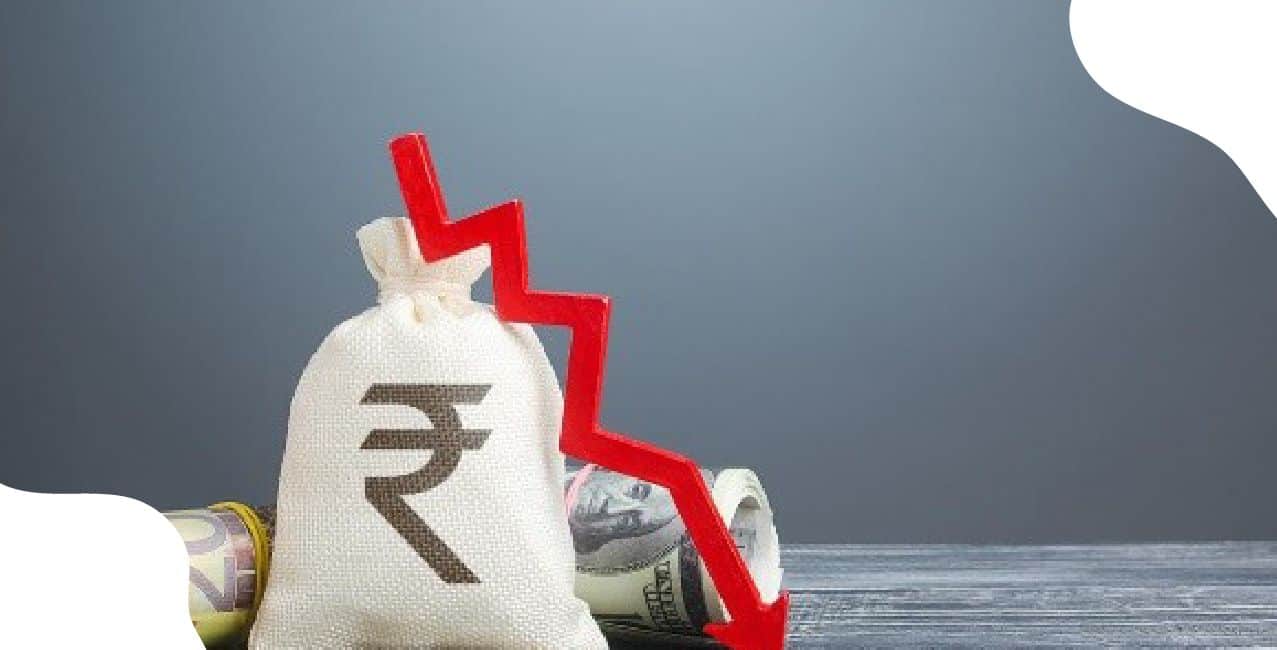
As the Indian rupee fall deepens, its impact is quietly seeping into household budgets, overseas education plans and gold purchases. The question is no longer whether the currency is weakening, but how Indians choose to respond.
The Indian rupee fall is no longer just a macroeconomic headline. It is increasingly affecting everyday financial decisions. On 16 December 2025, the rupee breached the ₹91-per-dollar mark for the first time, according to Reuters(see link).
This sharp depreciation has raised costs for imported essentials like gold, fuel and education abroad. While policymakers continue to attribute the weakness to a strong US dollar, households are feeling the pressure directly through rising prices and reduced purchasing power.
Pankaj Vidyarthi, an IT professional preparing for his wedding, offers a telling example. He plans to buy ₹10–15 lakh worth of gold jewellery. On 15 December 2025, gold prices touched an all-time high of ₹1.37 lakh per 10 grams, driven by global markets and the Indian rupee fall. Vidyarthi estimates that nearly ₹1 lakh of the additional cost is purely due to currency depreciation.
The pressure does not stop there. His younger brother studies at an Ivy League university in the US and now requires an additional ₹5 lakh annually as tuition and living costs rise with the weakening rupee.
According to Reuters on 15 December 2025, the rupee has depreciated over 7 percent in 2025 alone, moving from around ₹85 in January to nearly ₹91 by mid-December. Over five years, the currency has lost close to 19 percent of its value.
(Indian rupee fall report:
A LoansJagat analysis published in September 2025 noted that sustained currency weakness directly impacts household borrowing and savings decisions, especially when inflationary pressures remain sticky.
Read more: “Why the Rupee Is Falling Again and How RBI Is Trying to Hold It”
The Indian rupee fall has been building for months. Reuters reported on 15 December 2025 that foreign portfolio investor outflows and uncertainty around US trade policies have weakened investor confidence in emerging markets, including India.
According to the Reserve Bank of India’s Balance of Payments data for FY25, released on 27 September 2025 under RBI Press Release No. RBI/2025-26/412, India’s current account deficit narrowed to 0.6 percent of GDP, largely due to strong services exports. However, this improvement failed to fully offset pressure from capital outflows.
India’s import dependence has worsened the situation. Reuters business data showed that gold imports fell by nearly 60 percent in November 2025, despite a $42 per ounce drop in international base prices, and vegetable oil imports declined over 28 percent month-on-month in the same period.
*T&C Apply
(Indian rupee fall trend:
Three economists from leading Indian banks told Reuters on 17 December 2025 that the rupee could weaken further and test the ₹95-per-dollar level in 2026, citing India’s import-heavy economy and persistent global uncertainty.
Finance Minister Nirmala Sitharaman has reiterated in multiple public forums that the rupee’s movement reflects a strong dollar rather than domestic weakness. However, analysts argue that such explanations are wearing thin as the Indian rupee fall continues to outpace regional peers, including Pakistan’s currency in recent months.
The Indian rupee fall presents a clear choice. Ignore it and accept rising costs quietly, or acknowledge its impact and plan finances accordingly. Either way, the effects are already embedded in everyday life.









.png&w=3840&q=75)



