By continuing, you agree to LoansJagat's Credit Report Terms of Use, Terms and Conditions, Privacy Policy, and authorize contact via Call, SMS, Email, or WhatsApp
Disclaimer: The information published on LoansJagat is intended for general informational and educational purposes only and should not be considered financial, legal, or investment advice. Interest rates, loan terms, statistics, and other data may change over time and may vary by lender or source. Please verify the latest information and consult a qualified financial advisor or the respective Bank/NBFC before making any financial decisions.
Subscribe Now
About the author

LoansJagat Team
‘Simplify Finance for Everyone.’ This is the common goal of our team, as we try to explain any topic with relatable examples. From personal to business finance, managing EMIs to becoming debt-free, we do extensive research on each and every parameter, so you don’t have to. Scroll up and have a look at what 15+ years of experience in the BFSI sector looks like.
Related Blog Post
Simplify All Your Loans Into One Affordable EMI

Customers Served

Debt Consolidated

1200+ Reviews

Locations in India
Club all Loans & Credit Card Bills into Single EMI

Quick Apply Loan
Consolidate your debts into one easy EMI.

Takes less than 2 minutes. No paperwork.

10 Lakhs+
Trusted Customers

2000 Cr+
Loans Disbursed

4.7/5
Google Reviews

50+
Banks & NBFCs Offers
Other services mentioned in this article
Budget 2026-27 flags a banking review panel, a public-sector NBFC restructuring plan, and bond-market liquidity reforms, with foreign ownership rules also under review.
Finance Minister Nirmala Sitharaman used the Union Budget 2026-27 speech to position India’s financial system as healthier than before and ready for the next reform leg. The official government note highlights strong balance sheets, historic highs in profitability, improved asset quality, and banking coverage that has crossed 98% of villages.
Against this backdrop, the Budget signals 3 linked moves: a high-level banking committee, a roadmap-led reset for NBFCs, and reforms aimed at making corporate and municipal bond markets deeper and easier to trade.

Read More - Bond Valuation
The immediate issue is not a crisis headline. It is about capacity and structure. The Budget proposes a “High Level Committee on Banking for Viksit Bharat” to comprehensively review the sector and align it with India’s next growth phase, while safeguarding financial stability, inclusion and consumer protection.
In the background, there is also policy chatter on how public sector banks fund growth, including whether foreign capital rules need recalibration.
First, the proposed banking committee is expected to examine how lenders should evolve for a “Viksit Bharat” roadmap. The government framing is clear: review the system comprehensively, without diluting stability and consumer safeguards.
Second, the Budget outlines a vision for NBFCs with “clear targets” for credit disbursement and technology adoption.
Third, it proposes restructuring Power Finance Corporation (PFC) and Rural Electrification Corporation (REC) as a first step to achieve scale and efficiency in public sector NBFCs. Markets reacted fast: reports noted PFC and REC rising about 4% to 6% after the proposal.
The capital markets leg is the other pillar. The Budget proposes a market-making framework for corporate bonds with access to funds, derivatives on corporate bond indices, and total return swaps (TRS) on corporate bonds.
It also offers a ₹100 crore incentive for a single municipal bond issuance above ₹1,000 crore.
In the days around the Budget presentation, multiple reports linked the committee to a wider debate on banking structure. The Economic Times reported that the panel’s work could touch on bank ownership and consolidation, a theme that returns whenever policymakers talk about building fewer but stronger lenders.
Also Read - Budget 2026 Clarifies Tax Treatment
Separately, foreign investment limits in state-run banks have re-entered the policy conversation. Reuters reported on February 2, 2026 that inter-ministerial consultations are on to raise the FDI cap in state-run banks to 49% from 20%, citing Financial Services Secretary M. Nagaraju. Financial Times carried a similar theme, and noted private banks allow foreign investment up to 74% subject to conditions.
On NBFCs, sector-specific asks were visible even before Budget day. A LoansJagat
Restructuring PFC and REC
*T&C Apply
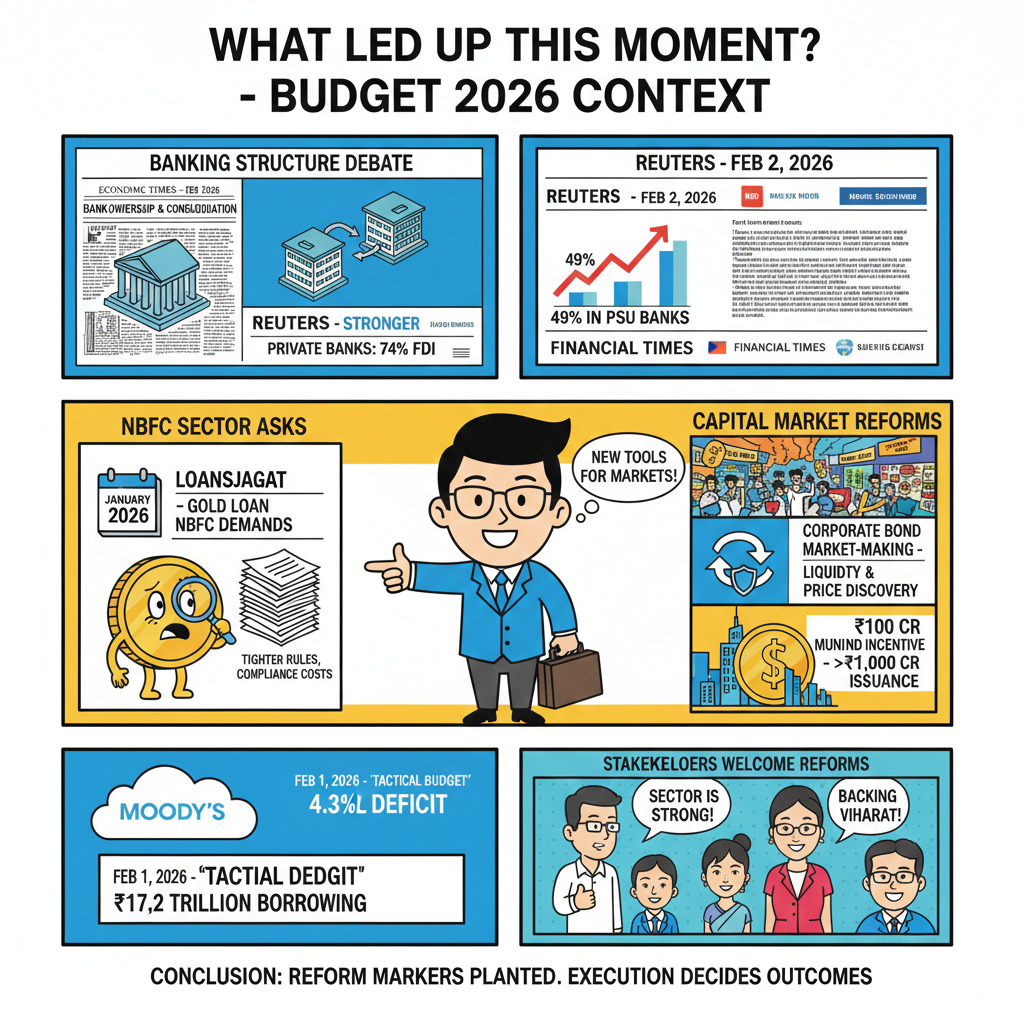
Note that global rating commentary kept expectations measured. A Reuters report dated February 1, 2026quoted Moody’s calling the Budget “tactical”, and also flagged macro numbers like a 4.3% fiscal deficit target and ₹17.2 trillion borrowing plan for the coming year.
What Stakeholders Are Saying?
The FM’s pitch is that the sector is now strong enough to plan the next phase, not just repair balance sheets. Bank-side voices also welcomed the review panel as a reform lever, with coverage citing industry stakeholders backing the committee’s role in the Viksit Bharat push.
Budget 2026-27 plants reform markers across banks, NBFCs and bond markets, but execution will decide outcomes. The committee’s scope and PFC-REC restructuring design will be watched closely.









.png&w=3840&q=75)



