By continuing, you agree to LoansJagat's Credit Report Terms of Use, Terms and Conditions, Privacy Policy, and authorize contact via Call, SMS, Email, or WhatsApp
The information published on LoansJagat is intended for general informational and educational purposes only and should not be considered financial, legal, or investment advice. Interest rates, loan terms, statistics, and other data may change over time and may vary by lender or source. Please verify the latest information and consult a qualified financial advisor or the respective Bank/NBFC before making any financial decisions.
Subscribe Now
About the author

Ananya Shrivastava
Ananya Shrivastava is a Content Writer specialising in finance-focused news, blogs, and long-form articles on Indian markets, RBI policy, personal finance, and lending. She has authored over 450 blogs and 250 news pieces, combining technical knowledge with rigorous research to simplify complex financial concepts into clear, engaging content. With a marketing-driven lens and sharp editorial judgment, she consistently achieves top Google rankings while ensuring every claim is backed by verified data.
Related Blog Post
Simplify All Your Loans Into One Affordable EMI

Customers Served

Debt Consolidated

1200+ Reviews

Locations in India
Club all Loans & Credit Card Bills into Single EMI

Quick Apply Loan
Consolidate your debts into one easy EMI.

Takes less than 2 minutes. No paperwork.

10 Lakhs+
Trusted Customers

2000 Cr+
Loans Disbursed

4.7/5
Google Reviews

50+
Banks & NBFCs Offers
Other services mentioned in this article
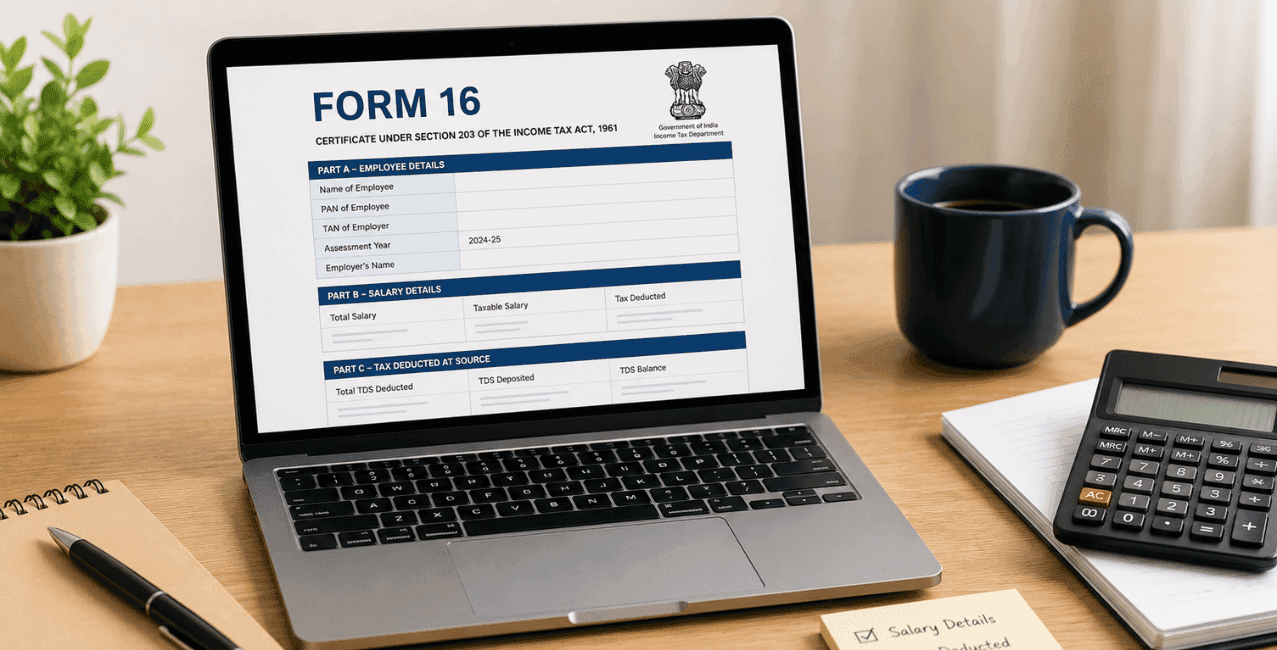
Form 16 is issued by your employer under Section 203 of the Income Tax Act, 1961, after deducting tax from your salary. It tells you how much tax was deducted and paid on your behalf to the government. For the financial year 2025-26, employers have until 15 June 2026 to hand it over.
Takeaways
As long as tax has been deducted from your salary at any point in the year, you will get a Form 16 after the end of the financial year from the employer. Most companies get it out by mid-June, after the previous year's TDS returns have cleared processing at their end.
Form 16 ends up doing a lot of work: filing your ITR, backing loan applications, and giving you a way to confirm your TDS reached the tax department.
Form 16 is a TDS certificate issued by the employer to the employee stating that tax was deducted from your pay and deposited with the government. It works as both income proof and tax proof, which is why so many places ask for it. The certificate currently in circulation covers 1 April 2025 through 31 March 2026, and employers only get to skip issuing it if no TDS was cut at all during that stretch.
There is no need to make any changes for the current year's filing, but one thing to note is that when the new Income Tax Act, 2025 becomes effective from Tax Year 2026-27, Form 16 will be renamed Form 130.
Part A is essentially the government's own paper trail of what tax reached their account. Part B covers the salary structure, HRA figures, standard deduction, and the final tax number that your employer puts their name to.
HR simply hands over the certificate once it is ready for most employees. Employers who register on TRACES as deductors are the ones actually pulling it from the portal, and the steps look roughly like this:
If you don’t want to check your tax credit through TRACES in any case, then Form 26AS on the Income Tax e-filing website will work.
*T&C Apply
For FY 2025-26, Form 16 continues to be the most dependable piece of paper in relation to the recording of salary income and tax deduction. If salary TDS was deducted, obtain Form 16 from your employer and keep it for your records before 15th June 2026, compare it with Form 26AS, and file it on 31st July 2026. Keeping a digital copy of Form 16 comes in handy in the future because it will be required for one or another loan application eventually.
A certificate from your employer confirming the tax deducted from your salary and deposited with the government.
Not strictly, given that salary slips and Form 26AS cover much the same ground, though having Form 16 does speed things along.
All individuals earning less than the taxable limit for that year; no deduction of TDS is made from their salary.
Form 16 is connected with the TDS on salary under section 192, while Form 16A is associated with TDS on interest/professional fees.
Individuals cannot generate their own Form 16. The certificate is furnished by the employer/deductor after the applicable TDS return has been processed..
Each employer you worked for during the year issues its own Part A, covering the TDS it deducted. For Part B, you can either collect a separate Part B from each employer, or ask your last employer to issue a single consolidated Part B, provided you've shared your previous employer(s)' salary and TDS details with them so those can be factored in.
The employer faces a penalty of ₹100 per day per certificate according to Section 272A(2)(g) till the issuance of the certificate.
Yes, Form 16 will be known as Form 130 from Tax Year 2026-27 when the Income Tax Act, 2025 becomes applicable.
By verifying the TDS amount and PAN information in Part A of Form 16 with those present in Form 26AS on the e-filing website.
Yes, part B for financial year 2025-26 contains information on whether TDS was calculated under the new or old regime.