By continuing, you agree to LoansJagat's Credit Report Terms of Use, Terms and Conditions, Privacy Policy, and authorize contact via Call, SMS, Email, or WhatsApp
The information published on LoansJagat is intended for general informational and educational purposes only and should not be considered financial, legal, or investment advice. Interest rates, loan terms, statistics, and other data may change over time and may vary by lender or source. Please verify the latest information and consult a qualified financial advisor or the respective Bank/NBFC before making any financial decisions.
Subscribe Now
About the author

Anishka Bhadly
Anishka Bhadly is a content writer with a finance and business background. She has completed her bachelor's degree with a specialisation in finance and is currently pursuing an MBA in the finance field too. The knowledge she has gained from her studies and experience working with EdTech companies helped her combine theoretical knowledge with practical industry insight. Her expertise lies in creating well-researched, informative, and reader-friendly content in various banking, personal finance, loans, insurance, and investment-related topics.
Related Blog Post
Simplify All Your Loans Into One Affordable EMI

Customers Served

Debt Consolidated

1200+ Reviews

Locations in India
Club all Loans & Credit Card Bills into Single EMI

Quick Apply Loan
Consolidate your debts into one easy EMI.

Takes less than 2 minutes. No paperwork.

10 Lakhs+
Trusted Customers

2000 Cr+
Loans Disbursed

4.7/5
Google Reviews

50+
Banks & NBFCs Offers
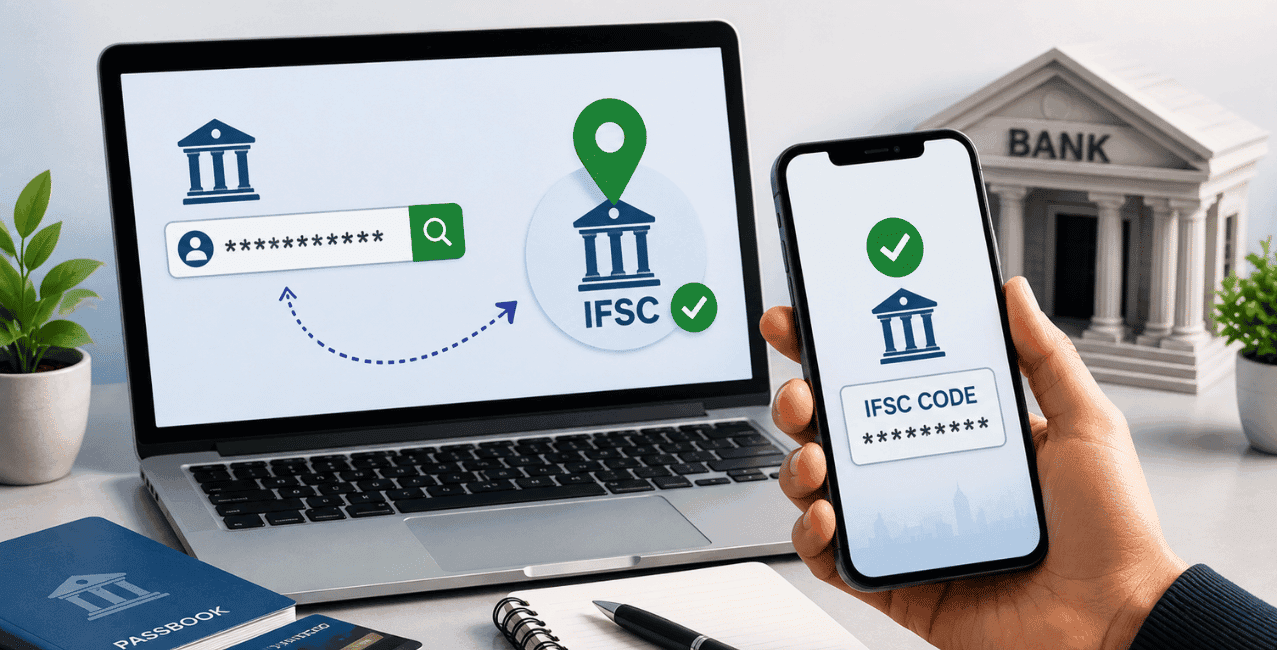
Banks in India use IFSC to route transactions between their own different branches via NEFT, RTGS, and IMPS. You can't search for an IFSC code using only an account number, since both are separate unconnected data. Here's what IFSC is and how to find it securely.
IFSC means Indian Financial System Code. This code has 11 characters that mix letters and numbers. The Reserve Bank of India creates one special code for each bank branch that handles online money movement.
Look at the parts of the code:
A complete code can read like ABCD0123456. This IFSC Code tells the NEFT, RTGS and IMPS systems which exact branch should receive the money. The transfer will not land correctly without the proper IFSC Code.
Each bank decides how to build its own account numbers. A few banks put branch information inside the number. Most do not. The IFSC Code always belongs to the whole branch and never to one single customer.
Assume your account number is the number on a house. The IFSC works like the PIN code of the bank branch. One branch looks after many accounts at the same time, so the same IFSC covers every account there. When you change your bank account to a different branch, your account number may remain the same. The IFSC still changes. That is why no official tool can pull an IFSC out of an account number by itself.
Here's the thing people often get wrong: an account number alone won't tell you the IFSC. There's no lookup that works that way. What you actually need is the bank and the branch. For that, RBI's website is your best way to find it.
Head to rbi.org.in/Scripts/IFSCMICRDetails.aspx. Pick your bank from the dropdown, then the state, then the district or city, then the branch. Once you do that, the IFSC and the branch address show up right there.
There's also another option. RBI publishes complete NEFT branch lists with every code included, and you can download these from the same site. It's a bit more manual since you have to scroll through and find your own bank and branch, but it works if the search tool is acting up.
Firstly, if you have a chequebook at hand, this is probably the easiest way to find your IFSC. It can be found at the upper corner near the MICR code on the cheque, and it's an 11-digit code that is the same for all cheques from a particular branch. This is also the code you should use for transferring funds to this particular account.
Sign in to your bank internet banking with the usual user ID and password. Open the account summary or the account details page. The IFSC sits next to your account number and branch name. Some banks also display it on the screen where you add a new beneficiary.
Launch the official mobile app of your bank and log in. Look under the account overview or the profile area. The IFSC shows up along with the rest of the account information. You can also spot it when you add a payee or check branch details inside the app.
The code is required whenever money travels online from one bank to another. For examples:
Payments made through a simple mobile number or a UPI address do not require an IFSC code. A transaction done by entering only an account number and a branch needs an IFSC.
It can, yeah. The code belongs to the branch, not to you or your account, so anything that changes the branch changes the code too. Maybe you switched to a different branch. Maybe your bank moved locations. Or maybe two banks merged and RBI handed out new codes as part of that. Whenever this happens, you'll get a new chequebook and passbook reflecting the update. So don't assume the code you used last year is still valid, especially if you're about to move a decent amount of money.
If you have accidentally used the wrong IFSC to make a payment, there are some factors to consider. In case you have used an IFSC code from another branch of the same bank, but the account number is correct, the money should arrive safely. If you have used another bank's IFSC code, it should be returned within 1-2 business days. However, there are cases where another bank has an account with the same account number as yours, and the money will be sent there instead. It is necessary to contact such a person and ask him to return the money, and also expect some banks' assistance in this process. So, double-checking the IFSC code is always a safe idea, and it shouldn't take more than two minutes.
*T&C Apply
No. The two codes look different and handle different tasks.
Machines that process paper cheques read the MICR Code. The IFSC works only for electronic transfers. One code cannot replace the other. You find the MICR Code at the bottom of every cheque while the IFSC Code guides online money movement.
Finding the IFSC Code is easy; all you have to do is make sure that you are using the branch name and correct location. You can’t find it with the account number. You can check your passbook, cheque, bank application or even the Reserve Bank of India website. It is essential that you verify the code to prevent any mishaps like misrouting of money or delay in transfer.
An 11 digit code that identifies a bank branch for processing NEFT, RTGS and IMPS payments.
Yes, always 11 characters, first 4 letters for the bank, then a zero, then 6 branch digits.
Yes, it identifies the specific branch, not the customer or account.
The first 4 letters show the bank, 5th is always zero, last 6 identify the branch.
The last 6 characters of the IFSC, representing the specific branch of that bank.
A 9-digit code used by the banks for identification and processing of cheques for clearance and payment.
It helps machines read and process cheques quickly during clearing, without manual sorting.
No. IFSC handles electronic transfers, MICR is only for cheque clearing, different formats too.
Yes, through UPI using a mobile number or virtual ID, no IFSC needed there.
No, each branch gets a unique IFSC. No two branches share the same code.