By continuing, you agree to LoansJagat's Credit Report Terms of Use, Terms and Conditions, Privacy Policy, and authorize contact via Call, SMS, Email, or WhatsApp
Disclaimer: The information published on LoansJagat is intended for general informational and educational purposes only and should not be considered financial, legal, or investment advice. Interest rates, loan terms, statistics, and other data may change over time and may vary by lender or source. Please verify the latest information and consult a qualified financial advisor or the respective Bank/NBFC before making any financial decisions.
Apply for Loans Fast and Hassle-Free
Subscribe Now
About the author

‘Simplify Finance for Everyone.’ This is the common goal of our team, as we try to explain any topic with relatable examples. From personal to business finance, managing EMIs to becoming debt-free, we do extensive research on each and every parameter, so you don’t have to. Scroll up and have a look at what 15+ years of experience in the BFSI sector looks like.
Simplify All Your Loans Into One Affordable EMI

Customers Served

Debt Consolidated

1200+ Reviews

Locations in India
Club all Loans & Credit Card Bills into Single EMI

Quick Apply Loan
Consolidate your debts into one easy EMI.

Takes less than 2 minutes. No paperwork.

10 Lakhs+
Trusted Customers

2000 Cr+
Loans Disbursed

4.7/5
Google Reviews

50+
Banks & NBFCs Offers
Other services mentioned in this article
Key Takeaways
Kabhi kisi ne aapko itni strong offer di ho ki mana karna mushkil ho gaya ho? That powerful moment is called a Bear Hug in Business.
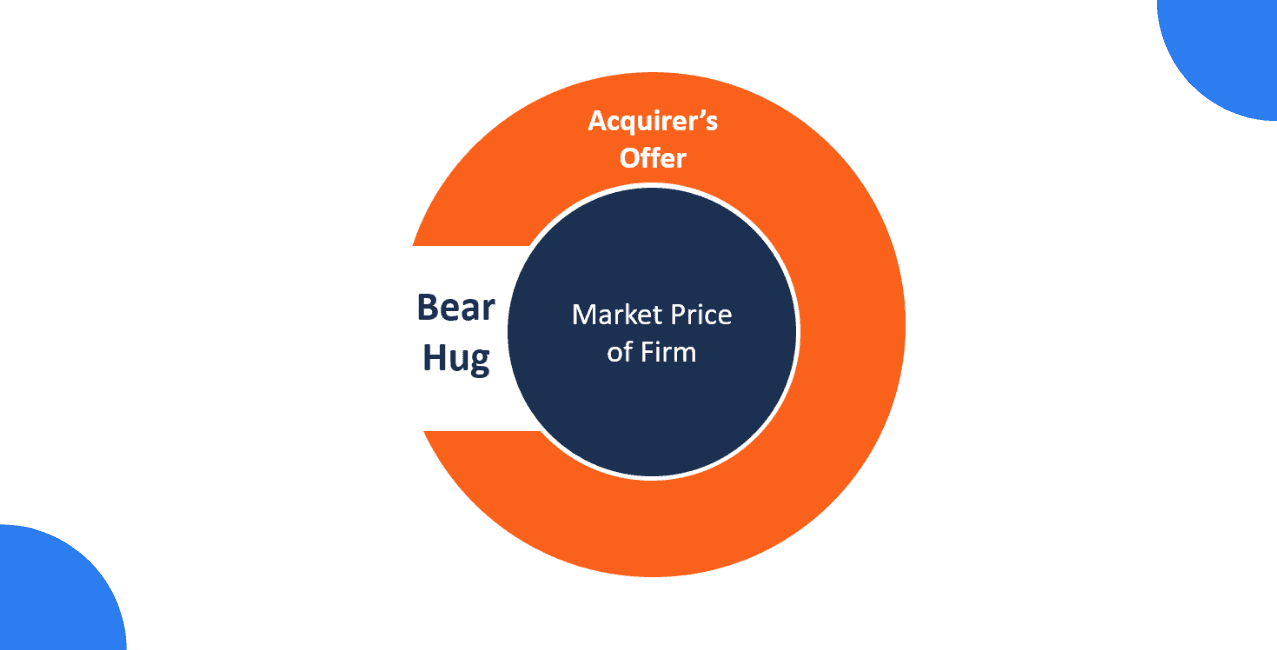
A Bear Hug strategy is an acquisition approach in which one company offers to purchase another company at a price significantly higher than its current market value. The high premium is designed to make rejection difficult and to encourage the target company’s board and shareholders to accept the offer.
When people search whats a bear hug in business, they are referring to this premium-based takeover strategy that creates financial pressure without immediate hostility.
I saw a company trading at ₹100 per share, and another company offers ₹140 per share. TYhat 40% premium immediately catches my attention and makes me seriously consider the acquisition proposal.
Companies often seek control without creating public conflict in major mergers and acquisitions. A Bear Hug strategy allows them to pursue expansion in a firm yet professional manner.
A Bear Hug offer is usually made at a price significantly higher than the current market value. This attracts shareholders and increases the likelihood that the board will seriously evaluate the proposal.
Hostile takeovers can lead to legal challenges and reputational damage. A Bear Hug allows the acquiring company to remain formal and structured while still presenting a strong and persuasive offer.
A generous premium signals serious intent. Negotiations tend to move faster and with fewer delays when the offer is financially attractive.
Companies adopt this strategy when they see long-term benefits such as market expansion, operational efficiency, or competitive strength. A premium may be justified if the company expects strong future growth.
When shareholders see a substantial premium, they may question the board if the offer is rejected. This creates internal pressure and increases the probability of approval.
The Bear Hug strategy combines financial strength with strategic positioning.
Companies often use pricing power to influence decisions in mergers and acquisitions. A Bear Hug strategy follows an approach that creates financial pressure without direct hostility. Here is how the strategy works:
The acquiring company decides to offer a price significantly higher than the current market value of the target company.
The offer is formally presented to the target company’s board of directors.
Shareholders compare the offered price with the current share price. A high premium usually gains their attention.
If the offer is financially attractive, shareholders may expect the board to accept it or clearly explain rejection.
The board can accept the deal, negotiate better terms, or reject it with strong justification.
A Bear Hug strategy works by using an attractive price to create decision-making pressure. It relies on financial appeal rather than aggressive takeover tactics.
Here are the key advantages of the Bear Hug Strategy in Mergers and Acquisitions:
A premium price attracts shareholders. This increases the likelihood that the board will seriously consider the offer.
A high price shows confidence and serious intent. It signals that the acquiring company values the target highly.
The strategy avoids confrontation. It appears formal and structured rather than aggressive.
An attractive offer can shorten discussions. It reduces delays compared to hostile takeover attempts.
Shareholders benefit from the premium. Their support can influence the board’s decision.
The Bear Hug strategy increases deal probability through financial strength. It allows companies to pursue growth in a controlled and strategic way.
*T&C Apply
Here are the main disadvantages of the Bear Hug Strategy in Corporate Takeovers:
A high premium may reduce future returns. The deal may destroy value if expected synergies do not materialise.
Shareholders of the acquiring company may believe the offer is too expensive. This can lead to a fall in share price.
The target board can still reject the offer. A premium alone does not ensure approval.
After the acquisition, cultural and operational differences may create difficulties. Poor integration can reduce expected benefits.
If rejected, the situation may turn into a hostile takeover. This increases legal and reputational risks.
The Bear Hug strategy involves high financial commitment and uncertainty. Companies must balance the premium offered with long-term value creation.
Several well-known companies have used the Bear Hug strategy to pursue acquisitions through premium offers. Here are some notable examples:
Microsoft offered to acquire Yahoo at a significant premium over its market price. The offer created strong pressure on Yahoo’s board. However, the proposal was eventually rejected.
Kraft made a premium offer to acquire Cadbury. The high price attracted shareholder attention. The acquisition was completed after negotiations and revised terms
InBev made a premium bid for Anheuser-Busch. The financial attractiveness of the offer increased shareholder support. The deal was successfully finalised.
These examples show that Bear Hug attempts rely on strong pricing to influence decisions.
A Bear Hug strategy shows how pricing power can influence corporate decisions without immediate hostility. It offers opportunity but also carries financial risk. It can lead to successful acquisitions when used carefully.
1. What is a “bear hug”?
A bear hug generally means a tight and strong embrace. In business, it refers to a takeover offer made at a price significantly higher than market value. The purpose is to make rejection difficult for the target company’s board.
2. How does a “bear hug” work in business?
A bear hug works by offering a premium price to acquire a company. The offer is formally presented to the board. If shareholders find the price attractive, pressure builds on the board to accept the proposal.
3. Is a product ownership or distribution dispute considered a bear hug strategy?
No. A product ownership or distribution dispute is a contractual or legal matter. A bear hug strategy specifically refers to a corporate acquisition tactic involving a premium offer to purchase another company.
4. What does a “Bear Hug” in corporate finance mean?
In corporate finance, a Bear Hug means an acquisition proposal made at a substantial premium over the current share price. It is designed to encourage acceptance without immediately initiating a hostile takeover.
5. What usually happens if a Bear Hug offer is rejected?
If rejected, the board must justify its decision to shareholders. Rejection may raise concerns since the offer includes a premium. In some cases, the acquiring company may reconsider terms or pursue more aggressive takeover methods.




