By continuing, you agree to LoansJagat's Credit Report Terms of Use, Terms and Conditions, Privacy Policy, and authorize contact via Call, SMS, Email, or WhatsApp
Disclaimer: The information published on LoansJagat is intended for general informational and educational purposes only and should not be considered financial, legal, or investment advice. Interest rates, loan terms, statistics, and other data may change over time and may vary by lender or source. Please verify the latest information and consult a qualified financial advisor or the respective Bank/NBFC before making any financial decisions.
Subscribe Now
About the author

Anishka Bhadly
Anishka Bhadly is a content writer with a finance and business background. She has completed her bachelor's degree with a specialisation in finance and is currently pursuing an MBA in the finance field too. The knowledge she has gained from her studies and experience working with EdTech companies helped her combine theoretical knowledge with practical industry insight. Her expertise lies in creating well-researched, informative, and reader-friendly content in various banking, personal finance, loans, insurance, and investment-related topics.
Related Blog Post
Simplify All Your Loans Into One Affordable EMI

Customers Served

Debt Consolidated

1200+ Reviews

Locations in India
Club all Loans & Credit Card Bills into Single EMI

Quick Apply Loan
Consolidate your debts into one easy EMI.

Takes less than 2 minutes. No paperwork.

10 Lakhs+
Trusted Customers

2000 Cr+
Loans Disbursed

4.7/5
Google Reviews

50+
Banks & NBFCs Offers
Other services mentioned in this article
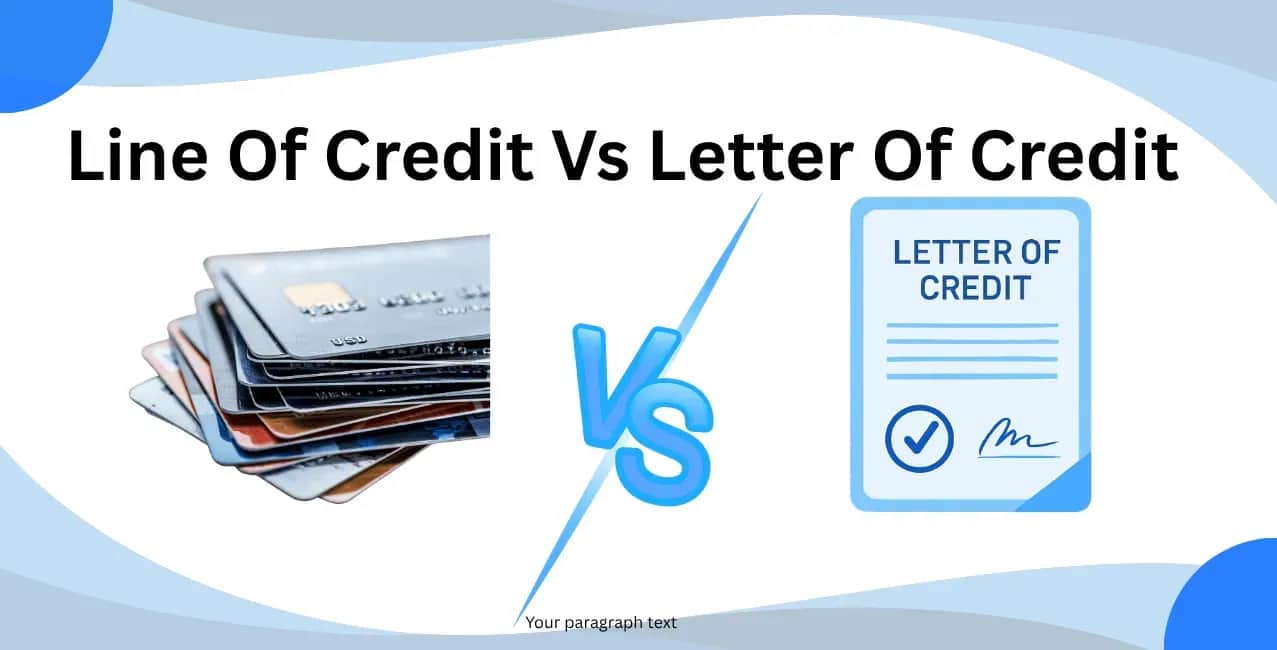
A line of credit and a letter of credit differ fundamentally in terms of the financial purpose they serve. A line of credit is a credit facility that enables the borrower to access funds, pay off some part of them, and re-access the newly available credit limit whenever the credit facility allows. In contrast, a letter of credit is the bank’s undertaking to pay the seller on behalf of the buyer upon the fulfilment of specific terms and documents. In general, lines of credit are usually taken to finance working capital needs or expenses, whereas letters of credit are commonly used in trade finance, reducing the risk of non-payment for the seller.
Key Takeaways:
A line of credit is a type of credit that allows an individual or organisation to borrow funds up to a certain limit. It is usually granted to a borrower with a good credit history. A line of credit is different from a standard loan since the person or organisation does not have to spend the amount of money at once and only pays back the amount they utilise. Additionally, unlike a loan, a line of credit allows the borrower to access funds as needed up to the credit limit while paying back what has been advanced.
A letter of credit (LC) is a commitment issued by a buyer’s bank to pay the seller, provided the seller meets the LC’s specified terms and documentary requirements. The bank’s payment obligation is based on compliance with these conditions rather than on whether the buyer fails to make the payment. It is commonly used in domestic and international sales where the buyer and seller may not have an established business relationship. The bank checks the submitted documents to ensure they comply with the terms of the letter of credit. If the documents meet the specified conditions, the issuing bank makes the payment according to the LC terms.
Letters of credit may have different types according to their purpose, payment, and protection. Standby, commercial, revolving, confirmed, and transferable letters are some examples.
Depending on the nature of the transaction and terms of payment, the type or form of the letter of credit varies as per the needs of the beneficiary or the seller.
Lines of credit may be categorised according to the purpose of the funds and whether they are secured or not. A revolving line of credit allows a borrower to repay and redraw funds within the time frame and limit provided. A secured line of credit requires collateral while an unsecured line of credit does not use any collateral. A home equity line of credit, for example, is a secured form of credit that is granted against the home of the borrower. The choice between a secured and unsecured line of credit depends on the lender’s requirements and the borrower’s financial situation, creditworthiness and ability to provide collateral where required.
A line of credit and a letter of credit help different spheres in business. The first one refers to a form of credit that gives the money to its owner, and the second one means the bank’s confirmation of payment; in other words, it’s the document for opening the letter of credit.
Main purpose
*T&C Apply
In conclusion, one should understand that the main difference is that a line of credit provides funds for any business purpose, while a letter of credit is used to ensure payments in a trade transaction. Moreover, LC can be used for both local and international trade, while businesses should assess their own needs to choose between line of credit or letter of credit.
While choosing between a Letter of Credit (LC) and a Line of Credit (LOC), it is essential to assess the purpose of using the funds. Both instruments have specific applications; hence, LC and LOC should be considered separately in regard to the needs, expenses, terms, and requirements.
However, everything depends on the situation, terms, and personal preferences. If someone wants to get funds for specific purposes, there are particular loans. In addition, one should consider the requirements, fees, compensations, and other aspects of the letter or line of credit.
A letter of credit and a line of credit are used for different purposes; hence, there is no better option in all situations. Individuals and companies should rely on personal circumstances, benefits, terms, and other factors while choosing between a letter and line of credit.
Consider the purpose, repayment terms, availability, transaction requirements and financial situation of the borrower and/or buyer before choosing between a letter of credit and a line of credit.
Consider your financial requirements, cash flow, transaction, repayment capacity and terms and conditions offered before choosing between a letter of credit and line of credit. I think it boils down to individual preference depending on their needs and circumstances.
A line of credit is a borrowing facility that provides access to funds, whereas a letter of credit is a bank undertaking to honour a complying presentation by the beneficiary, subject to its terms. Moreover, the two financial instruments are not fungible, as they have totally different applications. When flexible access to borrowed funds is required, a line of credit may be considered, while a letter of credit may be used where payment risk mitigation is required in a trade transaction, subject to the parties’ requirements and terms.
The Line of Credit option gives you access to the funds you have borrowed up to a certain limit, while the Letter of Credit provides the guarantor with payment assurance in the case of a transaction involving specified terms.
A line of credit is a credit facility that allows a borrower to draw funds up to an approved limit, subject to the facility’s terms.
A letter of credit is used to provide a bank undertaking to honour a complying presentation by the beneficiary, subject to the terms of the LC.
A Letter of Credit is issued by the bank on behalf of the buyer or the applicant. In some cases, another bank may add their confirmation to the Letter of Credit.
As far as line of credit is concerned, it may charge interest rates on the money you have borrowed, and these rates, along with any other fees, should be negotiated with the lender.
A Letter of Credit typically has no interest on the LC itself; however, there are fees, commissions, and charges that a bank may apply.
Yes, a revolving line of credit can be reused as long as you pay it back within the facility's period of validity.
No, LCs can be used both internationally and nationally. They are typically used for trade but can also be used for specific domestic transactions.
The two instruments are completely different and serve different purposes, meaning that they can't be directly compared.
It depends on the following factors: your purpose, cash needs, transaction requirements, ability to repay, fees, and terms, among other considerations. All things considered, it can be said that the choice between the two would greatly depend on a person's or a company's financial needs.