5 Reasons Why Banks Deny Credit Card Requests: Why Credit Card Application Is Rejected
By continuing, you agree to LoansJagat's Credit Report Terms of Use, Terms and Conditions, Privacy Policy, and authorize contact via Call, SMS, Email, or WhatsApp
Disclaimer: The information published on LoansJagat is intended for general informational and educational purposes only and should not be considered financial, legal, or investment advice. Interest rates, loan terms, statistics, and other data may change over time and may vary by lender or source. Please verify the latest information and consult a qualified financial advisor or the respective Bank/NBFC before making any financial decisions.
Subscribe Now
About the author

Anishka Bhadly
Anishka Bhadly is a content writer with a finance and business background. She has completed her bachelor's degree with a specialisation in finance and is currently pursuing an MBA in the finance field too. The knowledge she has gained from her studies and experience working with EdTech companies helped her combine theoretical knowledge with practical industry insight. Her expertise lies in creating well-researched, informative, and reader-friendly content in various banking, personal finance, loans, insurance, and investment-related topics.
Related Blog Post
Simplify All Your Loans Into One Affordable EMI

Customers Served

Debt Consolidated

1200+ Reviews

Locations in India
Club all Loans & Credit Card Bills into Single EMI

Quick Apply Loan
Consolidate your debts into one easy EMI.

Takes less than 2 minutes. No paperwork.

10 Lakhs+
Trusted Customers

2000 Cr+
Loans Disbursed

4.7/5
Google Reviews

50+
Banks & NBFCs Offers
Other services mentioned in this article
Banks can refuse a credit card application for several reasons, such as a bad credit history, a high level of debt, a low income, providing incorrect information, or simply not meeting the requirements. Most often, credit card approval is subject to a bank’s credit assessment policy. This usually includes a review of the credit history, the customer’s repayment history, the level of income and employment status, and any current credit liabilities.
Key Takeaways:
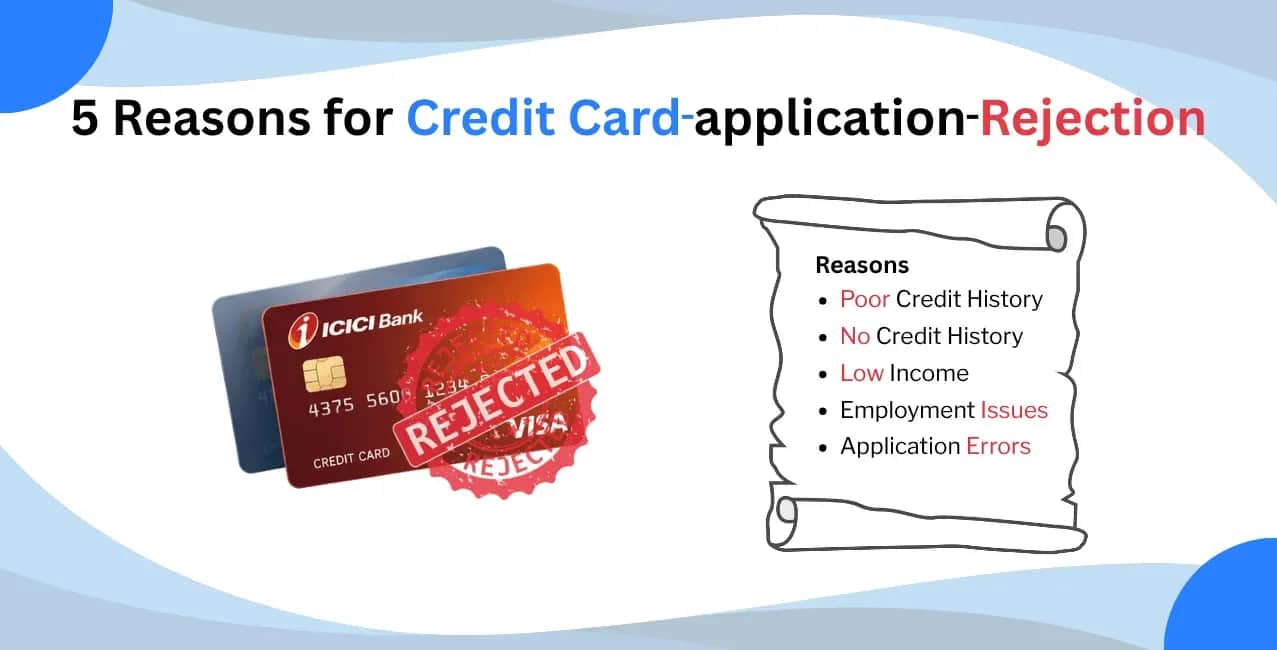
Banks may decline for several credit card rejection reasons, including poor credit history, lack of credit history, inadequate income, employment info, and other factors. Knowing them can help a person avoid the same mistakes.
One of the primary reasons for credit card rejection is poor credit history. For instance, credit card companies are not going to approve an application if a person has a history of late payments or a high amount of debt. Defaults or negative credit history also affect the chances of getting approved.
In certain situations, a credit card application may be declined due to credit history issues. Specifically, it applies to a situation when a person does not have a credit history. A credit card company would not give a card to a person with little or no credit history because there is no way to evaluate whether they will pay bills on time. Nonetheless, a new credit history does not necessarily mean that the application will be declined. The problem is that different credit card companies have different requirements for such applicants.
Most credit card companies set the incomes criteria. As a result, the credit card application may be decline due to an insufficient income. Thus, it is important to make sure that one’s income corresponds to the requirements, which may vary depending on the card one is going to apply for.
Credit card companies will look at employment and income info when considering an application. Accordingly, providing false employment info or information that cannot be verified may result in a credit card being declined. It is important to note that employment info is relevant because it shows whether an applicant will be able to make payments.
Errors in a credit card application may also result in it being declined. As stated above, employment info, personal info or other info cannot be left blank. In addition, providing false or incorrect info can also prevent a credit card from being approved.
There are several reasons why a credit card application can be declined. Checking eligibility criteria, reviewing one’s credit history, providing accurate info and making sure that payments are made on time can increase the likelihood of a credit card being approved.
Improving your credit score and providing correct financial details can make the difference in getting your credit card approved. A few simple tricks can offer higher chances of approval before you apply for a credit card.
Credit cards can be approved with different standards depending on the organisation and cannot be regulated. One should properly pay the dues, study the report, and eliminate mistakes to increase the possibility of getting approved. It is necessary to check the particular terms and requirements of the selected cards.
Eligibility for a credit card is determined by your state of residence, age, income, bank account, and credit history. Eligibility criteria may vary by issuer and credit card type.
Disclaimer: The conditions for credit card eligibility can vary depending on the bank and credit card type. Age, income, place of residence, and many other factors can affect eligibility. It is recommended that you check the most suitable card’s eligibility requirements directly with the issuing company.
Having an application for a credit card declined can be disheartening, but at least you have an opportunity to find out what went wrong. It is important to take a closer look at the rejection reason and check your credit report, outstanding debts, and income statement. You should also review the proposed credit card’s requirements to ensure that you have met all the conditions before reapplying. It is always a good idea to take some time to reconsider and address the possible issues that led to the application decline.
A credit card can be denied due to bad credit history, low income, lack of credit history, or incorrect application data. It is also rejected when a particular credit card is not suitable for the applicant or the chosen bank.
It depends. Some banks and card issuers may look at your credit score and repayment history. It may also be taken into account if an applicant has a poor credit history, low credit limit, or negative repayment history.
Yes, it is possible to apply for a credit card without credit history. Among the credit cards without credit history, there are credit cards for people who do not have any credit history, and there are also secured credit cards.
Yes, if the applicant’s income does not meet the card issuer’s requirements, they will not be able to get the card approved. Every card, depending on the bank, has its own minimum income requirements. Income is also relevant to whether the applicant meets the criteria for a particular card.
Yes, if any of the data filled out on the application is wrong or inconsistent, the bank may refuse to give a card. The applicant should double-check all the data, including personal data, work and position, and income and assets information.
I recommend that you understand what the problem was and double-check everything before you apply for credit cards again. Look at your credit report and the requirements for the card you are interested in.
If you apply for multiple cards at once, you may have several hard enquiries on your credit report. First, you should compare the cards you want and make sure you meet the requirements.
Some banks allow this, though terms and documents needed could be different.
To get a credit card approved, you need to make all payments on time, pay off some cards, ensure that nothing is wrong with your credit report, and study the requirements and terms of the credit card.
The denial itself will not hurt your credit score, but a credit inquiry will be visible on your credit report.