By continuing, you agree to LoansJagat's Credit Report Terms of Use, Terms and Conditions, Privacy Policy, and authorize contact via Call, SMS, Email, or WhatsApp
Disclaimer: The information published on LoansJagat is intended for general informational and educational purposes only and should not be considered financial, legal, or investment advice. Interest rates, loan terms, statistics, and other data may change over time and may vary by lender or source. Please verify the latest information and consult a qualified financial advisor or the respective Bank/NBFC before making any financial decisions.
Subscribe Now
About the author

Arshathul Afia is a journalism graduate and fintech content writer with 4+ years of experience in digital publishing and research-led writing. She has written 200+ articles covering personal finance, lending, banking, digital payments, credit, insurance, and major financial developments in India. At LoansJagat, she focuses on simplifying complex fintech news, RBI updates, loan-related changes, policy developments, and industry trends for everyday readers. Her journalism background helps her approach stories with research, context, and clarity, while her SEO experience ensures content remains discoverable and relevant. She aims to make financial news easier to understand, practical, and useful for readers across India.
Related Blog Post
Simplify All Your Loans Into One Affordable EMI

Customers Served

Debt Consolidated

1200+ Reviews

Locations in India
Club all Loans & Credit Card Bills into Single EMI

Quick Apply Loan
Consolidate your debts into one easy EMI.

Takes less than 2 minutes. No paperwork.

10 Lakhs+
Trusted Customers

2000 Cr+
Loans Disbursed

4.7/5
Google Reviews

50+
Banks & NBFCs Offers
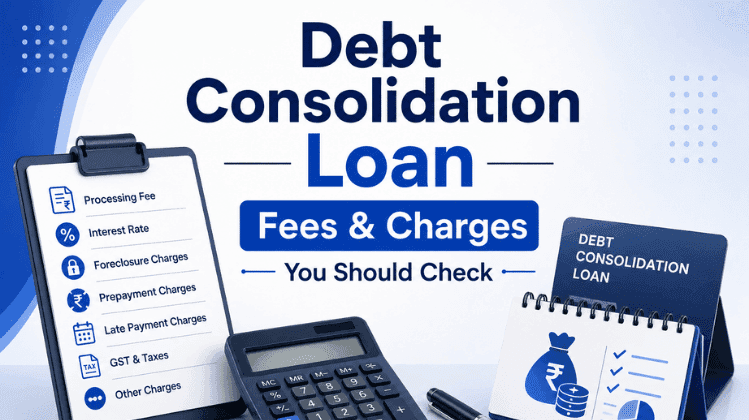
Taking a loan can affect your monthly budget for a long time. The interest rate matters, but it is not the only cost. Processing fees, payment charges, insurance and other costs can increase the amount you repay. So, it is very important to check the final cost of your debt consolidation loan before applying.
Key Takeaways
RBI requires regulated lenders to give clear information about covered loan costs. The Key Facts Statement, or KFS, gives important loan and cost details before the loan agreement is signed.
A processing fee is charged for handling your loan application. The amount differs by loan product, so there is no single fee for every debt consolidation loan.
Check the exact amount in rupees, not only the percentage. For example, a 1% fee on a ₹5,00,000 loan is ₹5,000 before applicable GST. Also check whether the fee is deducted from the loan amount. If ₹5,000 is deducted, you may receive ₹4,95,000 before other deductions. This matters if you need the full amount to close old debts.
For covered retail term loans, the KFS must show applicable charges and APR. Under RBI's KFS framework, charges not included in the KFS generally cannot be added later without your explicit consent, though this requirement is stated in absolute terms specifically for digital loans.
You may want to close the consolidation loan early if you have extra money later. Under RBI's Pre-payment Charges on Loans Directions, 2025, applicable to loans sanctioned or renewed from January 1, 2026, regulated lenders cannot charge foreclosure or prepayment fees on floating-rate loans given to individual borrowers for non-business purposes.
Different rules can apply to fixed-rate loans. Check whether your loan is fixed-rate or floating-rate and read the prepayment section in the KFS and loan agreement.
A debt consolidation loan may be used to close several old loans or credit accounts. Costs can come from both the old debts and the new loan.
Check whether your existing loans have foreclosure or prepayment charges. Then check the processing and other charges on the new loan. If the new lender pays old debts directly, check the amount paid and any fee deducted from the new loan.
Look at the full cost of moving your debts. A lower EMI does not always mean a lower total cost.
Missing an EMI can lead to a penal charge for non-compliance with a material loan term, separate from regular interest. A payment that fails or is returned may also have a separate charge under the loan terms.
Before taking the loan, check:
RBI rules say penal charges must be clearly shown and linked to failure to follow important loan terms. A lender cannot add a separate penal interest rate to the regular interest rate. Penal charges also cannot be added to the loan amount so that further interest is charged on those charges.
Regular interest on an unpaid amount can still apply at the contracted rate.
Insurance may be offered with a loan. A lender cannot force you to buy an insurance product as a condition for approving a loan. However, credit-linked insurance may be offered as an optional add-on, and its premium may be financed as part of the loan if you agree.
If you choose insurance, check:
Also check other add-on products or services. Do not agree to an extra product until you know its cost and purpose.
For covered loans, insurance charges collected through the lender for a third-party provider must be shown separately and included in the APR.
The interest rate tells you how interest is charged. It does not always show the full cost because other charges can also increase what you pay.
APR, or Annual Percentage Rate, gives a wider view of the yearly cost. Under RBI's KFS rules, APR includes the interest rate and applicable charges linked to the credit facility. The KFS also shows the APR calculation and repayment schedule.
When comparing debt consolidation loans, check the interest rate, APR, total repayment amount and fees together. This gives you a better idea of the actual cost.
Start with the KFS, sanction letter and loan agreement. Read the fee sections and ask about anything you do not understand.
Use this check before signing:
For covered retail term loans, the KFS must be given before the loan agreement is signed. It must be in a language you understand, and the lender must explain it. For loans with a term of seven days or more, the KFS validity period is at least three working days, giving you time to read the terms before accepting the loan.
Do not agree to a charge that has not been explained. If a charge is missing from the KFS, ask why it is being requested before giving your consent.
Comparing loans on your own means calling bank after bank. LoansJagat cuts that down; you get offers from over 50 RBI-approved lenders in one spot. Whether you need ₹50,000 or up to ₹50,00,000, you can check consolidation loan options online and merge multiple EMIs into a single monthly payment.
The cost of a debt consolidation loan is not limited to the interest rate. Fees and charges can also affect the amount you repay. Check the loan papers carefully and understand each cost before signing. This gives you a clearer idea of what the loan will cost.
Avoid taking more than you need, ignoring loan charges, missing EMIs, and using new credit to build debt again.
It does not always hurt you. A new loan may affect your credit score for a while, but regular EMI payments can help.
There is no set limit. You may not be able to consolidate the new EMI that you are paying or the new loan taken may turn out to be expensive.
The other options include; clearing debts one after the other, reducing spendings, discussing repayment options with the lenders, and enrolling in a debt management plan.
It can work when the new loan makes repayment easier, costs less, and you stop adding new debt.
No. Taking a consolidation loan does not automatically cancel your credit cards. Card closure depends on the card issuer and loan terms.
All applicable loan charges should be disclosed. Check the KFS and loan agreement carefully before accepting the loan.
Some companies may charge a service fee. Always ask how much you will pay and what service you will receive.
Debt consolidation refers to combining several debts into a single loan that is repaid on more manageable terms.
Yes, they can apply, but it is not certain that one’s request will be approved. A lender will assess an applicant’s credit history, income level, ability to repay debts, and existing CIBIL score before approving the request.