By continuing, you agree to LoansJagat's Credit Report Terms of Use, Terms and Conditions, Privacy Policy, and authorize contact via Call, SMS, Email, or WhatsApp
The information published on LoansJagat is intended for general informational and educational purposes only and should not be considered financial, legal, or investment advice. Interest rates, loan terms, statistics, and other data may change over time and may vary by lender or source. Please verify the latest information and consult a qualified financial advisor or the respective Bank/NBFC before making any financial decisions.
Subscribe Now
About the author

Vidhi Chauhan
Vidhi Chauhan is a copywriter and content writer with extensive experience creating high-quality, SEO-driven content across multiple industries, with a strong focus on fintech. She has written extensively on GST, banking, personal loans, business loans, credit cards, income tax, insurance, and other financial topics, helping Indian readers understand complex concepts through clear, accurate, and engaging content.
Related Blog Post
Simplify All Your Loans Into One Affordable EMI

Customers Served

Debt Consolidated

1200+ Reviews

Locations in India
Club all Loans & Credit Card Bills into Single EMI

Quick Apply Loan
Consolidate your debts into one easy EMI.

Takes less than 2 minutes. No paperwork.

10 Lakhs+
Trusted Customers

2000 Cr+
Loans Disbursed

4.7/5
Google Reviews

50+
Banks & NBFCs Offers
Personal Loan for Salaried Employees for Debt Consolidation means that multiple debts qualify to be merged into one loan, which has only one EMI and repayment structure. The borrower may find it easy to handle his or her debt, budget, and even reduce monthly repayments. But then, it is possible for the lower EMI to lead to an increase in the total repayable amount since the tenure for repaying the consolidated debt becomes long. Therefore, the borrower needs to consider the interest rate, tenure, processing fee, eligibility criteria, and cost of borrowing. LoansJagat assists borrowers in comparing personal loans.
Loan comparison assists salaried individuals in deciding how to borrow.
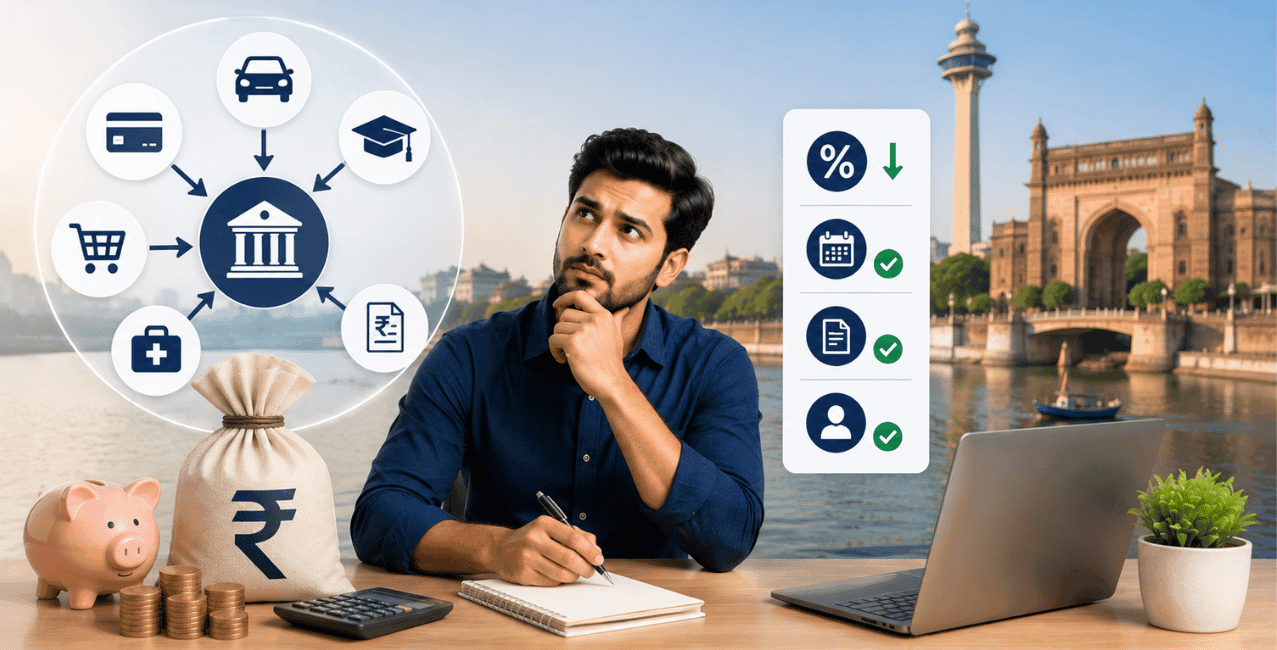
A Debt Consolidation Loan is a Personal Loan which may be utilised to repay various debts. Rather than handling multiple loans and EMIs, you can club all your debts into a single loan with only one EMI to be paid.
This may be used for repaying the eligible debts such as:
and other eligible unsecured loans.
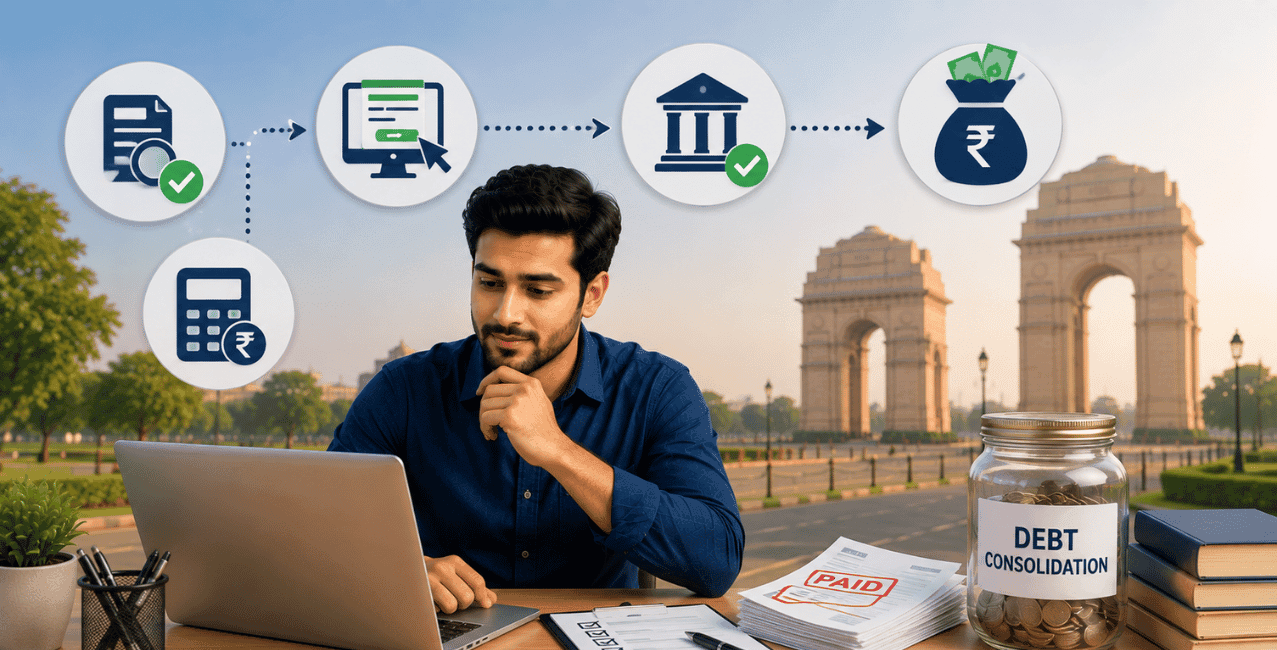
The process of debt consolidation is normally quite straightforward:
A Debt Consolidation Loan for Salaried Employees could be of great help when it comes to debt management because it allows for consolidating several outstanding loans into one. This kind of arrangement could work out well for salaried people who receive a monthly salary.
It would be easier for the borrower to deal with one EMI per month instead of remembering several due dates for different EMIs.
When the interest rates on the existing loans are higher than those on the new debt consolidation loan, the latter could lower the cost of the loan. It is important to compare the costs of both kinds of loans.
One EMI allows a person to easily manage monthly budgets based on their fixed income. Based on the conditions of the loan, the borrower is able to opt for an appropriate tenure for making the EMI convenient or repaying the loan early.
For instance, when multiple EMIs add up to ₹28,000 per month in comparison to a take-home salary of ₹60,000, a lower EMI will offer some flexibility.
A debt consolidation plan allows one to get a repayment structure along with a specific loan termination period. Salaried employees can make part payments from bonuses or incentives, based on the lender’s policies.
Managing a single loan will ensure that the payment becomes systematic and avoid the necessity of taking additional loans. Timely payments of EMI will help to maintain a good credit record in the future.
But at the same time, consolidation of loans may not always be advantageous. The EMI could turn out to be less due to increased tenure, which will ultimately lead to higher interest payments. Hence, one needs to take all the relevant factors into consideration while selecting a loan.
These benefits can make debt management simpler for salaried employees:
*T&C Apply
In combination, these benefits will be helpful for effective financial management. With the help of LoansJagat, a borrower will have an opportunity to compare different loans depending on his/her financial requirements. At the same time, the process of debt consolidation evaluation will become easier.
FACT: Salaries alone do not tell everything about eligibility for Debt Consolidation Loan. ET notes that the lenders tend to have preference for debt levels less than 40% of monthly earnings. Furthermore, utilisation of more than 30% of credit may be counter-productive for applicants. For instance, if your salary is ₹60,000 per month but EMIs amount to ₹30,000, you will have little borrowing room.
Eligibility for a Debt Consolidation Loan for Salaried Employees is usually based on certain income, credit score, and employment-related criteria determined by the lender.
These criteria can strengthen your application and improve loan approval prospects.
With the help of LoansJagat, salaried individuals can analyse and select loan options which suit their financial needs and eligibility conditions. At LoansJagat, borrowers can analyse loan options, compare interest rates, loan amounts, and repayment tenure, and select an option according to their repayment capacity. Comparing various options on a single platform will help salaried individuals to make better decisions about borrowing loans, rather than selecting a loan just due to its lower EMI.
Debt Consolidation Loan for Salaried Individuals can make it easy to pay back multiple debts through a single EMI payment and a repayment plan. The borrower needs to analyse all aspects of being eligible, interest rates, tenure, fees, and repayment cost. Comparison of the right loan schemes will benefit salaried individuals greatly.
Generally, debt consolidation is meant for unsecured loans that meet certain eligibility criteria. Whether one can consolidate secured loans is dependent upon the rules of the particular lender.
It is necessary for one to settle his/her outstanding loans during debt consolidation. One should consult with each lender and obtain documentation regarding the closure.
Possibly yes. The lender will take into account the total balances on your credit cards, among other factors like the payment history.
It might be necessary for the borrower to make the rest of the amount in order to pay off outstanding debts. The failure to pay off could result in managing the original debt along with the new loan.
There is a chance that paying off balances from credit cards will decrease the credit utilisation ratio. This will be determined by how fast the lenders refresh their records of the paid off balances as well as how you use the available credit.
The reason for this would defeat the purpose of debt consolidation. One should take care when using credit cards and avoid getting into high-interest debts again.
It is possible for some lenders to consolidate the debts from different financial institutions for some consolidation products.
Look for details such as the processing fee, prepayment terms, fees for foreclosure, fees for late payments, and other associated fees. Look for terms and conditions regarding the use of the loan for consolidating debts.
The availability of partial pre-payments depends on your lender and the loan agreement you have signed. Look out for fees, minimums, and other requirements before making a partial payment.
Debt consolidation will not solve the problem of overspending and borrowing regularly. The solution should be a combination of both.