By continuing, you agree to LoansJagat's Credit Report Terms of Use, Terms and Conditions, Privacy Policy, and authorize contact via Call, SMS, Email, or WhatsApp
Disclaimer: The information published on LoansJagat is intended for general informational and educational purposes only and should not be considered financial, legal, or investment advice. Interest rates, loan terms, statistics, and other data may change over time and may vary by lender or source. Please verify the latest information and consult a qualified financial advisor or the respective Bank/NBFC before making any financial decisions.
Subscribe Now
About the author

Vaishnavi kale
Vaishnavi is a Financial Content Writer at LoansJagat. She holds a B.Sc. and an M.Sc. She has experience in writing SEO-focused content across finance, digital marketing, education, and Ayurveda. Before joining LoansJagat, she worked with digital marketing agencies serving fintech clients and quick-commerce brands like Zepto and blinkit. At LoansJagat, Vaishnavi writes on banking, loans, personal finance, and insurance. Her work involves researching financial topics, understanding user search intent, and creating content that is clear and accurate. She has experience in SEO content writing, keyword research, content optimisation, and AEO. She enjoys simplifying complex topics into practical information that readers can easily understand and use. She believes that well-researched and reliable content plays an important role in helping people make informed financial decisions.
Related Blog Post
Simplify All Your Loans Into One Affordable EMI

Customers Served

Debt Consolidated

1200+ Reviews

Locations in India
Club all Loans & Credit Card Bills into Single EMI

Quick Apply Loan
Consolidate your debts into one easy EMI.

Takes less than 2 minutes. No paperwork.

10 Lakhs+
Trusted Customers

2000 Cr+
Loans Disbursed

4.7/5
Google Reviews

50+
Banks & NBFCs Offers
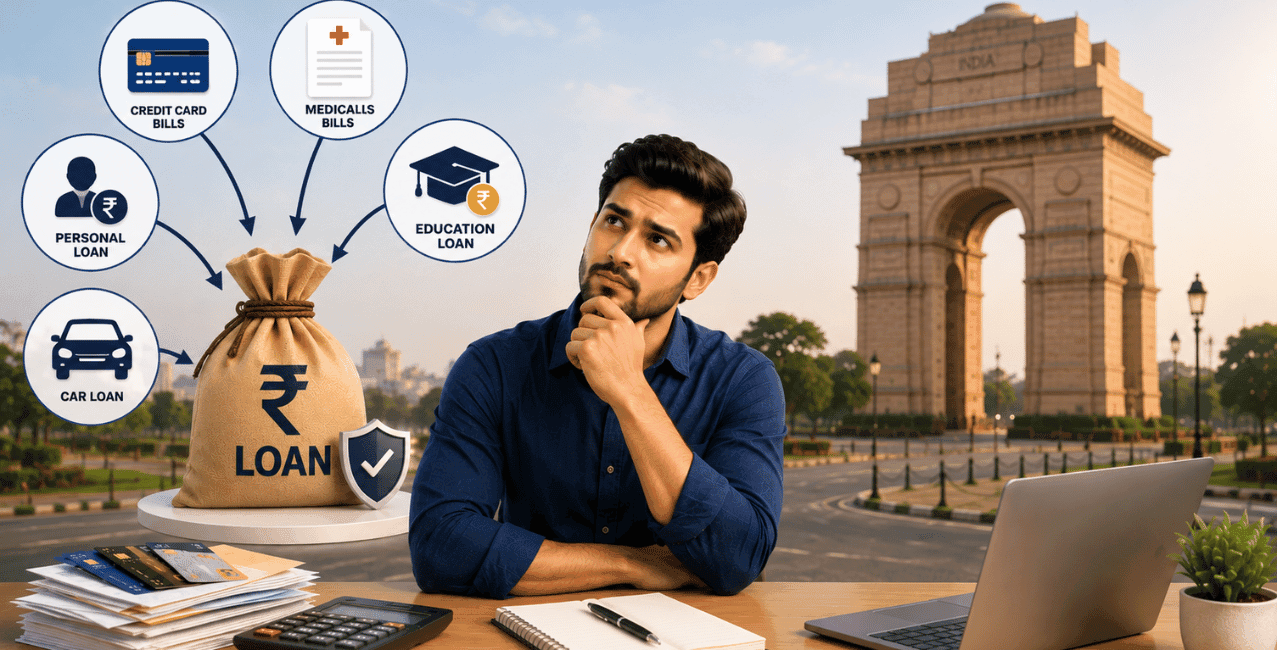
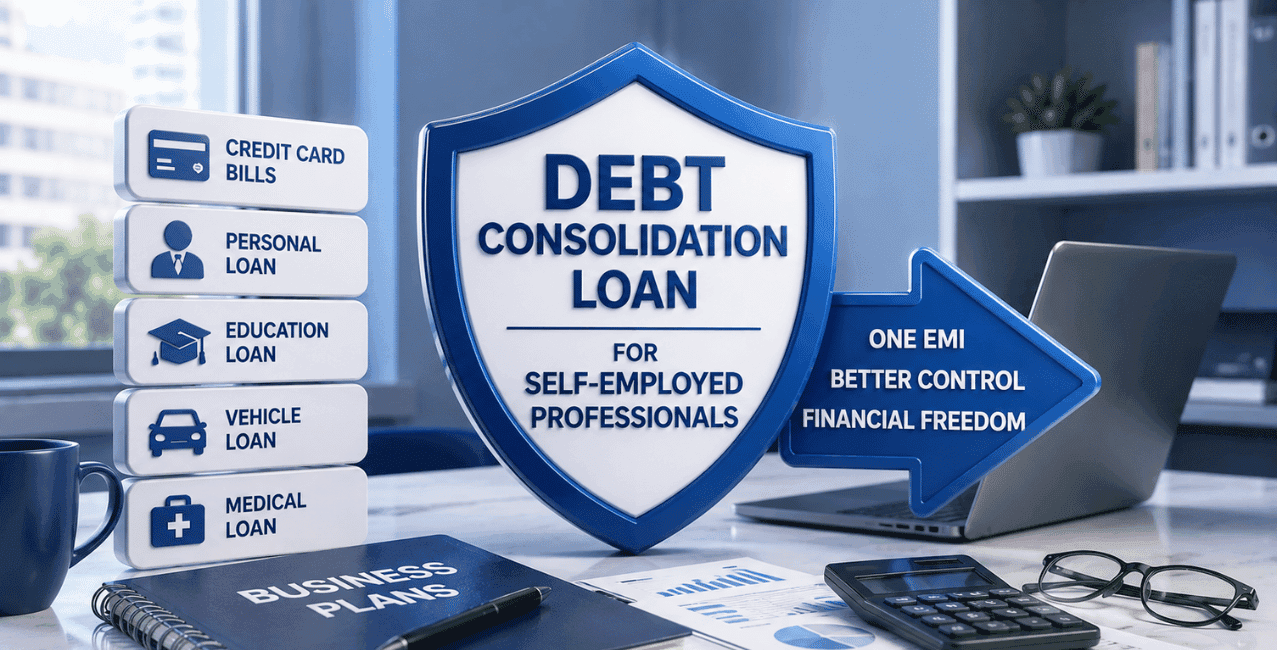
Multiple loans and their EMIs can be stressful. You can combine multiple loans into one debt. Debt consolidation can be a viable strategy for self-employed individuals managing irregular cash flows, provided the overall cost of borrowing decreases. Business or freelancing income varies. There is no fixed monthly income. So managing multiple loans can be difficult. If your new debt consolidation loan offers a lower interest rate, you can go for it.
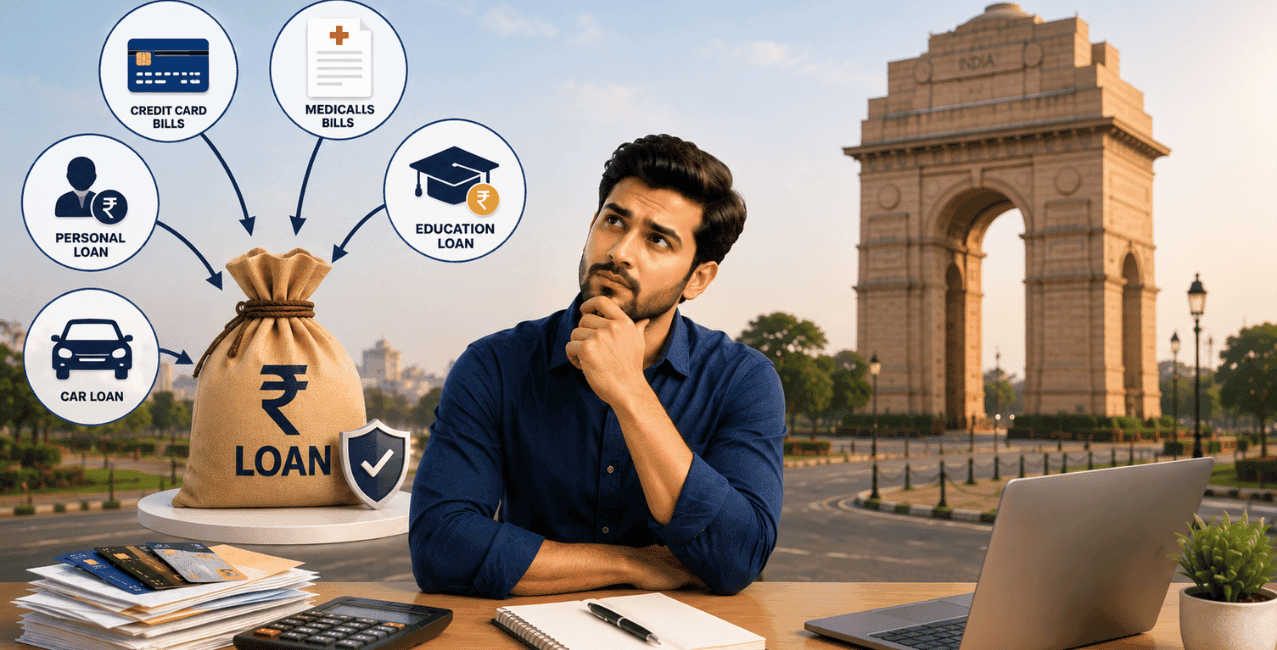
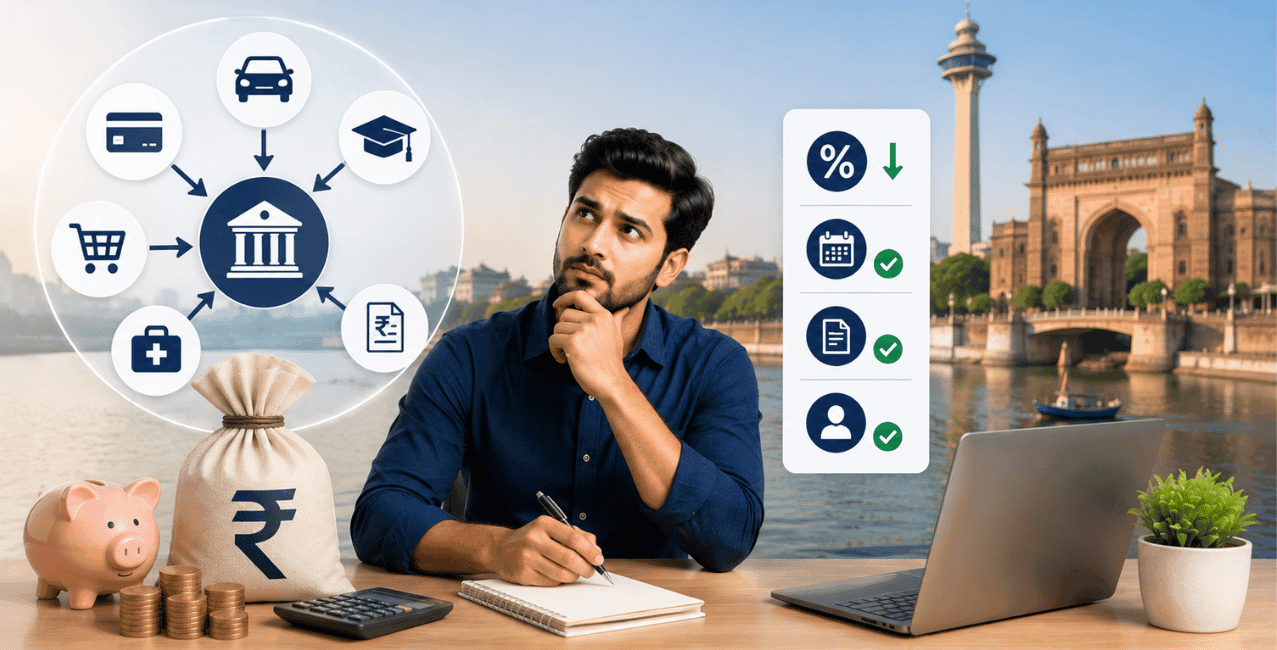
Debt consolidation is the process of combining multiple loans in a single loan, so that the borrower can repay it easily. After debt consolidation, you don't have to pay multiple EMIs. You can make just one monthly payment. If your new loan has low interest, your overall repayment cost also gets reduced due to debt consolidation.
For example:
Suppose you have 4 loans and now you consolidate them.
You cannot manage four EMIs easily, so you can get a debt consolidation loan of ₹6,00,000 at a lower interest rate. Now you don't have to pay ₹20,000 monthly. You can wrap up the EMI topic by paying a lower amount. But here is the twist. You should remember that when you pay lower interest you have to pay EMIs for long periods. Hence your total loan amount can be increased.
A lower monthly EMI achieved by extending your loan tenure increases the total interest paid over the life of the loan. Factor in upfront processing fees (usually 1%–3%) and any foreclosure charges on existing loans before deciding.
Self-employed individuals do not have fixed income. In one month their earnings are ₹1,00,000, and in the next month it's ₹30,000. In this situation, if they have four EMIs of ₹40,000. They will not be able to pay on time, and it will lead to a drop in CIBIL score.
What are the benefits for self-employed individuals?
Debt consolidation is used to lower the burden of monthly EMIs and get rid of the confusion of due dates. Let's understand it more:
If your income varies month to month, you should go for a lower interest rate debt consolidation loan. So that you don't have to worry about money next month.
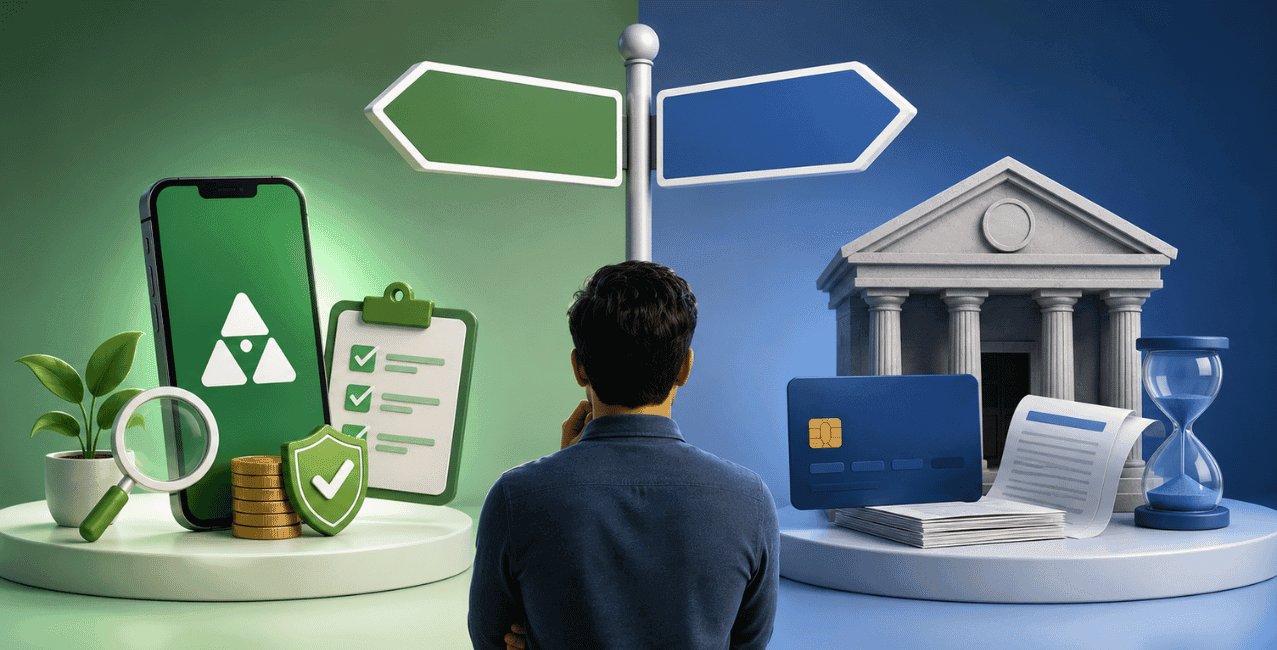
If you are self-employed and your income varies month to month, getting one loan with lower interest is much better due to uncertainty. You can get this loan from banks, NBFCs, or Fintech. Let's understand it.
Banks ffer competitive interest rates (typically for borrowers with credit scores of 750+ and steady 2–3 year ITR history), but have strict underwriting norms.
Banks usually check your credit report. It shows your financial behaviour. If they think that you are eligible, they can offer you a debt consolidation loan with a lower interest rate.
NBFCs can offer more flexible eligibility criteria for self-employed profiles, though interest rates and processing fees may be higher compared to public/private sector banks.
It is easy to get a loan from NBFCs because they are designed for this purpose.
Fintech acts primarily as Digital Lending Apps (DLAs) or Lending Service Providers (LSPs) partnering with RBI-regulated banks and NBFCs. They offer digitized documentation and quicker turnaround times, subject to the partner lender's credit policy.
If you are in a hurry and not getting a Personal debt consolidation loan from a bank or NBFC, then you can go for a Fintech platform.
But before choosing any of these options, always check and compare the interest rate, processing fee, repayment tenure, and other charges.
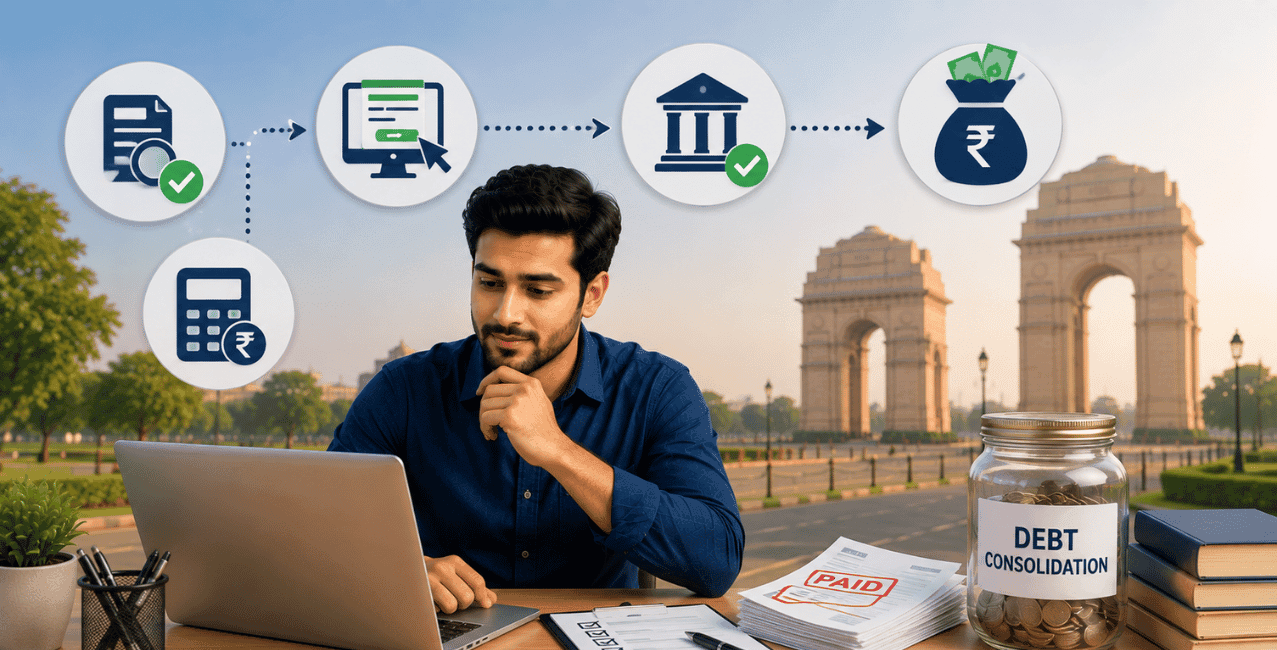
A debt consolidation loan is an alternative to your multiple loans. So you are combining multiple EMIs into a single EMI. While going for this loan, you should keep some things in mind:
When you repay on time, it protects your CIBIL score. And your CIBIL score helps you in future loans.
Conclusion
Debt consolidation loans are the viable strategy for self-employed individuals. They don't have a fixed income. That's why it's difficult to manage the same large amount every month. If they consolidate multiple loans into one single loan, they just have to pay one EMI instead of multiple. Sometimes the lender gives them a loan at a lower interest rate so they can use the rest of the money for other expenses.
You can get debt consolidation loans from banks, NBFCs, and Fintech platforms. Banks usually check your income and credit report before lending a loan, and if you are eligible, they can offer lower interest rates. Getting a loan from NBFCs and Fintech is easier and faster. Before choosing any loan, you should compare the interest rate and charges on it. If you want to know more such information, stay connected with Loansjagat.
LoansJagat connects you with trusted lenders, like banks and NFBCs. It is India’s first debt consolidating platform. It has partnered with 50+ banks and multiple NFBCs, all are RBI-approved. It provides its services all across India in more than 10,000 pincodes. You can get services like personal loans, business loans, and debt consolidation services from RBI-verified lenders. That's why you should choose LoansJagat when it comes to financial services.
In India, most banks (such as HDFC Bank, ICICI Bank, Axis Bank, and Kotak Mahindra Bank) facilitate consolidation through Personal Loan Balance Transfer (PLBT) facilities, uncollateralized personal loans, or secured options like Loan Against Property (LAP).
There can be many reasons behind your disqualification. Banks check your credit score and income proof. If your income is enough and your credit score is good, you have good chances of getting a loan with a lower interest rate.
Yes, banks can give personal loans to self-employed individuals. But before giving loans, banks check some important things like the status of the business, annual income, and a good credit score.
Lenders use the Fixed Obligation to Income Ratio (FOIR) to evaluate repayment capacity. For self-employed applicants, lenders generally prefer a FOIR between 40% and 55% of assessed monthly net profit, though high-income profiles may be evaluated at higher thresholds.
Sometimes your debt consolidation loan has high interest rates, upfront fees, risk of losing assets, and prepayment penalties. When you apply for a new debt consolidation loan, it can drop your credit score for a short period.
You should take care of some things while applying for a debt consolidation loan. If you are opting for a low interest rate, your loan tenure can be increased. Sometimes new lenders charge high fees. Also, you should avoid using your home or car as collateral to pay off unsecured liabilities like credit cards or personal loans
Banks and NBFCs usually avoid giving loans to people who have bad credit scores. Also, if borrowers do not have stable income and have active bankruptcies, then banks avoid giving them loans.
There are no specific guidelines about this. This amount depends on loan type and your income.
If your minimum age is 21, your business is 2-3 years old, and your credit score is more than 700, then you can get a loan easily in India. While applying for a loan, you should have income tax returns, bank statements, and profit statements.
Loans are specifically divided into two types: secured loans and unsecured loans. The 7 types of loans are personal loan, home loan, car or vehicle loan, education loan, business loan, gold loan, and loan against property.