By continuing, you agree to LoansJagat's Credit Report Terms of Use, Terms and Conditions, Privacy Policy, and authorize contact via Call, SMS, Email, or WhatsApp
Disclaimer: The information published on LoansJagat is intended for general informational and educational purposes only and should not be considered financial, legal, or investment advice. Interest rates, loan terms, statistics, and other data may change over time and may vary by lender or source. Please verify the latest information and consult a qualified financial advisor or the respective Bank/NBFC before making any financial decisions.
Subscribe Now
About the author

Ananya Shrivastava
Ananya Shrivastava is a Content Writer specialising in finance-focused news, blogs, and long-form articles on Indian markets, RBI policy, personal finance, and lending. She has authored over 450 blogs and 250 news pieces, combining technical knowledge with rigorous research to simplify complex financial concepts into clear, engaging content. With a marketing-driven lens and sharp editorial judgment, she consistently achieves top Google rankings while ensuring every claim is backed by verified data.
Related Blog Post
Simplify All Your Loans Into One Affordable EMI

Customers Served

Debt Consolidated

1200+ Reviews

Locations in India
Club all Loans & Credit Card Bills into Single EMI

Quick Apply Loan
Consolidate your debts into one easy EMI.

Takes less than 2 minutes. No paperwork.

10 Lakhs+
Trusted Customers

2000 Cr+
Loans Disbursed

4.7/5
Google Reviews

50+
Banks & NBFCs Offers
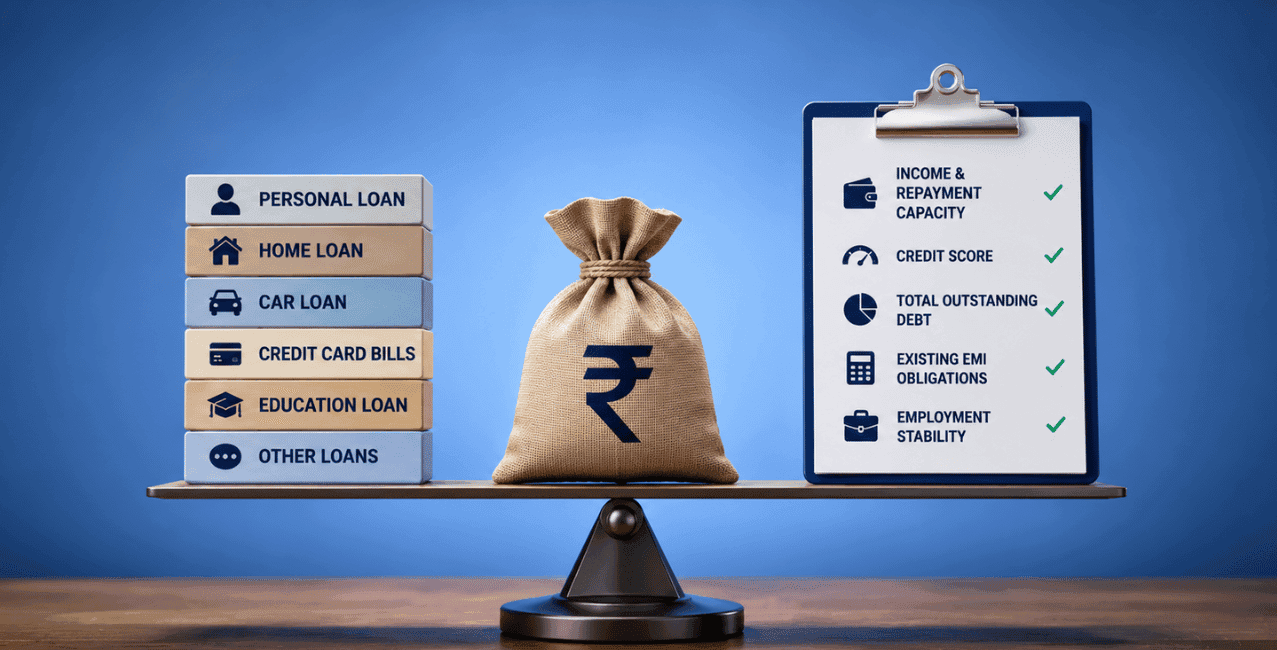
A lender decides your debt consolidation loan amount based mainly on your income, existing EMIs, credit score, and employment stability, using a combination of income multipliers and your Fixed Obligation to Income Ratio. HDFC Bank confirms it uses 6 specific factors to calculate this, while ICICI Bank states the amount is decided based on your age, income, and other factors, ranging from ₹50,000 to ₹50 lakh.
Anyone applying for a debt consolidation loan asks how a lender decides the amount of a debt consolidation loan, especially when the sanctioned figure doesn't match what they expected. This guide is for borrowers across India trying to combine multiple debts into 1 loan who want a clear, practical answer on exactly what banks look at before deciding your final amount. It covers income assessment, existing debt, credit score, and other factors that shape the number a lender actually offers you.
A lender decides your debt consolidation loan amount by weighing several factors together.
Here's what goes into that decision:
Age: Younger applicants with a longer working life ahead may qualify for longer tenures, supporting a higher amount at a manageable EMI.
Existing EMIs reduce your sanctioned debt consolidation amount, since lenders calculate your Fixed Obligation to Income Ratio and only extend credit that keeps this ratio within an acceptable range.
ICICI Bank states that existing loans and credit card dues impact your repayment capacity, and higher outstanding debt may reduce the amount of personal loan you receive. This matters specifically for debt consolidation, where the whole purpose is to combine existing debts, since the bank needs to be confident you can handle 1 larger EMI once your smaller ones are paid off. Here's how this plays out:
Since debt consolidation itself reduces your FOIR once existing debts get closed, lenders factor in this improvement when assessing the application.
Comparing how these 2 major lenders structure their eligibility criteria shows both similarities and differences worth knowing before you apply.
LoansJagat's debt consolidation loan is built to help you find the lender most likely to offer you the amount you actually need, rather than applying blindly and hoping for the best.
LoansJagat compares offers from 50+ partnered banks and NBFCs together, covering loans up to ₹50 lakhs across both unsecured and secured consolidation routes. You can see which lender's income multiplier and eligibility criteria actually suit your profile.
Submit your basic details, and LoansJagat returns instant loan offers within 2 minutes. This gives you a realistic sense of the amount you'd actually qualify for before committing to a full application anywhere.
A dedicated loan manager handles your case end-to-end, and applications get routed to lenders in a controlled manner rather than sent out indiscriminately. This protects your credit score from unnecessary multiple inquiries that could otherwise lower your sanctioned amount.
LoansJagat coordinates foreclosure letters, NOCs, and the rest of the paperwork on your behalf, where the lender permits it. It also supports lender-to-lender payout, so your existing debts get closed directly, improving your FOIR for the new loan.
The entire process runs 100% paperless, with no upfront fee for sanction or disbursal, so there's no cost barrier to simply checking what amount you'd qualify for.
Interest rates start at 9.99% per annum, going up to 17% depending on your credit profile, and many users cut their combined EMI by up to 50%, spread over a repayment tenure of 2 to 7 years.
Final approval always rests with the lender, but once your debt consolidation loan is sanctioned, multiple EMIs become just 1.
Take a salaried professional earning ₹60,000 a month, currently paying ₹18,000 in combined EMIs across a personal loan and credit card dues. Here's how their profile might affect the sanctioned amount at 2 different lenders:
Since this applicant's existing FOIR sits at a reasonable 30%, and their credit score falls just under the ideal 750 mark, both HDFC Bank and ICICI Bank would likely approve a consolidation loan.
The exact sanctioned amount and rate could differ slightly between the 2, purely based on each bank's internal income multiplier and risk assessment.
Comparing offers across lenders before committing, rather than applying to just 1, is exactly where a resource like LoansJagat becomes useful.
Deciding the amount of money that the lender may decide for your debt consolidation loan depends largely on the interplay of several factors such as your income, monthly EMIs, credit score, and job security, all together instead of individually. Both HDFC Bank and ICICI Bank validate the fact that your existing debt will lower your sanctioned amount, whereas a credit score greater than 750 will make things easier. In addition to this, before applying, you need to calculate your FOIR, know your credit score, and consider offers from several banks since the amount offered by one bank differs from others for certain reasons.
Lenders decide the amount of a debt consolidation loan by assessing your income, existing EMIs, credit score, and employment stability together, using an income multiplier and your Fixed Obligation to Income Ratio.
The minimum income needed for a debt consolidation loan is ₹25,000 a month at HDFC Bank, or ₹30,000 a month at ICICI Bank, though this can vary by city.
Yes, ICICI Bank confirms existing loans and credit card dues directly reduce your eligible loan amount.
A score of 750 or above secures both better terms and a higher sanctioned amount at most major banks.
The maximum debt consolidation loan amount available is up to ₹40 lakh at HDFC Bank, and up to ₹50 lakh at ICICI Bank, depending on your specific eligibility.
Yes, HDFC Bank requires a minimum of 2 years of total work experience, with at least 1 year at your current employer.
Yes, since factors like existing debt, credit score, and employer category vary between applicants and directly affect the final sanctioned amount.
A salary account can support a smoother assessment, since visible income patterns make evaluation easier, though overall credit profile still matters most.
Lowering your existing EMIs, improving your credit score, and maintaining stable employment all support a higher sanctioned amount.
LoansJagat compares offers from 50+ banks and NBFCs, shows instant offers within 2 minutes, and assigns a dedicated loan manager to help you secure the amount that best fits your profile.