By continuing, you agree to LoansJagat's Credit Report Terms of Use, Terms and Conditions, Privacy Policy, and authorize contact via Call, SMS, Email, or WhatsApp
Disclaimer: The information published on LoansJagat is intended for general informational and educational purposes only and should not be considered financial, legal, or investment advice. Interest rates, loan terms, statistics, and other data may change over time and may vary by lender or source. Please verify the latest information and consult a qualified financial advisor or the respective Bank/NBFC before making any financial decisions.
Subscribe Now
About the author

Arshathul Afia is a journalism graduate and fintech content writer with 4+ years of experience in digital publishing and research-led writing. She has written 200+ articles covering personal finance, lending, banking, digital payments, credit, insurance, and major financial developments in India. At LoansJagat, she focuses on simplifying complex fintech news, RBI updates, loan-related changes, policy developments, and industry trends for everyday readers. Her journalism background helps her approach stories with research, context, and clarity, while her SEO experience ensures content remains discoverable and relevant. She aims to make financial news easier to understand, practical, and useful for readers across India.
Related Blog Post
Simplify All Your Loans Into One Affordable EMI

Customers Served

Debt Consolidated

1200+ Reviews

Locations in India
Club all Loans & Credit Card Bills into Single EMI

Quick Apply Loan
Consolidate your debts into one easy EMI.

Takes less than 2 minutes. No paperwork.

10 Lakhs+
Trusted Customers

2000 Cr+
Loans Disbursed

4.7/5
Google Reviews

50+
Banks & NBFCs Offers
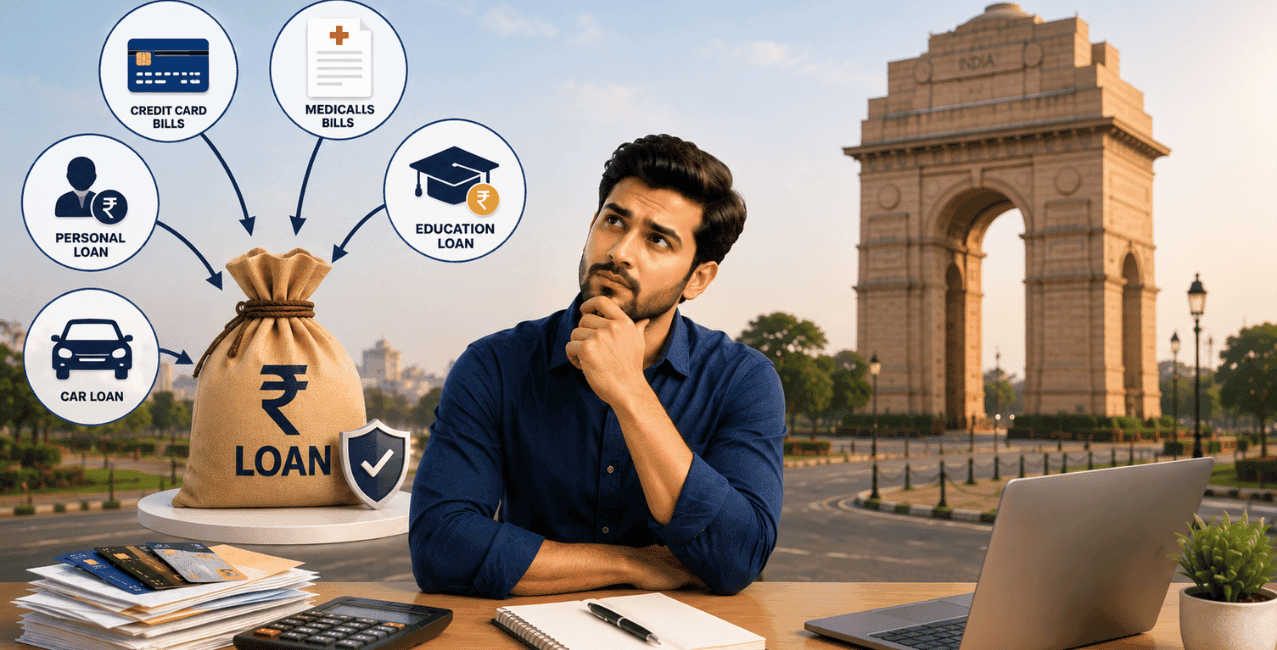
Having several debts means dealing with different EMIs, interest rates and due dates. It can also be hard to know how much you are paying in interest and fees. Before taking a new loan to clear these debts, check the full amount you will pay. This helps you see if the new loan will really cost less.
Key Takeaways
Total Borrowing Cost = Total Interest + Total Fees (only those not already paid as part of EMI) + Applicable Taxes
Total Repayment Amount = Principal + Total Interest + Total Fees (only those not already paid as part of EMI) + Applicable Taxes
For example, if you borrow ₹3,00,000 and pay ₹60,000 as interest and ₹6,000 in fees and taxes, your borrowing cost is ₹66,000. Your total repayment is ₹3,66,000.
Check these costs:
RBI requires applicable loan charges to be shown in KFS. The KFS also shows the Annual Percentage Rate (APR), which gives a wider view of the loan cost.
First, find the exact amount you owe on each debt you want to combine. For each debt, note:
Use the current outstanding amount and actual closure amount. Do not add all remaining EMIs because they may include future interest that you would avoid after closing the debt.
For credit cards, use the full amount needed to clear the balance. The minimum amount due is only that month's payment and is not the amount needed to clear the whole debt.
The interest rate tells you how interest is charged. APR gives a wider view because it expresses the overall cost of credit, interest plus other charges linked to the facility, as a single annualised rate.
RBI defines APR as the yearly cost of credit, including the interest rate and other loan charges. The KFS also shows the APR and repayment schedule.
When comparing loans, check the interest rate, APR and total amount payable. A loan with a similar interest rate can still cost more because of higher fees or a longer repayment period.
Read the KFS, sanction letter and loan agreement before accepting the loan. Check:
RBI requires applicable fees and charges to be disclosed in the KFS. A fee or charge not listed in the KFS generally cannot be charged later during the loan term by the regulated entity without the borrower's explicit consent.
Check the exact amount of each charge and when it must be paid.
The number of months you take to repay the loan affects total interest. A longer tenure usually gives a lower EMI because repayment is spread over more months. But you may pay more interest during that period.
For example, suppose you borrow ₹3,00,000 at 14% annual interest for 36 months. Using the monthly reducing-balance EMI formula:
EMI = P × r × (1+r)ⁿ ÷ [(1+r)ⁿ - 1]
Here:
The EMI is about ₹10,253. Total EMI payments are about ₹3,69,118. So, interest is about ₹69,118 before fees and applicable taxes.
Use the lender's repayment schedule for your actual figures.
Follow these steps:
Step 1: Add the current outstanding amounts of all debts you want to close.
Step 2: Add the amounts needed to close the old debts, including applicable closure charges.
Step 3: Check the new loan amount, interest rate, tenure, EMI and all KFS charges.
Step 4: Multiply the EMI by the total number of EMIs.
Step 5: Add the fees, applicable taxes and other charges you will pay.
Step 6: Keep the principal separate from the extra amount paid for the loan.
Use these formulas:
Total EMI Payments = EMI × Number of EMIs
Total Borrowing Cost = Total EMI Payments - Principal + Total Fees + Applicable Taxes not already included in the EMI
Total Repayment Amount = Principal + Total Borrowing Cost
Do not calculate interest by multiplying the annual rate by the original loan amount. In a reducing-balance loan, interest is based on the amount still owed, so it changes as the principal goes down.
Compare the cost of keeping the old debts with the cost of the new loan.
For the old debts, use the current repayment schedules to find the remaining interest. Also include the amount needed to close them if you plan to close them early.
For the new loan, add all EMI payments, fees and applicable taxes.
Cost of keeping old debts vs. Borrowing cost of the new loan
Do not choose the new loan only because its EMI is lower. A lower EMI can come from a longer tenure and may mean more total interest. Also check how long it will take to become debt-free under each option.
Read the KFS and loan agreement for prepayment, foreclosure, late payment and other charges.
RBI's Pre-payment Charges on Loans Directions, 2025 apply to loans sanctioned or renewed from January 1, 2026. For floating-rate loans given to individual borrowers for non-business purposes, regulated entities cannot charge prepayment fees. This applies to both part-prepayment and full prepayment, regardless of where the money comes from.
This rule applies to floating-rate loans. For other loans, including applicable fixed-rate loans, check the prepayment terms and charges in your loan documents.
The more options you have, the better rate you'll find. LoansJagat brings together 50+ RBI-approved lenders, so you're not stuck with whatever your local bank offers. Check consolidation loans up to ₹50,00,000 online, compare the terms side by side, and pick what actually works for your EMIs.
Before taking a debt consolidation loan, check the interest, fees, taxes and loan period. Then compare the full borrowing cost with your current debts. A lower EMI does not always mean a cheaper loan, so check the total amount you will pay.
Add the debts you want to combine, then compare the new loan's total interest, fees, taxes and repayment amount with your current debts.
There is no single formula for all debt. For a loan, total debt cost can be calculated as principal plus interest and applicable charges.
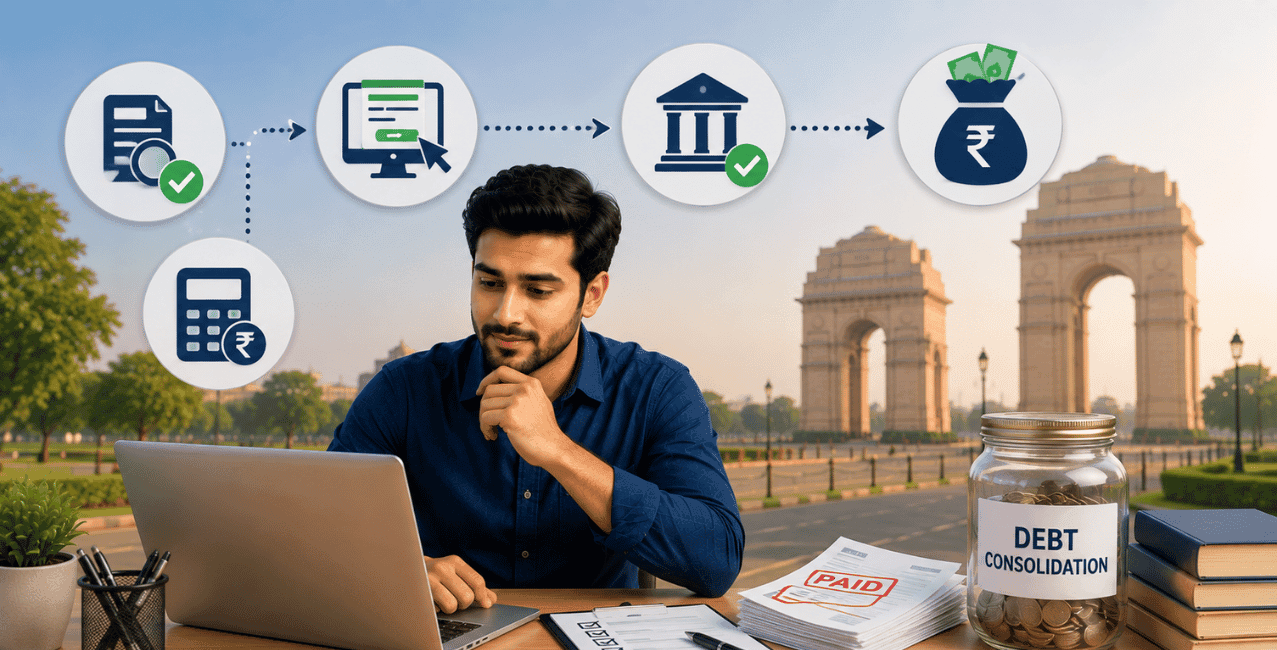
You take one new loan to pay off multiple debts. You then repay the new loan through one regular EMI.
It is feasible, but approval depends on the lender's underwriting criteria, income, obligations and credit history, some may decline or ask for a higher rate.
It can be cheaper if the new loan contract provides significant cost savings. However, it can also become more expensive if the extended payment period reduces the amount of money you can afford repayments, or additional costs are incurred.
You can be rejected by a lender if they consider your credit history too negative, you have insufficient income, too high debt, unstable employment, or you simply do not meet their requirements.
Debt consolidation can be a good choice if the terms of the new contract are significantly more favorable. It is essential to perform simple calculations to ensure that the new contract does not incur additional costs and that you can afford the payments.
It can dip slightly at first due to a new credit check and account, but timely EMI payments can help rebuild your score over time.
Lenders mostly consolidate unsecured debts like credit card payments, personal loan payments etc., based on certain eligibility criteria according to their policies.
The duration may differ depending on lenders, but it generally takes between a few days to two weeks to get approved and disbursed after verification of documents.