By continuing, you agree to LoansJagat's Credit Report Terms of Use, Terms and Conditions, Privacy Policy, and authorize contact via Call, SMS, Email, or WhatsApp
Disclaimer: The information published on LoansJagat is intended for general informational and educational purposes only and should not be considered financial, legal, or investment advice. Interest rates, loan terms, statistics, and other data may change over time and may vary by lender or source. Please verify the latest information and consult a qualified financial advisor or the respective Bank/NBFC before making any financial decisions.
Apply for Loans Fast and Hassle-Free
Subscribe Now
About the author

LoansJagat Team
‘Simplify Finance for Everyone.’ This is the common goal of our team, as we try to explain any topic with relatable examples. From personal to business finance, managing EMIs to becoming debt-free, we do extensive research on each and every parameter, so you don’t have to. Scroll up and have a look at what 15+ years of experience in the BFSI sector looks like.
Related Blog Post
Simplify All Your Loans Into One Affordable EMI

Customers Served

Debt Consolidated

1200+ Reviews

Locations in India
Club all Loans & Credit Card Bills into Single EMI

Quick Apply Loan
Consolidate your debts into one easy EMI.

Takes less than 2 minutes. No paperwork.

10 Lakhs+
Trusted Customers

2000 Cr+
Loans Disbursed

4.7/5
Google Reviews

50+
Banks & NBFCs Offers
Other services mentioned in this article
Key Takeaways
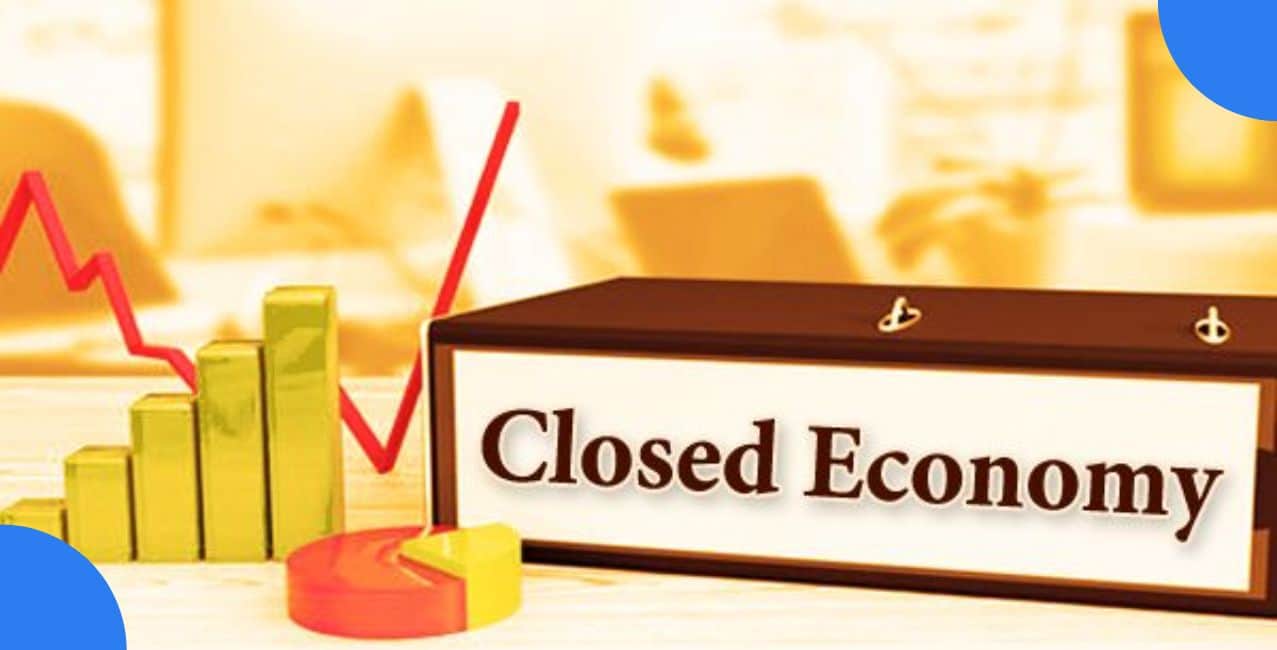
Have you ever thought about what happens when a country depends only on itself? It is a closed economy if there is no exchange of goods with other countries.
A closed economy is a system where a country does not trade with other countries. It neither buys goods and services from other countries nor sells them abroad. The entire economy depends on domestic production, consumption, investment, and government spending.
I imagine a country where I spend ₹600 on goods, businesses invest ₹300, and the government spends ₹200. Since there is no trade, the total output becomes ₹1,100, showing how everything depends only on domestic activity.
Bonus Tip: Global conflicts disrupting trade routes highlight why economic isolation fails, as economies remain deeply interconnected worldwide.
The closed economy formula helps you see how a country calculates its total output without depending on foreign trade. A closed economy does not include exports or imports. That means the GDP depends only on domestic activities. The formula is:
GDP = C + I + G
Suppose a country produces everything within its borders. In one year:
Now applying the closed economy formula:
GDP = 500 + 200 + 300 = ₹1000 crore
This means the total economic output is ₹1000 crore without any contribution from international trade.
You may think that some countries still follow a closed economy, but in reality, no nation is completely isolated today. However, a few countries show characteristics that come close to a closed economy.
You can see that even the strictest economies are not fully closed. This proves that a perfect example of what is a closed economy does not exist today. No country fully qualifies as a closed economy country. All nations engage in some form of trade, which makes the concept mostly theoretical in today’s globalised world.
Modern economies are deeply connected, which makes complete isolation very difficult.
Countries specialise in what they produce best. They trade to get better quality goods at a lower cost. This makes a fully closed economy country impractical.
Innovation spreads through international cooperation. Countries depend on others for technology and research. Without trade, growth slows down.
Exports increase income and jobs. Imports provide essential goods. This shows the difference between open economy and closed economy.
Government spending
300
*T&C Apply
No country can produce everything efficiently. People demand variety and quality. Trade helps meet these needs easily.
Strict rules are required to maintain isolation. For example, what restrictions would the government impose in a closed economy including banning imports and controlling currency. These measures are hard to sustain.
No country is fully closed today because trade helps economies grow, improve, and meet daily needs.
You can understand a closed economy when you compare it with an open system. This comparison explains how countries function in the real world.
The difference between open economy and closed economy shows why most countries prefer open systems, as they support better growth, innovation, and consumer choices.
A closed economy depends entirely on its own production and avoids international trade. It helps explain basic economic concepts, but it is not practical today. Most countries rely on global trade for growth, better resources, and improved living standards.
1. What does a closed economy mean?
A closed economy is a system where a country does not trade with other nations. It produces all goods and services within its borders. There are no imports or exports. The economy depends completely on domestic consumption, investment, and government spending for growth and development.
2. What is the main difference between an open and a closed economy?
An open economy allows trade with other countries through imports and exports. A closed economy does not allow any foreign trade. Open systems benefit from global markets and variety. Closed systems rely only on internal production, which limits growth, choices, and access to advanced technology.
3. Is charging higher prices in a closed economy unfair?
Charging higher prices can happen due to a lack of competition. Since foreign goods are not available, domestic producers may have more control over pricing. This is not always exploitative, but it can reduce consumer welfare. Government regulation becomes important to ensure fair pricing and protect consumers.
4. Why are GDP and GNP equal in a closed economy?
GDP measures total production within a country, while GNP includes income earned by residents. In a closed system, there are no foreign income flows. This means residents earn only domestically. As a result, both measures become equal because there is no external income to add or subtract.
5. Can a country survive without international trade today?
It is very difficult for any country to survive without trade today. Nations depend on others for resources, technology, and goods. Without trade, costs increase, and growth slows down. This makes complete economic isolation impractical in the modern global economy.