By continuing, you agree to LoansJagat's Credit Report Terms of Use, Terms and Conditions, Privacy Policy, and authorize contact via Call, SMS, Email, or WhatsApp
Disclaimer: The information published on LoansJagat is intended for general informational and educational purposes only and should not be considered financial, legal, or investment advice. Interest rates, loan terms, statistics, and other data may change over time and may vary by lender or source. Please verify the latest information and consult a qualified financial advisor or the respective Bank/NBFC before making any financial decisions.

Apply for Loans Fast and Hassle-Free
Subscribe Now
About the author

Diwaker Sharma
Diwaker Sharma is a finance content specialist with expertise in banking, personal finance, credit cards, loans, fintech, and financial news. An MBA in Finance with prior experience in the banking sector, he combines industry knowledge with SEO and content strategy to produce insightful, research-backed articles. Passionate about making finance accessible, he transforms complex financial concepts into clear, engaging content that empowers readers to make smarter financial decisions with confidence.
Related Blog Post
Simplify All Your Loans Into One Affordable EMI

Customers Served

Debt Consolidated

1200+ Reviews

Locations in India
Club all Loans & Credit Card Bills into Single EMI

Quick Apply Loan
Consolidate your debts into one easy EMI.

Takes less than 2 minutes. No paperwork.

10 Lakhs+
Trusted Customers

2000 Cr+
Loans Disbursed

4.7/5
Google Reviews

50+
Banks & NBFCs Offers
Other services mentioned in this article
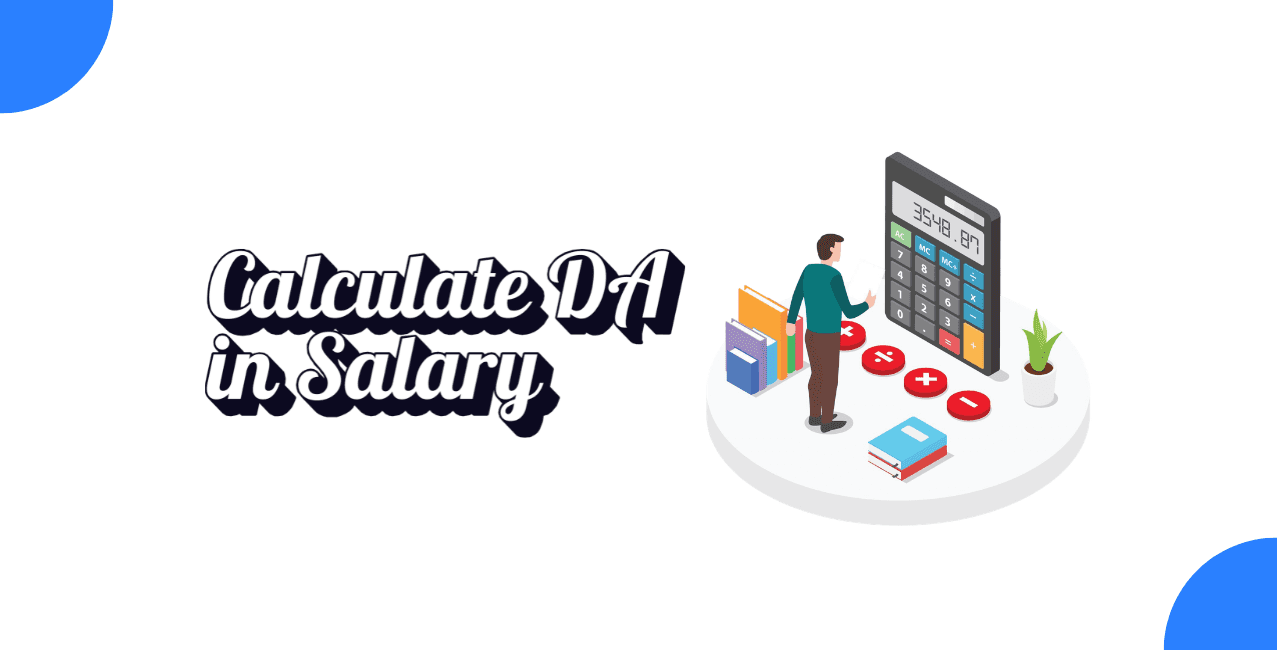
Take your basic pay, multiply it by the current rate, and there's your DA. For Central Government employees that rate is sitting at 60% right now, in effect since January 1, 2026. So if your basic pay is ₹50,000, you're looking at a DA of ₹30,000.
At some point, if you're on a government payroll or just trying to figure out a confusing payslip, you'll need to sit down and work this out yourself. Central Government employee, pensioner, or just someone curious, this is for you. We'll walk through the formula, where the rate stands today, how often it shifts, and a real example with actual numbers attached.
DA, short for Dearness Allowance, is basically a cut of your basic pay meant to soften the blow of inflation.
Here's the thing about basic pay: it's revised roughly every 10 years under a Pay Commission, though employees also receive annual increments and promotions in between that raise their basic pay. DA is what bridges the gap for inflation between these broader pay revisions. That gap is exactly what DA is meant to fill. Central Government employees get it, and pensioners get a version of it too, called Dearness Relief. Every time the rate changes, it's the Finance Ministry's Department of Expenditure that puts out the official word.
There's an actual formula running behind this number, built around the 12 month average of the AICPI-IW index, fixed under 7th Pay Commission rules.
The official DA formula, used by the government to set the DA rate, works like this:
DA% = [(Average AICPI-IW for the last 12 months × 2.88) minus 261.42] divided by 261.42, then multiplied by 100
Breaking that down a bit:
This formula is how the government arrives at the DA percentage every six months. Employees themselves don't need to run these numbers. Once the government announces the DA rate, the practical calculation for an employee is much simpler:
DA amount = Basic Pay × DA rate (%) / 100
So if the announced DA rate is, say, 53% and an employee's basic pay is ₹30,000, the DA works out to ₹15,900 a month.
Sitting at 60% of basic pay since January 1, 2026, confirmed by an official Cabinet call.
The Cabinet pushed this up from 58%, a 2 point jump meant to keep pace with rising prices. Pensioners aren't left out either, they get that same 60% as Dearness Relief on their pension. And this percentage applies across the board, so while the number stays fixed, the actual rupee amount naturally grows with a higher basic pay.
Since DA scales with basic pay, someone earning more ends up with a bigger DA in rupee terms, even though the percentage never changes.
*T&C Apply
Take Ramesh, a Central Government employee on ₹56,100 basic pay under the 7th Pay Commission. Multiply that by 60%, and his monthly DA comes to ₹33,660. Add that to his basic, and before any other allowances kick in, he's sitting at ₹89,760.
Twice yearly, January 1 and July 1, and each round is based on inflation data from the 12 months before it.
The Department of Expenditure fires off a fresh Office Memorandum whenever this changes. There's usually a lag between the effective date and when it's actually announced, which means back pay for those in-between months rides along with a later salary. Case in point, the January 2026 bump to 60% wasn't formally notified until April, with everyone's arrears for those earlier months landing in that same payout.
If you're working out your own DA, all you really need is your basic pay and the current percentage, 60% as things stand since January 2026. Since this number moves twice a year on Labour Bureau data, it's worth checking the latest Department of Expenditure order before trusting your own math. Multiply basic pay by the rate, and that's your monthly figure, plain and simple.
Once you've got your basic pay and the current rate in hand, this whole calculation takes maybe ten seconds. Just keep half an eye on the Department of Expenditure's orders each January and July, since that's when things actually shift based on fresh inflation numbers.