By continuing, you agree to LoansJagat's Credit Report Terms of Use, Terms and Conditions, Privacy Policy, and authorize contact via Call, SMS, Email, or WhatsApp
Disclaimer: The information published on LoansJagat is intended for general informational and educational purposes only and should not be considered financial, legal, or investment advice. Interest rates, loan terms, statistics, and other data may change over time and may vary by lender or source. Please verify the latest information and consult a qualified financial advisor or the respective Bank/NBFC before making any financial decisions.
Apply for Loans Fast and Hassle-Free
Subscribe Now
About the author

‘Simplify Finance for Everyone.’ This is the common goal of our team, as we try to explain any topic with relatable examples. From personal to business finance, managing EMIs to becoming debt-free, we do extensive research on each and every parameter, so you don’t have to. Scroll up and have a look at what 15+ years of experience in the BFSI sector looks like.
Simplify All Your Loans Into One Affordable EMI

Customers Served

Debt Consolidated

1200+ Reviews

Locations in India
Club all Loans & Credit Card Bills into Single EMI

Quick Apply Loan
Consolidate your debts into one easy EMI.

Takes less than 2 minutes. No paperwork.

10 Lakhs+
Trusted Customers

2000 Cr+
Loans Disbursed

4.7/5
Google Reviews

50+
Banks & NBFCs Offers
Other services mentioned in this article
Key Takeaways
Market kabhi kabhi itna unpredictable ho jata hai ki you are left with ‘ye kya ho gaya’? Let’s understand why that happens!
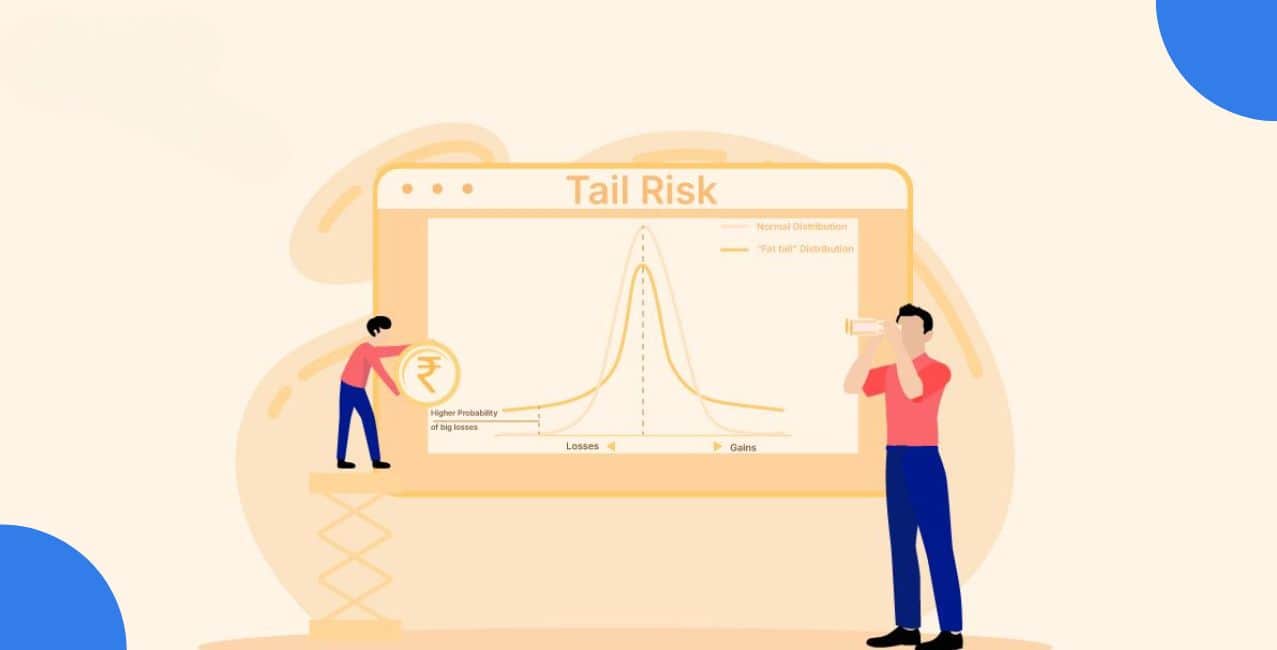
Tail risk refers to the possibility of rare and extreme events occurring at the ends of a probability distribution that can lead to significant financial losses. It represents unexpected market movements that fall outside normal expectations and can severely impact investments.
If a portfolio worth ₹1,00,000 suddenly drops by 25% during a market crash, I would lose ₹25,000 in a short time. This kind of unexpected and extreme loss is what I understand as tail risk.
Returns are often expected to follow a predictable pattern in everyday investing. This explains how asset returns behave under a normal distribution:
This comparison shows that while normal distribution simplifies analysis, real-world markets behave differently.
The understanding of tail risk vs head risk helps investors identify which risks occur frequently and which ones can cause sudden and severe losses.
This comparison shows that both risks require attention, but tail risk demands stronger protection strategies. Investors can prepare for both normal and extreme market conditions by understanding tail risk vs head risk.
Extreme market events may seem rare, but they have a strong impact when they occur.
*T&C Apply
Global stock markets crashed in a single day
These examples show how rare events can lead to major financial disruptions. Such situations highlight the importance of strategies like tail risk funds and tail risk insurance, which help investors stay protected during extreme market downturns.
Market uncertainty can never be fully avoided, but it can be managed. Hedging strategies help investors reduce the impact of extreme events.
Investors often use put options to protect portfolios from sudden market declines. This method acts like tail risk insurance, where losses are limited during extreme downturns.
You can spread investments across equities, bonds, and commodities to reduce exposure to a single risk. This approach ensures that not all assets are affected during tail events.
Specialised tail risk funds are designed to perform well during market crashes. These funds provide a hedge against extreme volatility and unexpected losses.
Assets like gold and government bonds tend to perform better during crises. You can include such assets to help balance the portfolio during adverse conditions.
Active portfolio adjustments based on market conditions help manage risks effectively. This includes rebalancing and using derivatives as part of tail risk hedging, Cambria Tail Risk ETF, tail risk ETF, tail risk protection strategies.
These strategies show that while tail risks cannot be eliminated, their impact can be reduced significantly. Investors can build a more resilient portfolio and stay prepared for extreme market events by combining multiple approaches.
Investors can apply practical measures to reduce the impact of unexpected market shocks by understanding what is tail risk.
Investors and institutions simulate extreme market scenarios to evaluate how portfolios perform under pressure. This helps in identifying weak points before real losses occur.
Define maximum exposure levels for different assets to ensure that losses remain controlled. This approach is essential when comparing tail risk vs head risk in portfolio planning.
Keep sufficient cash or liquid assets that allow investors to respond quickly during crises. It also prevents forced selling at unfavorable prices.
Tools like tail risk insurance and derivatives help protect against sudden market downturns. These instruments act as a financial safety net during extreme events.
Allocate a portion of the portfolio to tail risk funds provides built-in protection. These funds are specifically designed to perform during market crashes.
These measures highlight that managing tail risk is not about avoiding risk entirely but about being prepared. A balanced approach ensures stability and long-term financial security even during extreme market conditions.
Tail risk highlights the reality that rare events can cause major financial losses. Its concepts, examples, and strategies help investors stay prepared. A balanced approach with smart hedging and diversification can protect portfolios while still allowing steady long-term growth.
1. What is tail risk in hedging?
Tail risk in hedging refers to protecting a portfolio from rare but extreme market losses. It involves strategies like options or tail risk insurance that help limit downside during sudden crashes.
2. Is tail-risk hedging still a useful strategy today?
Yes, tail-risk hedging is still useful. Markets remain unpredictable, and extreme events continue to occur. It provides long-term protection and stability, especially during crises while hedging may reduce short-term gains.
3. How can tail risk be managed in options strategies?
Tail risk in options can be managed by controlling exposure and using structured strategies. Investors often prefer defined-risk trades like spreads instead of naked positions. They limit capital allocation per trade, diversify across ETFs, and adjust positions based on changing volatility levels to reduce large losses.
4. What are efficient ways to hedge tail risk without losing too much profit?
Efficient hedging focuses on maintaining a balance between protection and returns. Investors allocate a small portion to tail risk funds and use protective puts during low volatility periods. They also combine growth assets with safe-haven assets and avoid excessive hedging so that overall returns are not significantly reduced.
5. How can tail risk be reduced without sacrificing returns completely?
A practical approach includes diversification, disciplined allocation, and selective hedging. The strategies like tail risk hedging, Cambria Tail Risk ETF, tail risk ETF, tail risk protection allow investors to stay protected while still participating in market growth.




