By continuing, you agree to LoansJagat's Credit Report Terms of Use, Terms and Conditions, Privacy Policy, and authorize contact via Call, SMS, Email, or WhatsApp
Disclaimer: The information published on LoansJagat is intended for general informational and educational purposes only and should not be considered financial, legal, or investment advice. Interest rates, loan terms, statistics, and other data may change over time and may vary by lender or source. Please verify the latest information and consult a qualified financial advisor or the respective Bank/NBFC before making any financial decisions.
Subscribe Now
About the author
Darshana Patel is a finance and tech writer with a strong background in journalism, financial economics, and political science, working with Loans Jagat. She has immense experience writing content through her previous work in fintech and edtech companies. Her contribution at Loans Jagat is to simplify finance-backed content and academically powered content for the readers.
Related Blog Post
Simplify All Your Loans Into One Affordable EMI

Customers Served

Debt Consolidated

1200+ Reviews

Locations in India
Club all Loans & Credit Card Bills into Single EMI

Quick Apply Loan
Consolidate your debts into one easy EMI.

Takes less than 2 minutes. No paperwork.

10 Lakhs+
Trusted Customers

2000 Cr+
Loans Disbursed

4.7/5
Google Reviews

50+
Banks & NBFCs Offers
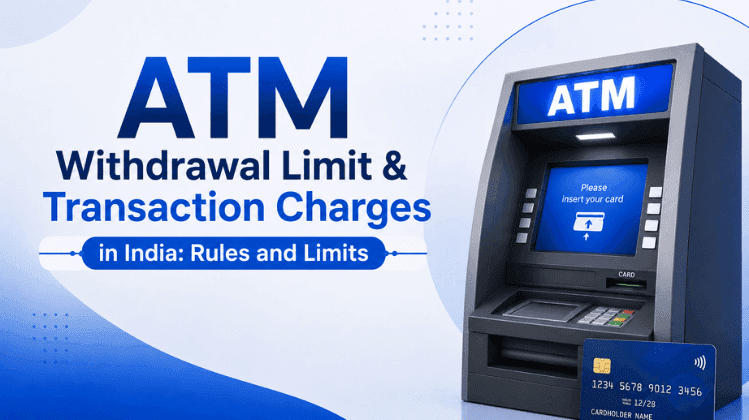
ATMs make it easy to take out cash and do basic banking without going to a branch. But there are rules on how much cash you can take out and how many free ATM uses you get. In this blog you will learn what ATM withdrawal limit and transaction charges mean.
An ATM withdrawal limit is the highest amount of cash you can take out with your debit card in a set time, usually one day. The bank that gave you the card sets this limit. It can be different for different cards and account types.
Your account balance and withdrawal limit are not the same. You may have enough money in your account but still not be able to take out more cash after you reach the allowed limit.
The RBI does not set one daily withdrawal limit for every debit card. Banks set these limits based on their card and account rules.
The withdrawal limit usually covers the total cash you take out in a day. The amount you can get in one go can also depend on the ATM’s own cash limit.
So your withdrawal may be limited by both your card’s daily limit and the amount the ATM can give in one transaction.
The daily withdrawal limit is different from the number of free ATM transactions allowed each month. One deals with the amount of cash you can take out. The other deals with the number of transactions that can be made without extra charges.
After you reach your daily withdrawal limit, another cash withdrawal will normally be declined until the limit becomes available again.
A failed ATM transaction is different from a completed transaction. If the transaction fails because of technical problems (hardware, software or network issues), no cash in the ATM, or other reasons linked fully to the bank or service provider, it is not counted as a valid ATM transaction. No charge is taken for it. Other declined transactions may be treated differently.
An ATM can be used for financial and non-financial services.
An On-Us transaction is made at an ATM of the bank that issued your card. An Off-Us transaction is made at another bank’s ATM.
For savings accounts, RBI requires banks to give a minimum number of free ATM transactions each month. Banks can also give more free transactions than these minimum limits.
The six metro locations are Bengaluru, Chennai, Hyderabad, Kolkata, Mumbai and New Delhi.
At your own bank’s ATM, non-cash services such as balance enquiry, cheque book request, tax payment and fund transfer are not counted in the five free financial transactions. These non-cash transactions are not counted in the five free financial transactions under RBI rules. Banks may still set their own extra terms, so check your bank’s rules.
At another bank’s ATM, both financial and non-financial transactions count toward the monthly free limit.
After the free limit is crossed, the bank may charge a fee. RBI currently allows a maximum charge of ₹23 per transaction, plus applicable taxes, for transactions above the required free limit.
These rules mainly apply to regular savings bank accounts. They do not apply to Basic Savings Bank Deposit Accounts (BSBDA). BSBDA accounts have their own free withdrawal limits set by RBI for those accounts.
Cash deposits through Cash Recycler Machines (CRMs) are a separate service from ATM cash withdrawals. A cash deposit should not be treated as an ATM withdrawal transaction under these free withdrawal limits. Any applicable deposit charges depend on the account and bank’s rules.
*T&C Apply
An ATM withdrawal limit is about the amount of cash you can withdraw. It is usually set as a daily limit based on your debit card and account.
An ATM transaction limit, when talking about free ATM use, is about the number of transactions you can make without paying an extra charge during a month.
Both limits work separately. You may still be within your daily cash withdrawal limit but have to pay a charge if you have already used your free ATM transactions for the month.
Several things can affect the amount you can withdraw through an ATM:
If your account is debited but the ATM does not give the cash, RBI requires the bank to put the money back within a maximum of T+5 calendar days (T is the transaction date). If the bank takes longer than this, it must pay ₹100 per day as compensation for the delay.
An ATM withdrawal limit tells you how much cash you can withdraw, while free transaction limits tell you how many ATM transactions you can make without extra charges. The limits depend on your card, account and bank rules. Knowing these rules can help you understand ATM use and avoid unexpected charges.
It depends on your bank and card limit. Many cards allow it if that is your set daily limit.
It is the cash you take out in one go or the total cash allowed in a day under your limit.
Yes. You can request your bank through the app, net banking or by visiting the branch.
Yes. You can use any bank’s ATM, but free uses and charges differ for other bank machines.
Your bank sets it. It changes by card type and account. There is no single fixed amount for all.
Check it on your bank app, net banking, mini statement or by calling customer care.
It is mostly set per debit card linked to the account, based on the card and account type.
Yes. Most ATMs work day and night, but cash may run out or the machine may face issues.
At your own bank ATM, no. At other bank ATMs, yes. They use up the free count.
Bank must return it in T+5 days. Late return means ₹100 per day compensation.