By continuing, you agree to LoansJagat's Credit Report Terms of Use, Terms and Conditions, Privacy Policy, and authorize contact via Call, SMS, Email, or WhatsApp
The information published on LoansJagat is intended for general informational and educational purposes only and should not be considered financial, legal, or investment advice. Interest rates, loan terms, statistics, and other data may change over time and may vary by lender or source. Please verify the latest information and consult a qualified financial advisor or the respective Bank/NBFC before making any financial decisions.
Subscribe Now
About the author

Diwaker Sharma
Diwaker Sharma is a finance content specialist with expertise in banking, personal finance, credit cards, loans, fintech, and financial news. An MBA in Finance with prior experience in the banking sector, he combines industry knowledge with SEO and content strategy to produce insightful, research-backed articles. Passionate about making finance accessible, he transforms complex financial concepts into clear, engaging content that empowers readers to make smarter financial decisions with confidence.
Related Blog Post
Simplify All Your Loans Into One Affordable EMI

Customers Served

Debt Consolidated

1200+ Reviews

Locations in India
Club all Loans & Credit Card Bills into Single EMI

Quick Apply Loan
Consolidate your debts into one easy EMI.

Takes less than 2 minutes. No paperwork.

10 Lakhs+
Trusted Customers

2000 Cr+
Loans Disbursed

4.7/5
Google Reviews

50+
Banks & NBFCs Offers
Other services mentioned in this article
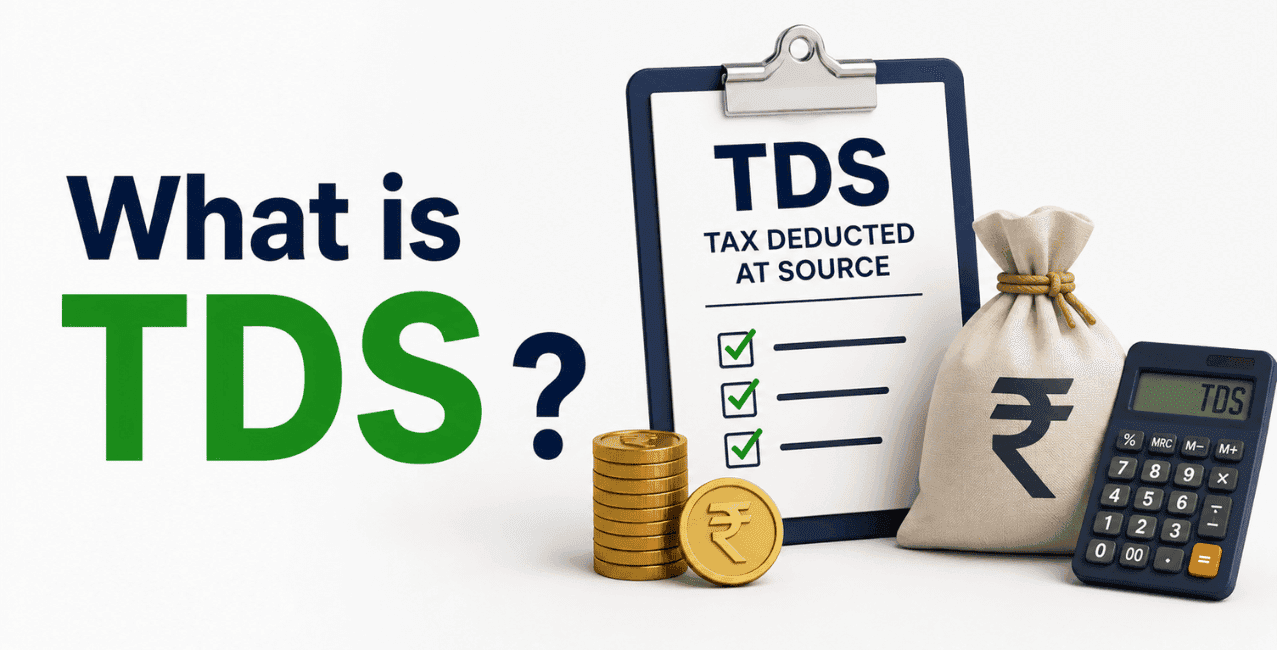
TDS just means Tax Deducted at Source, the payer skims off a bit of tax before your money reaches you and hands that portion straight to the government. Starting Tax Year 2026-27, this whole system runs under Section 393 of the Income-tax Act, 2025, alongside the Income-tax Rules, 2026, swapping out the old 194-series framework from the 1961 Act.
Key Takeaways
Got a salary, some FD interest, maybe a bit of freelance income, and you've almost certainly noticed TDS chipping away at what actually lands in your account. Question is, what's it actually deducting, and how much has this shifted under India's new tax code. This one's written for taxpayers across India who want the real picture of how TDS behaves from Tax Year 2026-27 onward, which threshold applies where, and how you'd actually get back anything deducted in excess.
Put simply, TDS is the payer holding back a portion of your income as tax, then forwarding that amount to the Central Government before you ever see it.
As of April 1, 2026, nearly all non-salary TDS rules live under a single section, Section 393 of the Income-tax Act, 2025, sitting inside Chapter XIX, and it's swallowed up more than 20 separate 194-series sections that used to exist under the 1961 Act. Salary based TDS still lives on its own, under Section 392. As the Income Tax Department itself explains, the basic logic hasn't shifted at all; tax still gets collected right at the source instead of waiting for your return. Only now, Section 393 consolidates non-salary TDS provisions into three principal tables, each one dedicated to a different kind of payment.
Interest income under Section 393(1) actually splits into two entirely separate categories, each running its own threshold, so there's really no single number that applies across the board.
Here's precisely how it breaks down, straight from Section 393(1), Table Serial 5(ii) and 5(iii):
Cross whichever threshold applies to you, and TDS lands at 10% if your PAN's on file, jumping to 20% if it isn't, but that's specifically for interest sitting under Serial 5(ii) or 5(iii). It's not some universal rate stretching across everything Section 393 touches. Rent, commission, professional fees, contractor payments, they've each got their own separate thresholds and rates entirely, distinct from interest altogether.
Whoever's actually paying you salary TDS is deducted at payment, while most non-salary TDS is deducted at credit or payment, whichever occurs earlier.
Nothing's really changed here moving into the new framework. Section 393(1) pins the deduction moment to whenever the income gets credited to your account, or actually paid out, cash, cheque, draft, doesn't matter the method, whichever happens sooner. If a branch hasn't switched over to core banking solutions, the threshold gets calculated purely off what that individual branch credited or paid, rather than looking at the whole institution together, a detail that's simply carried forward from the older law without any real change.
Hand your payer Form No. 121, but only once you've genuinely cleared two separate conditions together, not just a rough sense that your income sits on the lower end.
Per the Income Tax Department's own Form 121 FAQ page, filing Form No. 121 requires both of these holding true simultaneously:
This form runs under Section 393(6) of the Income-tax Act, 2025, read together with Rule 211 of the Income-tax Rules, 2026, and it's the single replacement for both Form 15G and Form 15H, which previously sat under Section 197A(1), 197A(1A), and 197A(1C) of the 1961 Act. Companies and firms can't touch Form No. 121, non-residents are shut out too. Form 121 may be used by eligible resident individuals, HUFs and certain other eligible entities; companies, firms and non-residents cannot use it. That old age split, 15G for under 60, 15H for senior citizens, doesn't exist anymore, everyone fills out this same form regardless of age. You still need to clear that nil tax liability bar though, and if you're under 60, that ₹4,00,000 income ceiling too, before submitting anything. And PAN's non-negotiable, skip it and the whole declaration falls apart, meaning TDS gets pulled at the higher rate no matter what else checks out.
File your Income Tax Return, lay out your total income alongside whatever's already been deducted, and let the department figure out if you've paid too much, though which specific law actually governs your refund hinges on which tax year the income falls under.
Roughly, here's the sequence:
Income earned through Financial Year 2025-26, assessed under AY 2026-27, still falls under the Income-tax Act, 1961, including Section 244A, which pegs refund interest at 0.5% monthly, or 6% a year, on eligible amounts. But income earned from Tax Year 2026-27 onward, meaning anything arising after April 1, 2026, falls under the new Act's own equivalent provisions instead. Since the exact matching section number under the new Act may not line up with 244A, and transitional details can genuinely affect which rule applies to your specific case, checking the Income Tax Department's current guidance for your tax year beats assuming.
Getting clear on which threshold actually belongs to your situation stops you from mistakenly applying one number across every kind of interest you earn.
*T&C Apply
Just to walk through this, take a senior citizen earning ₹95,000 in FD interest from a bank across one tax year. That sits comfortably under the ₹1,00,000 threshold reserved specifically for senior citizens under Section 393(1), Serial 5(ii), and assuming their broader estimated tax liability genuinely comes to nil for that year, they could submit Form No. 121 to their bank, ticking off both the nil tax box and the income ceiling test wherever that applies. Get it accepted, and no TDS touches that interest whatsoever. Now swap the source, same ₹95,000, but coming from a non-bank payer this time, and that already blows straight past the much smaller ₹10,000 threshold sitting under that category, meaning TDS applies regardless of their overall tax situation unless Form No. 121 was already filed in time. Comparing FD rates, or weighing a loan alongside sorting out your taxes? Something like LoansJagat is worth a look to see how different income streams actually feed into your broader tax planning.
TDS on interest doesn't run off one flat threshold, banking company, co-operative bank, and post office interest sits at ₹50,000 or ₹1,00,000 depending on your age, while interest from anyone else lands at a much lower ₹10,000, all sitting under Section 393(1) of the Income-tax Act, 2025. Form No. 121 has completely taken over from Form 15G and Form 15H since April 1, 2026, and it only actually works once you clear both a nil tax liability test and, where applicable, an income ceiling check, together, not separately. As for refunds, income earned before April 1, 2026 still answers to the 1961 Act, while anything after that date falls under the new Act's own rules, so it's genuinely worth confirming which framework covers your specific tax year before filing.