By continuing, you agree to LoansJagat's Credit Report Terms of Use, Terms and Conditions, Privacy Policy, and authorize contact via Call, SMS, Email, or WhatsApp
Disclaimer: The information published on LoansJagat is intended for general informational and educational purposes only and should not be considered financial, legal, or investment advice. Interest rates, loan terms, statistics, and other data may change over time and may vary by lender or source. Please verify the latest information and consult a qualified financial advisor or the respective Bank/NBFC before making any financial decisions.
Apply for Loans Fast and Hassle-Free
Subscribe Now
About the author

LoansJagat Team
‘Simplify Finance for Everyone.’ This is the common goal of our team, as we try to explain any topic with relatable examples. From personal to business finance, managing EMIs to becoming debt-free, we do extensive research on each and every parameter, so you don’t have to. Scroll up and have a look at what 15+ years of experience in the BFSI sector looks like.
Related Blog Post
Simplify All Your Loans Into One Affordable EMI

Customers Served

Debt Consolidated

1200+ Reviews

Locations in India
Club all Loans & Credit Card Bills into Single EMI

Quick Apply Loan
Consolidate your debts into one easy EMI.

Takes less than 2 minutes. No paperwork.

10 Lakhs+
Trusted Customers

2000 Cr+
Loans Disbursed

4.7/5
Google Reviews

50+
Banks & NBFCs Offers
Other services mentioned in this article
Key Takeaways:
Wait! Are you going to opt for a fixed-income investment? Or simply search how to calculate bond value/how to calculate bond price? Congratulations, you are the perfect place for that.
I don’t know about you, but “BONDS” seems very scary to me. All those big old letters staring at me. But at heart? It is just like us, soft-hearted and always ready to help others. A bond is a future payout that you just have to sit and wait for in the meantime.
Until then, let us just understand what it actually means and how it is going to help you.
Basically, a bond valuation works on a present value concept, where the money you are going to get in the future is not worth enough today. You simply need to combine the idea of money with the coupon payments and the bond's eventual principal payment. BOOM! You got your answer.
Read More - Bond Liquidity Measures
Ok! Ok! I know this is too much to absorb just from textbook knowledge. Let me break this down for you with the help of practical examples, formulae, and easy explanations.
In financial terms, a bond valuation is defined as the estimated fair price by discounting the future cash flow and bringing it back to the present.
The main concept of a bond valuation is to make you understand that the value of your money today is worth more than its value tomorrow. Meaning that if you invest a rupee today, you can actually earn interest on it, and it will become almost double in the coming months/years.
In the bond valuation, the interest rate plays a very important role. Every year, the interest rates are updated by the government. As the interest rates go high, the value of those bonds goes down. If the interest rates decrease, the bond’s rate increases along with your demand among the investors.
Understanding this is really important if you are buying a corporate bond or a government security bond. The market price of the bond always reflects the future cash flow in the investment market. That is why using a bond calculator or learning a basic formula gives you a clear edge for such calculations.
One of the most famous ways of understanding how to calculate bond price is by evaluating the current value of expected future payouts. This process includes:
With the help of a simple formula given below, you can calculate the bond easily:
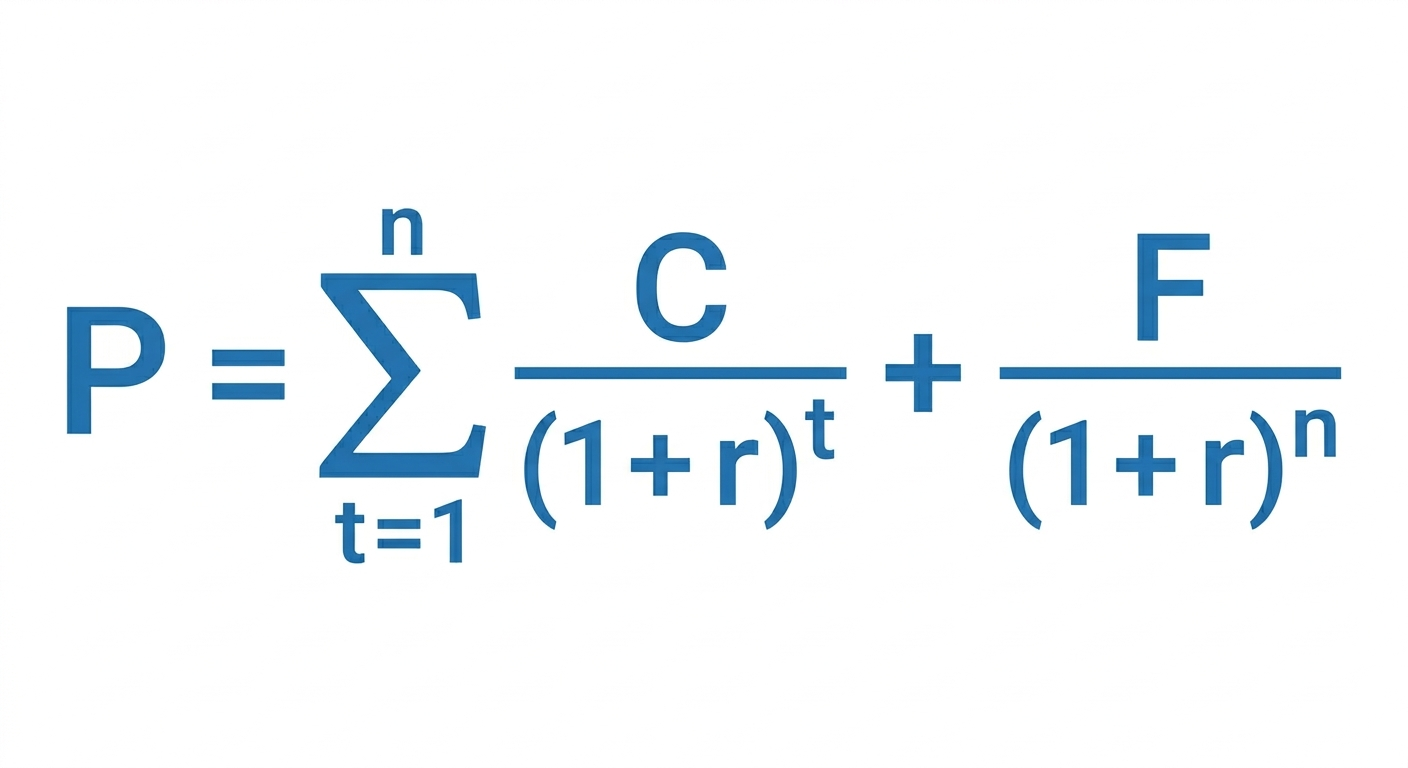
Here:
Let’s check with a quick example.
A ₹50 coupon payment and the ₹1,000 redemption at maturity will be discounted back just by using the bond price formula. By calculating the discounted payments, you can actually check the real bond’s fair value.
Simply, the present value of bonds is the key to calculating bond value. It works on the time-value of money principles. In simpler words, the money you will have in the future won’t be worth as much as it is today because of the missed opportunities that you should have invested it in.
The logic of this remains the same even if you are using a formula or a financial calculator. You just have to discount future payments to the present with the help of appropriate rates and maturity period.
Why do bond prices change along with the Interest Rates?
The core of the bond valuation lies in the meaningful relationship between the interest rate and the bond price, equally. This is what every investor should know:
So, why does this happen? It happens when the new bonds are issued in the market with higher interest rates; the old bonds do not attract investors. In order to compete with the newly launched bonds, the older bonds need to drop their market price. This is the reason why most traders and financial planners keep track of the interest trends during bond valuation.
Also Read - Budget 2026 Clarifies Tax Treatment
Maybe you are just like me, who hates maths and doing long, boring calculations. Here is a simpler way to do it. There are many websites and apps like the Canva bond price calculator, CalcifyAI Bond Calculator, etc, available online that help you calculate bonds in a few steps. You just need to enter:
…..And the calculator will automatically provide you with the relevant information regarding the bond value.
Other than the online calculators, Excel also has an in-built function to instantly calculate the bond value. With teh help of this formula, you can simply calculate the bond value in seconds.
Excel Formula:
=PV(rate, nper, -pmt, -fv)
*T&C Apply
Here:
Through this formula, you can work with different scenarios, interest rates, and that too without brain-tiring mathematical calculations.
Bonus Tip: While calculating the bond value, always make sure to enter the correct semi-annual coupon rates, interest rates, and number of periods. Avoid any mistakes if you are calculating manually.
Bond valuation does not help; it provides you with relevant information so that you are aware of certain trends and updates for the future. Understanding how to calculate bond price and how to calculate bond value allows you:
Bond valuation does not need to be complicated or intimidating. Once you have actually understood how the interest rates fluctuate and influence the present value. You’re gonna say “It's a piece of cake”. Now, tools have made it simpler to calculate the bond valuation; just a few inputs, and the answer is on your screen.
No wrong calculations and future guesses, just a real concept. Whether you are a beginner or a pro investor, this analysis is going to open many doors to opportunities for your investment decisions.
In simple words, bond valuation is the analysis of checking if the bond you are buying is worth the money or not. It's not about guessing and trusting the market, but it's about actual calculations.
Investors should check all the factors, like interest payments, the time it will last, and what can affect its value, before investing in a bond. Once you have learned about how bond valuation works, it will all be easier for you. Overall, some basic ideas on bond valuation can make you a investing pro.
Who needs bond valuation services?
Bond valuation is used by institutional investors, banks, portfolio managers, and corporate finance teams to identify investment risks and access fair pricing.
Can you use the bond valuation equation for real estate investment?
No, not directly. You can use the same value concept while you are investing in the rental or permanent property cash flows.
How do bond prices actually work?
The bond prices are equivalent to the present value of the future coupon payment adjusted as per today’s interest rate. As the market rate changes, the bond prices adjust accordingly.
Why do bonds become more expensive as demand rises?
As the bond price increases, its effectiveness decreases. When investors see a price drop, they are willing ot pay high prices in return.
Why does my bond price calculation differ from the bank’s, even when I use the same formula?
Major banks often use different accrued interest and compounding frequencies, which can slightly change the final bond price.