By continuing, you agree to LoansJagat's Credit Report Terms of Use, Terms and Conditions, Privacy Policy, and authorize contact via Call, SMS, Email, or WhatsApp
Disclaimer: The information published on LoansJagat is intended for general informational and educational purposes only and should not be considered financial, legal, or investment advice. Interest rates, loan terms, statistics, and other data may change over time and may vary by lender or source. Please verify the latest information and consult a qualified financial advisor or the respective Bank/NBFC before making any financial decisions.
Subscribe Now
About the author

Darshana Patel
Darshana Patel is a finance and tech writer with a strong background in journalism, financial economics, and political science, working with Loans Jagat. She has immense experience writing content through her previous work in fintech and edtech companies. Her contribution at Loans Jagat is to simplify finance-backed content and academically powered content for the readers.
Related Blog Post
Simplify All Your Loans Into One Affordable EMI

Customers Served

Debt Consolidated

1200+ Reviews

Locations in India
Club all Loans & Credit Card Bills into Single EMI

Quick Apply Loan
Consolidate your debts into one easy EMI.

Takes less than 2 minutes. No paperwork.

10 Lakhs+
Trusted Customers

2000 Cr+
Loans Disbursed

4.7/5
Google Reviews

50+
Banks & NBFCs Offers
Other services mentioned in this article
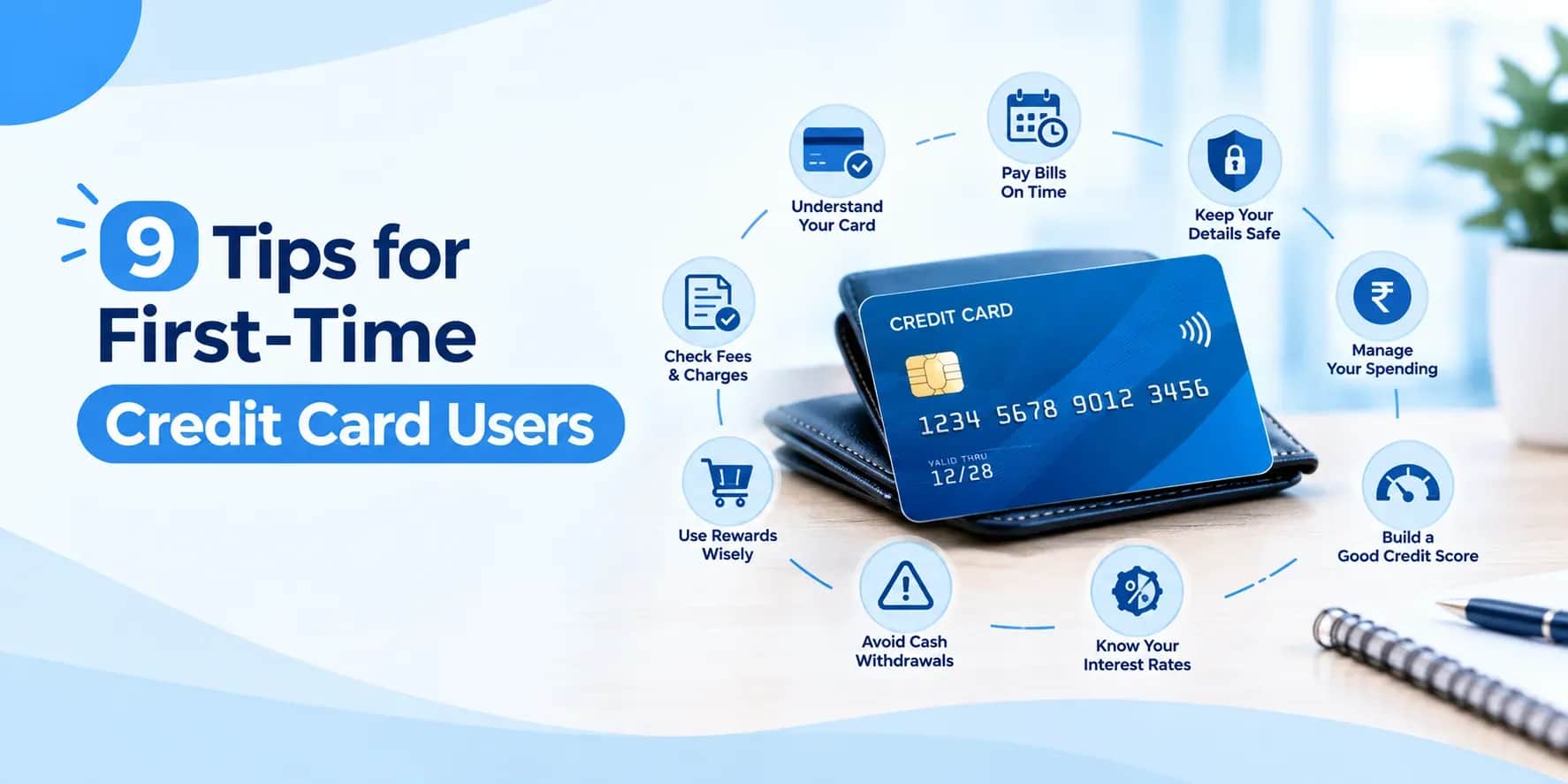
Credit cards can be useful in emergencies or when making purchases, allowing people to pay with available credit rather than their own funds immediately. However, the amount needs to be repaid to the issuer by the payment due date specified in the credit card statement. Moreover, for first-time credit card users, it is very important to consider certain things to avoid causing any harm to your finances and credit report in the future. In this blog, we will discuss 9 important credit card guides for first-time credit card users.
Key takeaways:
A credit card is a financial tool that helps banks or credit card issuers lend you money for a short period as a loan. These short-term loans may come with interest rates, other fees, and terms as per the lender’s policy, which vary. So, it is very important for the credit card user, especially the first-time credit card user, not to overlook such important aspects.

A credit card offers the facility of rewards, cashbacks, and other multiple offers. These features may vary from one card to another. One can gain these cashbacks or reward points after purchasing something or using a credit card to gain other benefits.
A credit card offers a short-term loan that one needs to repay, but when? This is totally dependent on the lender's policy. Every credit card has a billing cycle during which transactions are recorded, followed by a statement and a specific payment due date by which the amount needs to be repaid.
A credit card helps people during an emergency situation. This is because situations are unpredictable, but funds are needed. There can be situations where you might need funds but may not have enough money available. Therefore, credit cards can pay during those emergency situations, like medical bills, travel issues, etc.
Multiple credit cards may offer security and insurance, like travel insurance for borrowers to protect them from unexpected experiences. These insurance benefits and other protections may vary from one card to another, depending on the lender’s terms and conditions.
A credit card can be used for digital payments. It makes the payment method more convenient for people and motivates them to move cash-free anywhere.
Hence, these are the major features of credit cards.
To use a credit card properly, it is important to understand how you should handle the credit card, when to use it, etc. Therefore, in this paragraph, we will help beginners understand credit card tips as a smart credit card guide.

Getting the first credit card is not as challenging as handling it. You need to understand your finances before using it. Make sure you use your credit card only for an amount that you can comfortably repay without putting pressure on your budget or savings. Therefore, it is important to analyse your finances or budget before using your credit card.
Getting a credit card comes with a responsibility to maintain it. Every credit card has a billing cycle where you repay the amount used for any reason. If you pay the full amount on time, you can save yourself from the interest rate applied to the credit card as per the lender’s policy. Timely payment can also build your credit history to support future borrowings. Therefore, it is important to know to use only a sufficient amount from the credit card that you can repay in full at the end of the billing cycle.
Nobody wants to be embarrassed in front of others, indicating that you can’t use your financial tool due to a credit limit. Especially while shopping or paying bills. Therefore, it is very important to check your credit limit before using your credit card anywhere. If you need more money for any reason, you may contact your lender for a limit extension and can follow the further steps as per the lender’s assessment and requirements.
Credit cards highly support digital payments, and one needs to make sure to keep the payments digital or online rather than withdrawing cash from ATMs. Credit-card cash withdrawals may attract cash-advance fees and finance charges. Interest may accrue from the date of withdrawal, depending on the card’s terms. So, to avoid the financial shock of withdrawing money from the credit card, try to keep the transaction digital.
It is very important to use the right credit card at the right time. Using a travel credit card for shopping if you are a shopaholic might be wrong. Therefore, it is important to understand where you spend more money, and using your credit card according to it can be beneficial.
*T&C Apply
Every credit card has a credit limit, like ₹100,000, ₹150,000, etc., as per the lender’s assessment. You should keep your credit card spending low. This is because if you spend the maximum on the credit card, it can financially burden you while making repayments. Multiple factors affect this, such as the interest rate, other charges, the repayment period, etc. So, if the repayment amount is lower and you can pay it in full on time, then you can save yourself from paying interest. Otherwise, it may lead to a greater financial burden. Hence, using the credit card in small amounts can benefit the users themselves.
It is true that credit cards may fund you during emergencies or times when you do not have sufficient money. But this does not mean you should be completely dependent on credit cards. Recurring usage can burden you with repayment of the credit card bill. Therefore, try to keep an emergency fund as a backup to credit cards.
It is important to avoid sharing sensitive credit card details with others, as this may increase the risk of fraud or unauthorised transactions. Sharing sensitive card or authentication information, such as your card number, CVV, PIN, or OTP, may increase the risk of unauthorised transactions or data misuse. To prevent any such activities, do not share your credit card-related information with another person.
Even after getting your first credit card, it is important to understand its terms and conditions. You must read the booklet that may come with your new credit card. This is because it highlights important terms and conditions that may affect your credit card usage. So, to create awareness, it is important to read the credit card booklet.
Hence, these are the 9 important guides for first-time credit card users.
A credit card is not a financial tool that does not need consideration. If you have a credit card, especially your first credit card, it is important to understand how carefully you need to use it. Moreover, a borrower needs to use a credit card in such a way that does not cause any financial burden on them or hurt their credit score. A smart move is enough to prevent upcoming bad financial situations.
A credit card is a financial tool that allows eligible borrowers to take short-term loans.
The two major functions of a credit card are that it provides short-term funds to people and also provides rewards and cashback after its use, as per the lender’s terms and conditions and card types.
Yes, it is necessary to use the credit cards responsibly because if you manage your credit card improperly, this may hurt your credit record and also cause financial burdens.
The major benefits of using a credit card are that it provides instant funds in emergency situations, offers rewards to people, and the payment method is simpler.
Every lender has their own terms and conditions for the borrowers to offer the credit card. Hence, there is no standard eligibility offered by all the banks.
Use your credit card responsibly and make timely and full repayments by the payment due date specified in the statement.
If you use your credit card to its full capacity, you may face a financial burden because you have to repay those amounts to the lender at the end of the billing cycle.
You can extend your credit limit depending on your current financial condition, the lender’s policy, and assessment.
Getting a credit card is a personal choice and depends on your financial needs. There is no mandatory requirement to get a credit card.
Yes, several lenders may provide different credit card variants to eligible people as per their requirements, assessments, and policies.