Check AI Loan Optimisation Plans to Reduce Your EMI

Disclaimer: The information published on LoansJagat is intended for general informational and educational purposes only and should not be considered financial, legal, or investment advice. Interest rates, loan terms, statistics, and other data may change over time and may vary by lender or source. Please verify the latest information and consult a qualified financial advisor or the respective Bank/NBFC before making any financial decisions.
Subscribe Now
About the author

Vaishnavi is a Financial Content Writer at LoansJagat. She holds a B.Sc. and an M.Sc. She has experience in writing SEO-focused content across finance. At LoansJagat, Vaishnavi writes on banking, loans, personal finance, and insurance. Her work involves researching financial topics, understanding user search intent, and creating content that is clear and accurate. She has experience in SEO content writing, keyword research, content optimisation, and AEO.
Related Blog Post
Simplify All Your Loans Into One Affordable EMI

Customers Served

Debt Consolidated

1200+ Reviews

Locations in India
Club all Loans & Credit Card Bills into Single EMI

Quick Apply Loan
Consolidate your debts into one easy EMI.

Takes less than 2 minutes. No paperwork.

10 Lakhs+
Trusted Customers

2000 Cr+
Loans Disbursed

4.7/5
Google Reviews

50+
Banks & NBFCs Offers
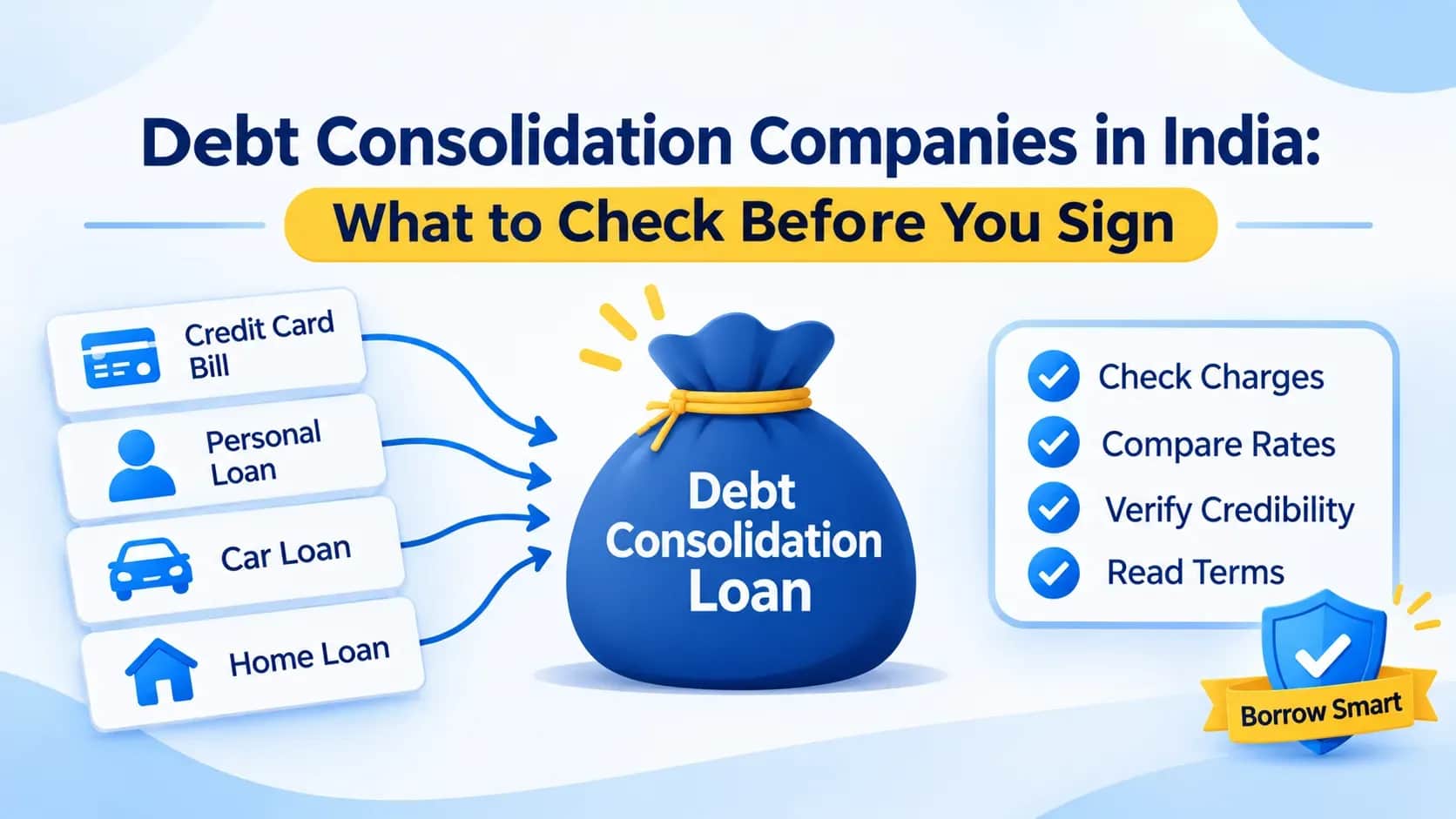
Managing multiple loan EMIs and credit card payments can make monthly finances difficult to organise. A debt consolidation loan may help eligible borrowers combine selected outstanding dues into one repayment. However, choosing the right lender requires more than comparing the proposed EMI. Interest rates, processing fees, repayment tenure and loan conditions can affect the total cost significantly. Before signing an agreement, understand the lender’s credentials, compare available offers and check whether the new repayment arrangement suits your financial position.
Key Takeaways
Debt consolidation companies help borrowers explore ways to combine multiple outstanding dues into a single repayment arrangement. This may involve taking a new personal loan to repay existing personal loans, credit card balances or other eligible liabilities.
Banks and Non-Banking Financial Companies (NBFCs) can provide loans for this purpose. Some lenders offer dedicated debt consolidation products, while others provide personal loans that eligible borrowers may use to manage existing financial commitments.
It is important to distinguish between a direct lender and a loan marketplace:
Understanding this difference helps you identify who is responsible for the loan agreement, repayment terms and grievance resolution.
Borrowers can explore dedicated debt consolidation products or personal loan options, depending on their financial requirements and eligibility. The following institutions have different offerings.
IDFC FIRST Bank offers a dedicated debt consolidation personal loan through its FIRSTmoney product. Eligible borrowers can use the loan amount to repay multiple outstanding dues and manage them through a single EMI.
The bank lists features such as an unsecured loan facility, a digital application process and repayment tenures ranging from 9 to 60 months. Its published interest rates start from 9.99% per annum, subject to eligibility and the final offer.
The bank also specifies applicable processing fees and other charges. Borrowers should check the latest IDFC FIRST Bank debt consolidation loan details, including eligibility, fees and repayment conditions, before applying.
Tata Capital offers personal loans that eligible borrowers may explore to manage existing financial commitments. A borrower with ongoing loans may still apply, but approval depends on income, existing obligations, repayment history and credit profile.
Its personal loan offering includes unsecured borrowing and flexible repayment tenures. The interest rate and applicable charges depend on the applicant's profile and the terms of the offer.
Tata Capital does not need to be treated as a dedicated debt consolidation provider for borrowers to consider its personal loan options. Anyone considering this route should first confirm whether the proposed loan can be used for their intended repayment purpose.
Review the latest Tata Capital personal loan details and interest rates and charges before making a decision.
The products, rates, fees and eligibility conditions mentioned above are subject to change. Refer to the respective lender's official website and sanction letter for current terms.
Selecting a provider requires you to assess the complete loan arrangement. A convenient application process or an attractive EMI should not be the only deciding factors. Review these aspects before proceeding.
First, identify the organisation offering the loan. Check whether it is a bank, an RBI-registered NBFC or a loan marketplace working with lending institutions.
If you are applying through an aggregator, find out which bank or NBFC will actually provide the loan. Check the lender's official website and verify that the loan offer is genuine.
You should also confirm:
Never rely only on a brand name or a verbal assurance. The actual lending institution and its terms should be clearly disclosed.
The interest rate determines how much you pay for borrowing. However, comparing interest rates alone may not give you the complete cost of a loan.
Check the Annual Percentage Rate (APR), which reflects the interest rate along with applicable charges and costs included in the calculation. It provides a broader view of the borrowing cost.
Before accepting an offer, compare:
A new loan may offer a lower interest rate than your existing dues. However, check the complete repayment cost before deciding whether consolidation is financially suitable.
A debt consolidation loan may involve charges beyond interest. These costs can reduce the financial benefit of replacing existing loans.
Ask the lender for a complete breakdown of applicable fees, including:
For example, a loan with a comparatively attractive interest rate may involve a higher processing fee. Include these costs when calculating the total amount payable.
Do not proceed until you understand which charges apply, when they are collected and whether they are refundable.
The repayment tenure affects both your monthly EMI and total interest payable. A longer tenure may reduce the monthly instalment, but it can increase the total interest paid over the loan period.
Compare the proposed EMI with your current combined monthly repayments. Also check whether the new tenure extends repayment beyond the remaining periods of your existing loans.
Consider these questions:
Choose a repayment period that balances monthly affordability with the overall cost of borrowing.
Lenders assess applications based on factors such as income, employment, credit history, existing EMIs and repayment capacity. Meeting the basic eligibility conditions does not guarantee approval.
You should also confirm which dues can be covered by the proposed loan. Depending on the lender's product and policy, eligible liabilities may include personal loans, credit card outstanding balances or other forms of borrowing.
Before applying, check:
If the approved amount is insufficient to clear the selected dues, you may continue managing multiple repayments. Check the amount required for closure before deciding how much to borrow.
Read the loan agreement and sanction letter carefully before accepting the offer. These documents explain the terms that will govern your borrowing and repayment.
Pay attention to:
Also check whether the lender requires any specific process for closing your existing loans. Retain the closure statements or no-dues certificates after clearing the old accounts.
Do not sign an agreement with blank fields or unclear clauses. Ask the lender to explain any condition you do not understand.
Loan applications involve sharing personal and financial information, including identity documents, income details and bank statements. Check how the provider collects, processes and shares this information.
Use official websites and verified application channels. Avoid sharing sensitive information through unknown links, personal email addresses or unverified messaging accounts.
If you are applying through a marketplace, read its privacy policy and understand whether your information may be shared with lending partners for evaluating loan offers.
Never share your OTP, PIN or banking password with anyone claiming to arrange a loan.
Reliable customer support matters throughout the loan lifecycle, not just during application. You may need assistance with repayment schedules, account statements, loan closure or incorrect charges.
Before signing, check whether the lender provides:
If you apply through an aggregator, understand which queries it can assist with and which must be directed to the lending institution.
Be cautious of providers promising guaranteed loan approval, assured savings or a specific interest rate without assessing your profile. Loan approval and terms depend on the lender's credit assessment.
Avoid paying money to individuals or unauthorised agents who promise to arrange approval. Verify any fee directly with the lending institution through its official channels.
Ask for written details of the offer, including the interest rate, charges and repayment conditions. If the provider cannot explain these details clearly, do not rush into signing an agreement.
Once you have shortlisted suitable options, compare them using the same loan amount and repayment period wherever possible. This makes it easier to understand the differences between offers.
You should also calculate the total amount payable under the new loan and compare it with the remaining repayment cost of your existing dues. For example, a lower EMI may appear attractive because the new loan has a longer tenure. However, the additional interest over the extended period could make the arrangement more expensive.
Consider consolidation only after accounting for outstanding balances, foreclosure charges on existing loans, new loan fees and the total repayment amount. The objective should be to make repayments more manageable without increasing the overall cost unnecessarily.
LoansJagat is a digital loan consolidation marketplace that helps borrowers explore loan options from its network of 50+ banking partners, including banks and NBFCs.
Instead of approaching multiple lending institutions separately, borrowers can explore available options through the platform. This can help them understand which offers may match their financial profile and repayment requirements.
LoansJagat's role is to facilitate access to loan options and comparisons. It does not function as a bank or NBFC. The partner lending institution independently evaluates the application, determines eligibility, decides the interest rate and loan amount, and handles sanction and disbursal.
Before accepting any offer through the platform, review the lending partner's terms, charges and repayment conditions. You can explore loan consolidation options on LoansJagat and compare available offers, subject to lender eligibility and terms.
Choosing a debt consolidation provider requires careful evaluation of the lender, borrowing cost and repayment conditions. Compare the total repayment amount rather than focusing only on the proposed EMI. Read the agreement, understand all applicable charges and confirm which institution will provide the loan. A well-considered decision can help simplify repayments while keeping your financial commitments manageable.
A lender, such as a bank or NBFC, provides and sanctions the loan. A loan marketplace helps borrowers explore and compare offers from lending partners. The lender remains responsible for the loan agreement, disbursal and repayment terms.
Some lenders allow eligible borrowers to use a personal loan to repay multiple personal loans and credit card outstanding balances. However, the types of dues covered depend on the lender's product and policies. Confirm this before applying.
Applying for a new loan may lead to a credit enquiry, which can affect your credit score. Closing existing dues and making timely repayments on the new loan may support healthier credit management over time. The actual impact depends on your credit profile and repayment behaviour.
You may be eligible, depending on your income, existing EMI commitments, credit history and repayment capacity. The lender will assess your overall financial position before deciding whether to approve the application.
Compare the interest rate, APR, processing fees, EMI, tenure and total repayment amount. Also review prepayment conditions and other charges. Do not select an offer based only on the lowest monthly EMI.
It may be useful when the new loan offers manageable repayment terms and a suitable overall borrowing cost. It may not be appropriate if the new loan increases total interest, involves high charges or encourages further borrowing.
Start your journey today
Apply Now*T&C apply