By continuing, you agree to LoansJagat's Credit Report Terms of Use, Terms and Conditions, Privacy Policy, and authorize contact via Call, SMS, Email, or WhatsApp
Disclaimer: The information published on LoansJagat is intended for general informational and educational purposes only and should not be considered financial, legal, or investment advice. Interest rates, loan terms, statistics, and other data may change over time and may vary by lender or source. Please verify the latest information and consult a qualified financial advisor or the respective Bank/NBFC before making any financial decisions.
Subscribe Now
About the author

Anishka Bhadly is a content writer with a finance and business background. She has completed her bachelor's degree with a specialisation in finance and is currently pursuing an MBA in the finance field too. The knowledge she has gained from her studies and experience working with EdTech companies helped her combine theoretical knowledge with practical industry insight. Her expertise lies in creating well-researched, informative, and reader-friendly content in various banking, personal finance, loans, insurance, and investment-related topics.
Related Blog Post
Simplify All Your Loans Into One Affordable EMI

Customers Served

Debt Consolidated

1200+ Reviews

Locations in India
Club all Loans & Credit Card Bills into Single EMI

Quick Apply Loan
Consolidate your debts into one easy EMI.

Takes less than 2 minutes. No paperwork.

10 Lakhs+
Trusted Customers

2000 Cr+
Loans Disbursed

4.7/5
Google Reviews

50+
Banks & NBFCs Offers
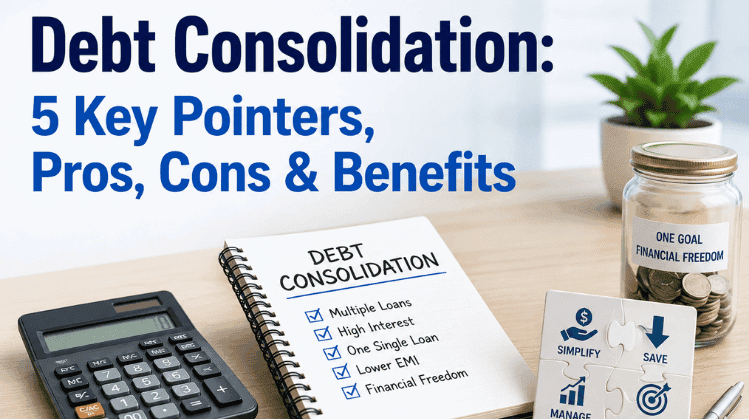
'Debt consolidation' refers to the combining of multiple debts, like personal loans, credit card bills, or any dues, into a single payment scheme. This single payment scheme could be a loan, which provides a lower interest rate than other forms of debt. This helps in managing debts more easily, as it is easier to deal with a single entity. However, there are both pros and cons to debt consolidation. For instance, although a lower interest rate could save you some money, a longer tenure could mean more interest to be paid overall. Processing fees and other charges are also incurred.
Debt consolidation can ease the repayment of multiple outstanding debts. The following are the five benefits of consolidating debts to repay them:
With debt consolidation, you would have only one EMI to pay instead of several EMIs for different debts. Furthermore, you would also know precisely how much you have to pay as a consolidated EMI. Having a single EMI can make repayment easier to plan and manage, so long as the new terms are affordable.
Debt consolidation does not automatically imply a lower interest rate. It only means that you pay off your old debts (or some of them) with a new loan. The rate of the new loan should be compared with the rate at which you are borrowing now (or on average over the entire period of debt consolidation). For example, there is probably little sense in consolidating credit card debts with your credit card.
A consolidation loan is when an individual applies for a loan in order to pay off other debts that they may owe. This could impact an applicant's credit, as taking out any kind of loan would leave a hard enquiry on one's credit file and add another account to one's credit report. In contrast, paying off credit cards through the use of a consolidation loan could reduce one's credit utilisation rates and improve one's creditworthiness. Furthermore, maintaining monthly repayments on one's consolidation loan would positively affect one's credit score. However, consolidation loans do not necessarily improve an individual's credit score.
If the consolidation loan has a lower interest rate, you may be able to reduce the amount of interest paid on the debt and repay it early by making appropriate payments. However, at the same time, a longer repayment period may lead to much higher total payments and increased debt. For this reason, compare the new terms and the amount of money to be returned.
Having multiple loans to repay can be overwhelming as you might forget about one or more EMIs. With a consolidation loan, you only have to worry about a single EMI. You would also know how much to pay and when to pay it. Furthermore, it is also essential to remember that repayment of debts does not feel as stressful if you know that you have only one EMI to pay.
Debt consolidation can make managing debts easier and less stressful. At the same time, it can also help you save significantly on the interest paid on the debts.
Debt consolidation helps reduce the burden of repayment by enabling the conversion of multiple dues into a single instalment. However, like every measure, it also has its advantages and disadvantages. It is essential to consider both aspects before finalising any decision related to debt consolidation.
Debt consolidation may be a good option if the new loan has better repayment conditions and terms. The borrower must evaluate the interest rates, repayment period, processing fees, and overall cost of the new loan to ensure that it is a better option than the existing debts.
Debt consolidation can be a good option when the existing debts are becoming difficult to manage. Before considering consolidation as an option, it is important to understand the factors that determine the need for debt restructuring.
Debt consolidation should be considered as an option when it facilitates easier repayments without adding to the quantum of outstanding debt.
LoansJagat enables borrowers to know more about the loans that can help them consolidate their debts. It helps the borrowers to compare different attributes like interest rates, the loan amount, monthly instalments, and tenure of the loans for their debts. The website then helps the borrowers to understand if that particular instalment is the right choice for them according to their financial status by giving the overall cost details of taking that loan.
Our portal helps users to consider the entire cost of borrowing rather than just the EMI and assists with debt consolidation decisions that allow borrowers to repay their debts with greater ease.
Consolidation of debts may make repayment easier and save you money in case the new loan has advantageous terms. However, if the tenure of the new EMI is longer, a lower rate might not be beneficial. Always compare the interest rate, processing fees, tenure, and overall amount payable for both loans before consolidating debts, as EMI consolidation does not reduce the total amount of debt.
Debt consolidation consists of consolidating several debts through a new contract, in a single payment by the debtor, and the subsequent receipt of instalments according to the new contract terms.
Debt consolidation can be a good choice if the new repayment terms are favourable to you, that is, affordable to you and provide more benefits than previous ones. It is also essential to calculate the total repayment amount to see if a particular method is cost-effective.
According to the service you choose, credit card debt, personal loans, or other types of unsecured debts can be consolidated.
Your interest cost could decrease if the consolidation loan has a lower effective interest rate than the consolidated debts and the cost of the new loan does not reduce the interest savings.
Debt consolidation cannot necessarily enhance your credit score. New credit applications and accounts can negatively affect one’s credit rating, and paying off charged-off accounts may lower utilisation. However, consistently meeting payments on the consolidated loan can help establish a positive payment history.
Consider consolidation if you have multiple debts that are hard to repay and a new loan can help you pay them off in a more convenient way. Compare the total amount you'll need to pay, duration, and other conditions of the new credit contract.
Some disadvantages include processing fees, a longer repayment period than credit cards, more interest to be paid, credit enquiries, and the temptation to use cleared credit cards again.
If approved for the consolidation loan and structured for such a purpose, then the new consolidated loan can indeed pay off qualifying debts, leaving you with only the new consolidated loan to pay.
It depends on the requirements set by the lender, your income, liabilities, and credit history. If you have a low credit score, you may have fewer options available.
LoansJagat can help you compare relevant loan products and understand the difference in terms of interest rates, EMIs, repayment tenure and other costs associated which will enable you to make a more informed decision on taking a debt consolidation loan.