By continuing, you agree to LoansJagat's Credit Report Terms of Use, Terms and Conditions, Privacy Policy, and authorize contact via Call, SMS, Email, or WhatsApp
Disclaimer: The information published on LoansJagat is intended for general informational and educational purposes only and should not be considered financial, legal, or investment advice. Interest rates, loan terms, statistics, and other data may change over time and may vary by lender or source. Please verify the latest information and consult a qualified financial advisor or the respective Bank/NBFC before making any financial decisions.
Subscribe Now
About the author

Vidhi Chauhan is a copywriter and content writer with extensive experience creating high-quality, SEO-driven content across multiple industries, with a strong focus on fintech. She has written extensively on GST, banking, personal loans, business loans, credit cards, income tax, insurance, and other financial topics, helping Indian readers understand complex concepts through clear, accurate, and engaging content.
Related Blog Post
Simplify All Your Loans Into One Affordable EMI

Customers Served

Debt Consolidated

1200+ Reviews

Locations in India
Club all Loans & Credit Card Bills into Single EMI

Quick Apply Loan
Consolidate your debts into one easy EMI.

Takes less than 2 minutes. No paperwork.

10 Lakhs+
Trusted Customers

2000 Cr+
Loans Disbursed

4.7/5
Google Reviews

50+
Banks & NBFCs Offers
An online debt consolidation loan enables an individual to take out a single loan from which various outstanding debts can be repaid. This online method of borrowing does not necessarily have to involve all the processes that accompany traditional loans. Some of these may include application, submission of documents, and verification, which can now be done online. Despite their convenience, online debt consolidation loans do not necessarily imply cheaper borrowing. It is crucial to know the interest rate, fees, loan term, loan requirements, and repayment amounts before taking up an online debt consolidation loan.
Be careful about your budgeting to avoid being trapped in debt again.
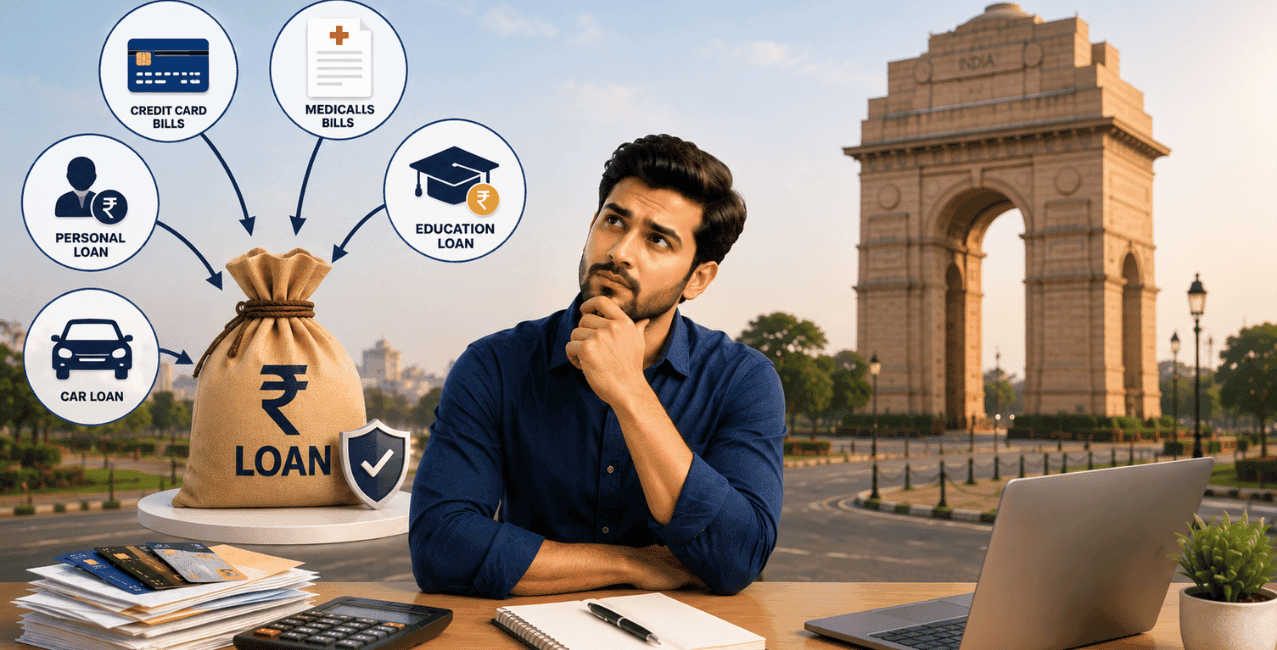
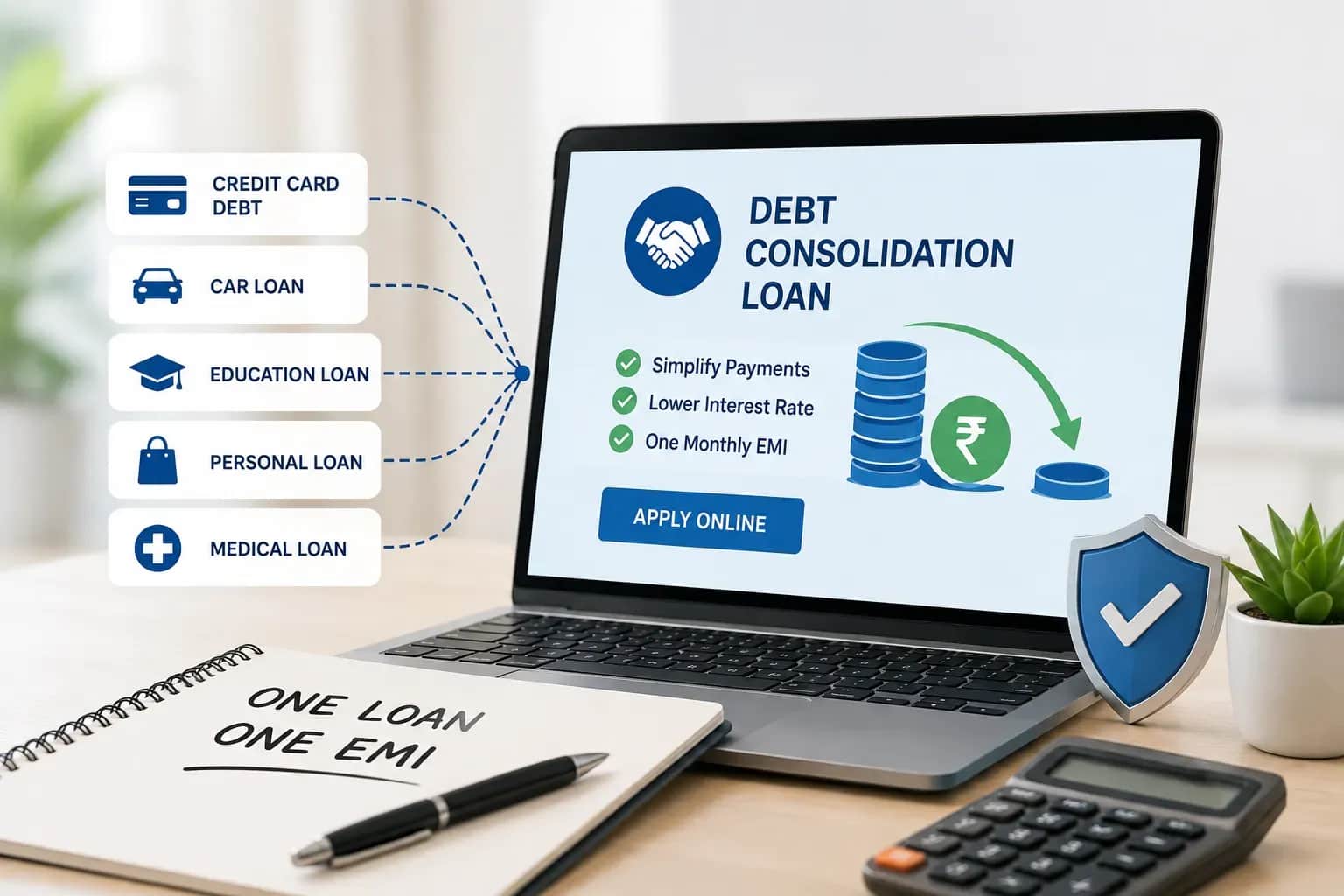
An online debt consolidation loan is a loan that can be applied for using the lender's website or mobile app to consolidate several debts into a single repayment liability.
Instead of repaying multiple EMIs individually, the borrower can use the loan amount to settle the eligible existing debts. The borrower then starts making repayments towards the consolidated loan, taking into account its duration and interest rate.
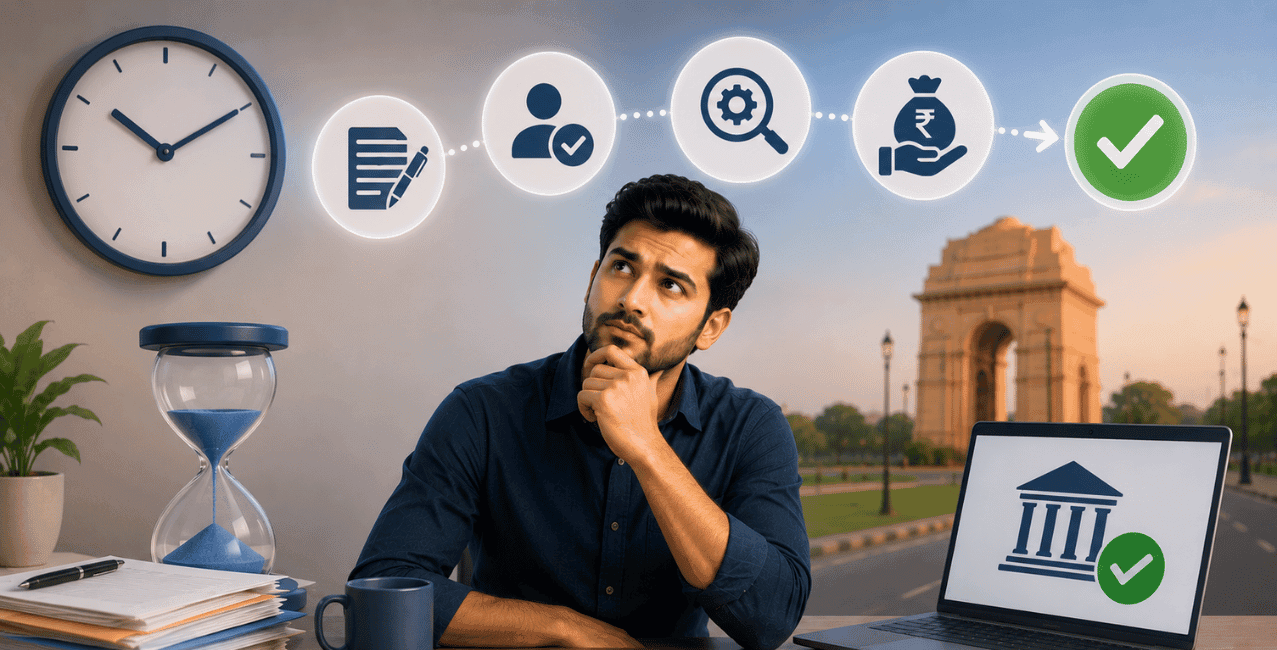
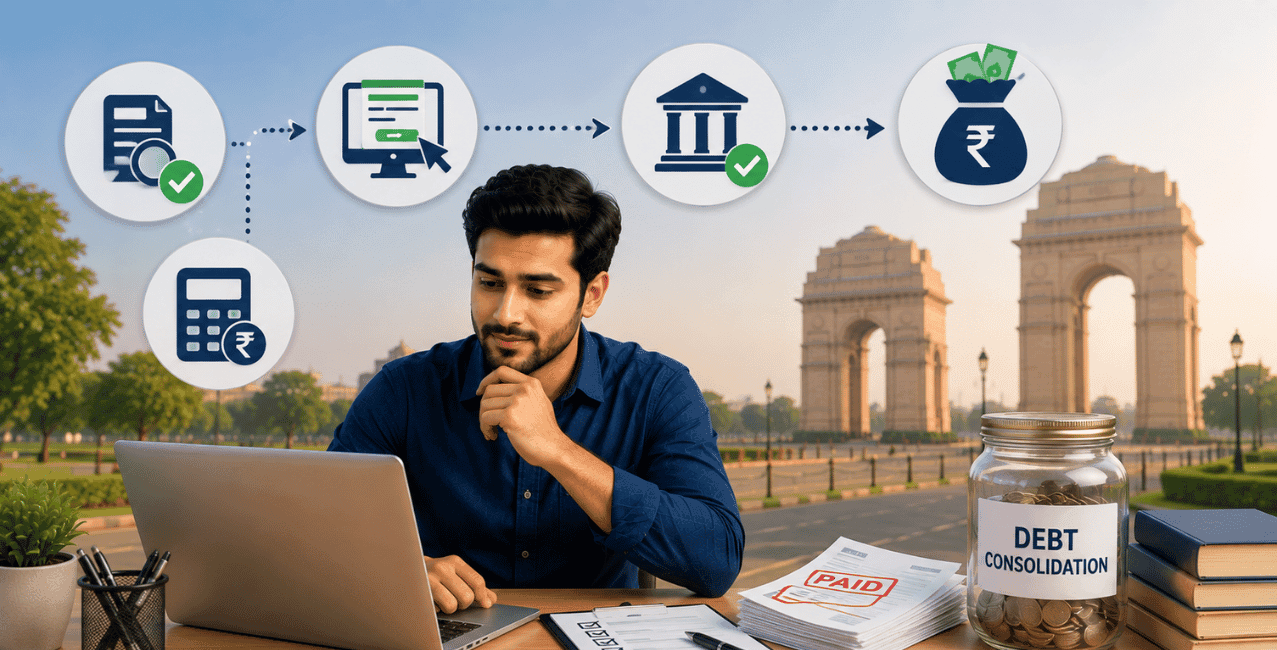
As per the lender, the following are the primary steps in the whole procedure, which can be completed digitally:
‘100% online’ doesn't necessarily mean that all lenders make it mandatory to remove physical verification.
Also Read: Debt Consolidation Loan Eligibility: Check Criteria & Documents Required
Yes, several online lending institutions provide a Video-based Customer Identification Process (V-CIP) for the online loan application process. According to the guidelines provided by the RBI, a V-CIP process is equivalent to a face-to-face identification procedure within its KYC guidelines.
Within the Video KYC process, the borrower is likely to communicate with an authorised agent over an audio-visual call session. The process also involves authentication of one's identity through various procedures to confirm that the individual conducting verification is authentic.
The borrowers are expected to ensure that they have their documents handy and that they have a reliable internet connection and adequate lighting at their place.
This will vary based on the lender and profile of the individual applying for the loan. However, some of the common documents that may be required include:
It is good to have these documents prepared prior to initiating the application process.
The loan application can usually be made as per the following steps:
Step 1: Calculation of Outstanding Debt
You should first list out all the personal loans, credit card balances, and other such eligible unsecured debts that you want to consolidate. You must take note of the outstanding principal amount, interest rate, EMI, and tenure for each debt.
Step 2: Eligibility Assessment
Before you make a complete loan application, check whether the lender offers an eligibility assessment based on a soft enquiry. A soft enquiry, where used, does not affect your CIBIL score. However, not every lender offers a soft enquiry-based eligibility check, so confirm the lender's process before proceeding.
Step 3. Submit Online Application
Provide all mandatory personal, employment, and financial information via the lender’s website/application. Ensure that the provided data is consistent with official documents to minimise the chances of authentication errors.
Step 4. Attach Mandatory Documents
Upload mandatory documents like PAN card, proof of identification, income-related proof, and current bank statements. Providing readable documents will help prevent any processing delays.
Step 5. V-KYC
In case the lender offers the V-CIP option, you will have to undergo live video authentication. While V-CIP can allow customer identification to be completed digitally, it does not necessarily rule out the need for additional physical verification. The lender may require an offline step depending on its process and applicable requirements.
Step 6. Examine the Offered Loan
Don’t take an offer just because it offers you a lower EMI. Consider the interest rates, processing fee, tenure, total repayments, and foreclosure conditions, along with all the other related costs.
The Key Fact Statement (KFS) also needs to be considered carefully because it contains important details about your loan’s terms and costs.
Step 7. Obtain the Loan and Pay Off Your Existing Debts
Once you get approved for the loan, it will be disbursed based on the conditions set by your lender. You can use the loan amount to pay off your existing eligible debts and consolidate them into one. After making the required repayments, make sure that the outstanding balances with the old lenders have actually been paid off and that the respective accounts are closed or updated as applicable.
Being online does not necessarily mean that the loan will come at a cheaper cost. This will depend on factors like interest rate, processing cost, repayment period, and other costs.
The reduced EMI might seem alluring, but it can just be the effect of an increased repayment period. An extended repayment period will mean more total interest being paid despite having a reduced EMI.
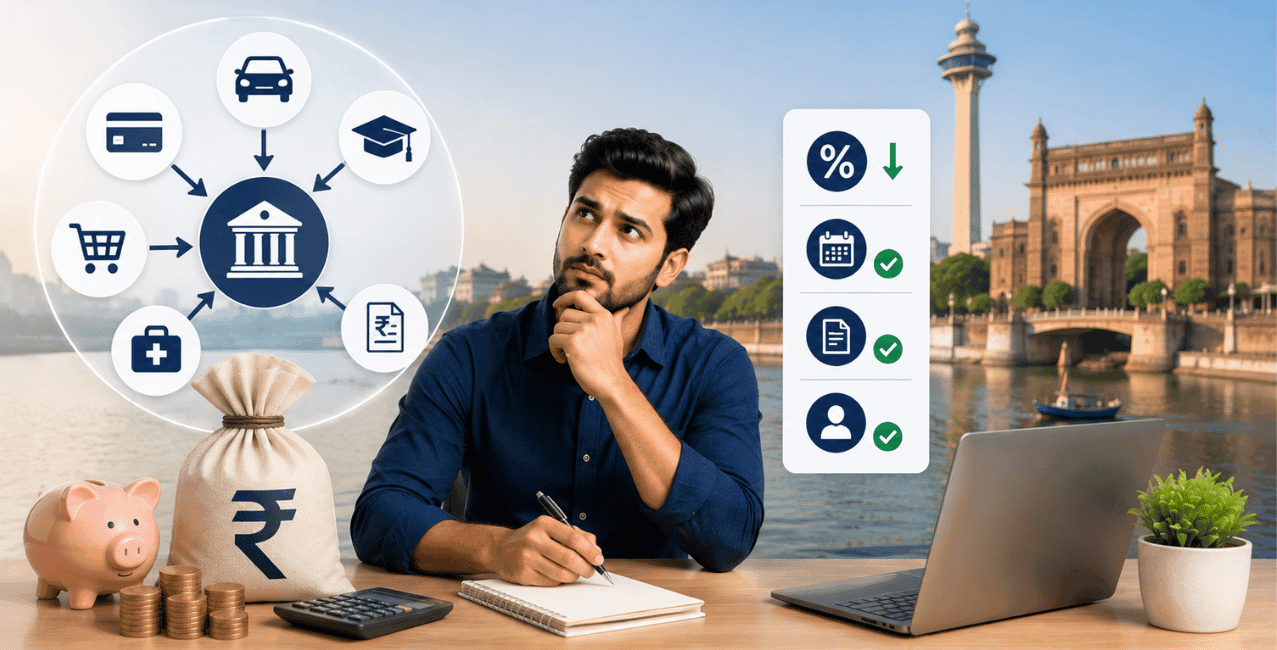
When changing to the consolidation loan, consider the following:
*T&C Apply
The aim should be to simplify repayments without making the process more costly.
Even though applying online is convenient, borrowers can encounter some problems as well.
The following checklist may come in handy while considering taking an online debt consolidation loan:
LoansJagat makes debt consolidation easy for people through an online platform that enables comparison of loan amounts, interest rates, tenure, qualification, and fees for various loans. The process is very easy since it saves time and allows people to find out which type of loan suits them.
The convenience of having a consolidation loan to pay off debts should be weighed against affordability. It is essential that borrowers compare different loans and fully comprehend what their lenders require before applying for such a loan. This way, people will be able to repay their debts in a structured manner without imposing additional financial stress on themselves.
The process of taking out a new loan will temporarily impact your credit score because the lender can list the loan on your credit record. But with regular repayments made on schedule, you will build up a better credit score eventually.
It is possible depending on whether the lender allows credit card debts to be consolidated through the loan. You should check the list of eligible debts allowed by the lender before submitting your application.
Your existing accounts will typically be closed or settled once the outstanding balances are paid off in full. This depends on the procedures followed by the lenders.
Lenders who offer debt consolidation products targeted at such borrowers can accept self-employed loan applicants. Their eligibility will be determined based on parameters such as income from business, financial history, banking background, and ability to repay.
It will be challenging to make monthly installments if the income varies greatly month-by-month. Loan applicants need to determine if they have enough cash flow to sustain the repayment over the course of the loan.
Debt consolidation products do not always allow consolidation of both types of debt into one loan. Applicants are supposed to review the conditions offered by lenders, as some may limit consolidation to certain types of unsecured debt.
Debt consolidation entails replacing your debt with a new repayment program, whereas debt settlement is settling a debt by means of negotiating for less money than owed. Debt consolidation vs debt settlement may lead to different outcomes when it comes to your finances and credit score.
The option of making additional payments or partial prepayments depends on the loan terms that are available for the particular lender. It is recommended to check the terms and conditions before making an additional payment.
Just because your loan application is denied, it doesn’t mean that you won't be able to obtain a loan in the future. Find out why your loan was denied and avoid sending multiple applications right away.
It is advisable to create a practical budget for yourself, as well as to try to avoid borrowing money to stop yourself from getting into more debt.