By continuing, you agree to LoansJagat's Credit Report Terms of Use, Terms and Conditions, Privacy Policy, and authorize contact via Call, SMS, Email, or WhatsApp
Disclaimer: The information published on LoansJagat is intended for general informational and educational purposes only and should not be considered financial, legal, or investment advice. Interest rates, loan terms, statistics, and other data may change over time and may vary by lender or source. Please verify the latest information and consult a qualified financial advisor or the respective Bank/NBFC before making any financial decisions.
Subscribe Now
About the author

Vaishnavi is a Financial Content Writer at LoansJagat. She holds a B.Sc. and an M.Sc. She has experience in writing SEO-focused content across finance, digital marketing, education, and Ayurveda. Before joining LoansJagat, she worked with digital marketing agencies serving fintech clients and quick-commerce brands like Zepto and blinkit. At LoansJagat, Vaishnavi writes on banking, loans, personal finance, and insurance. Her work involves researching financial topics, understanding user search intent, and creating content that is clear and accurate. She has experience in SEO content writing, keyword research, content optimisation, and AEO. She enjoys simplifying complex topics into practical information that readers can easily understand and use. She believes that well-researched and reliable content plays an important role in helping people make informed financial decisions.
Related Blog Post
Simplify All Your Loans Into One Affordable EMI

Customers Served

Debt Consolidated

1200+ Reviews

Locations in India
Club all Loans & Credit Card Bills into Single EMI

Quick Apply Loan
Consolidate your debts into one easy EMI.

Takes less than 2 minutes. No paperwork.

10 Lakhs+
Trusted Customers

2000 Cr+
Loans Disbursed

4.7/5
Google Reviews

50+
Banks & NBFCs Offers
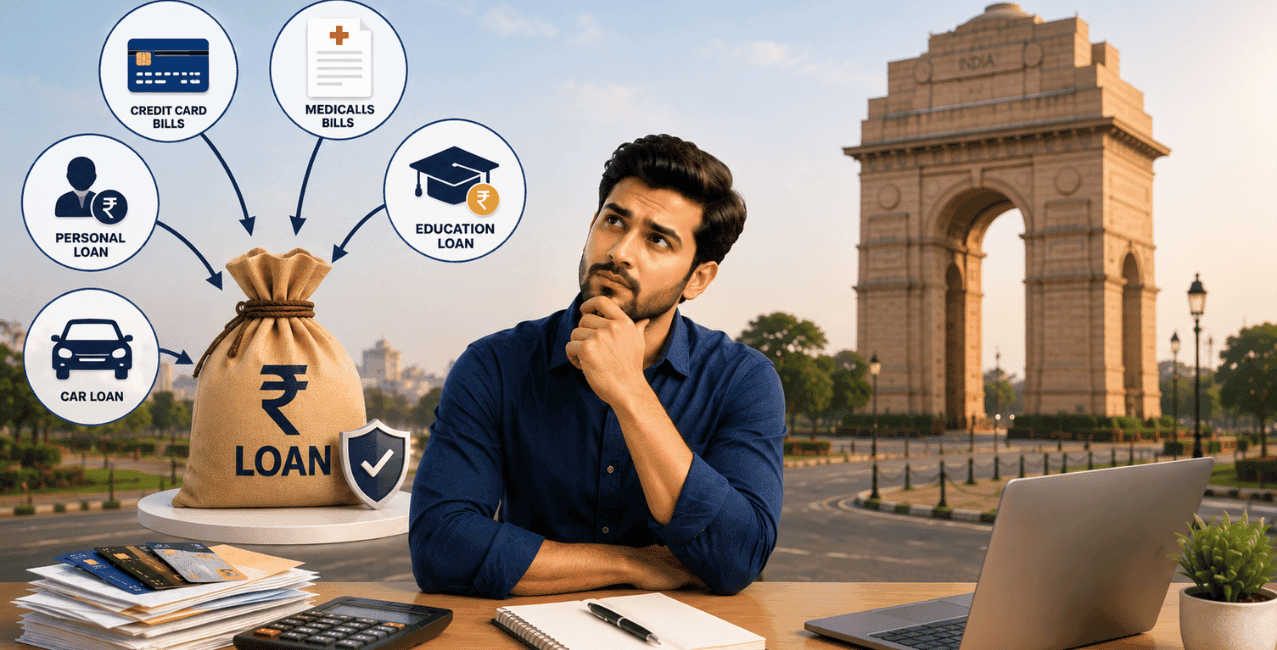
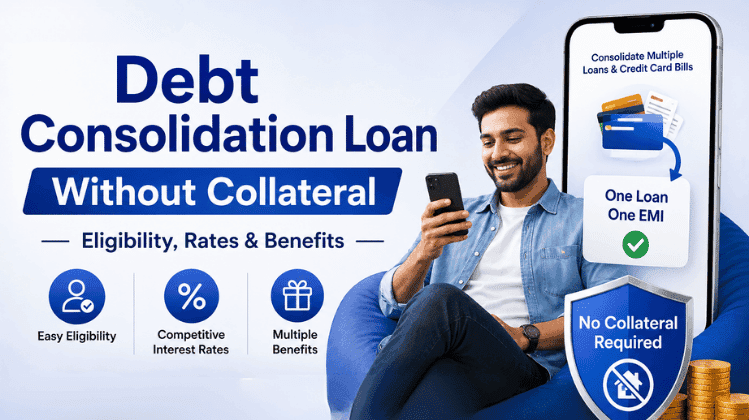
A debt consolidation loan without collateral is a personal loan you take without giving any house, gold or other asset as security. You use this single loan to clear all your other debts like credit cards and old personal loans. Once those old debts are paid off, you only have one EMI left to pay every month.
The lender checks your income and credit record before approving. The amount you get depends on how much you can repay each month. Tenure is decided by each lender. Many offer 12 to 60 months. Some go up to 72 or 84 months.
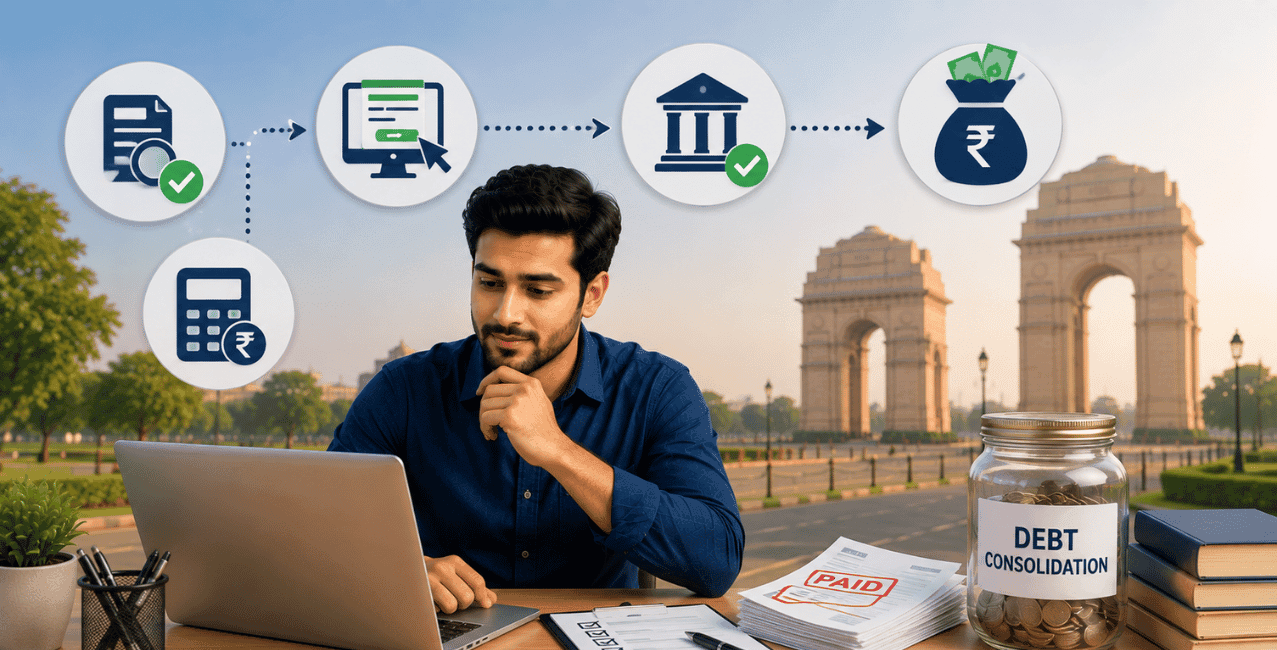
Start by writing down the exact amount you still owe on every debt. Then apply for a personal loan of that total size. When the loan gets approved, the money comes into your bank account. Use it at once to fully pay and close the old loans and credit cards. Keep the closure letters or NOC safely with you. After that you only pay the new EMI.
Most people apply online now. You share your basic details and papers. Approval time depends on the lender and your papers. Some online cases finish in a few hours or one day. Others take longer. The most important thing is to close the old accounts the same day the money arrives. If you leave them open you might start using those cards again. Close them fully and keep the proof.
Both people with regular jobs and people who run their own work can apply. You need steady income and a repayment record the lender accepts. People who carry many high interest debts often find this useful. If your present EMIs already take a large part of your salary, getting approval becomes harder.
This loan helps when you have high interest debts, mainly credit cards that often charge high interest (commonly 30% or more per year, set by each bank). When different due dates make you miss payments or feel worried, one new EMI can reduce the stress. It works well if the new interest rate is lower than what you pay now and if you decide not to take any new loan while repaying this one.
It may not help if your income keeps changing, if a longer tenure makes total interest higher, or if you plan to take new credit soon. In those cases the same problem can come back.
It is very useful if you don't make a mistake.
Interest rates are usually higher than loans that need an asset because the lender has no security. Processing fees of about 1% to 3% of the loan amount plus GST are common. When you apply, the lender checks your credit report and this can lower your score for a short time. If you choose a longer tenure only to reduce the EMI, you may pay more total interest. The biggest risk is that if your spending habits stay the same, new debt can start again. A longer tenure lowers the EMI but can increase the total interest paid.
The RBI does not set any fixed official limit for age, income, credit score or FOIR. Each bank or NBFC decides its own rules. Age, income and credit score rules are set by each lender. Common ranges are age 21–60, monthly income from around ₹15,000–₹30,000, and a score of 700 or higher for better chances. These are not fixed RBI rules. Some lenders accept lower scores but charge higher interest. Stable work for at least 6 to 12 months is preferred. Lenders want the new EMI plus your old EMIs to leave enough money for daily needs. You must be an Indian resident and have a valid bank account.
Documents Required
You will typically need:
Many lenders finish most of this work through digital KYC.
Lenders mainly check your credit score and how you repaid loans in the past, how steady your income is, and how much of your take-home pay already goes in EMIs. A higher score with on-time payments and steady work improves your chance of a better rate and higher amount. Exact cut-offs differ by lender. High existing EMIs, recent late payments or frequent job changes can lead to rejection or a higher rate. They also check if the new EMI will leave enough money for your daily expenses.
Interest rates for these loans usually start around 10% per year for people with strong profiles and can go up to 24% or more for average or weaker profiles. The exact rate depends on your credit score, income and the lender’s rules. Processing fees are set by each lender. Many charge around 1% to 3% of the loan amount plus taxes, but check the exact figure. Late payment charges apply if you miss an EMI.
Under RBI (Pre-payment Charges on Loans) Directions, 2025, from 1 January 2026 lenders cannot charge prepayment fees on floating-rate loans given to individuals for non-business purposes (loans sanctioned or renewed on or after that date). Fixed-rate personal loans may still carry such charges as per the lender’s policy. Always check the Key Fact Statement. Always check your Key Fact Statement. RBI requires every lender to give you a Key Fact Statement (KFS) before you sign. It shows the real yearly cost (APR), all fees and full terms in one place. Ask for it and read it carefully.
Finding the right loan is easy with LoansJagat. Instead of visiting different banks, you can compare offers from over 50 RBI-approved lenders in one place. You can check consolidation loans up to ₹50 lakh online. Their simple process helps you find the best rates to turn your scattered EMIs into one easy monthly payment.
This loan can make your debts easier to handle and lower the interest if you use it carefully. It works best when you have high interest debts, get a fair rate, and close the old accounts right away with the proof. Work out the full cost including fees, check it against what you pay now, and see that the new EMI fits your budget. Always ask for the Key Fact Statement before signing. If the numbers add up and you spend less, it can help you clear the debt with less stress. Remember that a longer tenure can cut the monthly EMI but raise the total interest cost.
Yes. Most debt consolidation loans in India are personal loans that need no house, gold or other asset as security.
It is very hard. Lenders usually reject people with recent defaults or a very low credit score.
Cut extra spending, use any savings to pay high-interest dues first, and try to earn some extra money if possible.
The negative mark may leave your credit report after seven years, but the debt itself does not disappear and lenders can still chase recovery.
Very high existing EMIs, unstable income, recent loan defaults, or a credit score that is too low often lead to rejection.
Focus on strict budgeting, talk to the lenders for possible settlement, or look for ways to raise your income.
Some NBFCs may still give it at a higher interest rate, but banks usually say no to low scores.
Yes. Many NBFCs offer unsecured personal loans that people use for debt consolidation.
It can help over time if you close the old accounts and pay the new EMI on time every month.
Many online applications give the money in a few hours to one or two days if your papers are ready.