Check AI Loan Optimisation Plans to Reduce Your EMI

Disclaimer: The information published on LoansJagat is intended for general informational and educational purposes only and should not be considered financial, legal, or investment advice. Interest rates, loan terms, statistics, and other data may change over time and may vary by lender or source. Please verify the latest information and consult a qualified financial advisor or the respective Bank/NBFC before making any financial decisions.
Subscribe Now
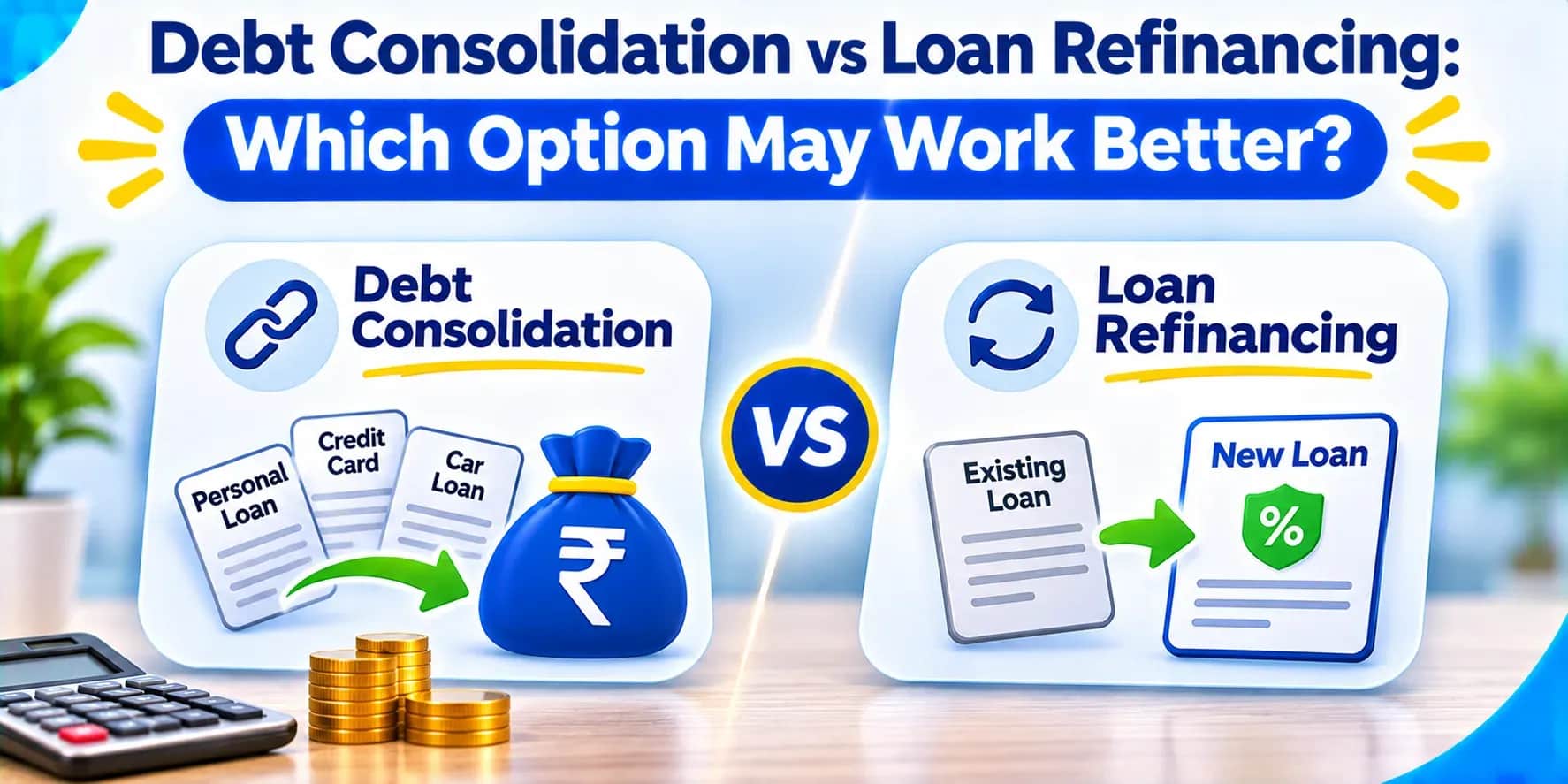
Managing multiple EMIs, keeping track of different due dates and paying high interest on existing loans can make monthly finances difficult to manage. Two options that may help are debt consolidation and loan refinancing. While both aim to make debt management easier, they work in different ways. Debt consolidation combines multiple debts into one repayment arrangement, whereas refinancing replaces an existing loan with a new one on revised terms. Understanding how they differ can help you choose an option that better fits your financial needs.
Key Takeaways:
The main difference between debt consolidation and loan refinancing is the number of debts involved. Consolidation focuses on combining multiple outstanding debts, whereas refinancing focuses on replacing an existing loan with a new borrowing arrangement.
Both options may help borrowers manage their financial commitments. However, neither automatically reduces the outstanding principal or guarantees lower borrowing costs. Potential savings depend on the revised loan terms, interest rates and applicable charges.
Loan refinancing involves replacing an existing loan with a new loan, potentially from the same lender or another financial institution. Borrowers generally explore this option to obtain more suitable interest rates, repayment tenures or other loan terms.
For example, suppose you have an outstanding personal loan of ₹5 lakh at an interest rate of 15% per annum. Another lender offers a refinancing option at 12% per annum, subject to eligibility and applicable charges.
You can compare the new loan's terms with your existing arrangement to determine whether switching makes financial sense.
Loan refinancing can offer several advantages when your existing loan no longer suits your financial needs. Depending on the new lender's terms, it may help you reduce borrowing costs, adjust EMIs, and manage repayments more comfortably.
Refinancing also involves certain costs. These may include processing fees, applicable foreclosure charges, documentation expenses and other lender-specific costs. Compare the total cost of the new arrangement before switching.
Debt consolidation may make managing multiple financial commitments easier by combining eligible debts into one repayment arrangement. Depending on the loan terms, it can offer several benefits:
However, consolidation is not always cheaper. A longer repayment tenure may reduce your monthly instalment but increase the total interest paid over the loan period. Processing fees and other applicable charges should also be considered.
Neither option is universally better. Your choice should depend on the number of outstanding debts, their interest rates, repayment terms and your current financial position.
Here is when each option may be worth considering:
For example, if you have several outstanding loans with different interest rates, consolidation may help simplify your repayments. However, if you have one expensive personal loan and qualify for a lower-rate replacement, refinancing may be worth exploring.
Remember that a lower EMI alone does not necessarily mean a better deal. Always compare the total repayment amount and the remaining loan tenure.
Before making a decision, review the following aspects of your existing loans:
Considering these factors can help you compare both options beyond the monthly EMI. Choose an arrangement that suits your repayment capacity, controls borrowing costs and leaves enough room for your regular expenses and savings.
Choosing between debt consolidation and loan refinancing depends on your existing debts, repayment capacity and financial goals. Consider these factors before making a decision:
A careful comparison can help you avoid unnecessary borrowing costs and repayment pressure. Choose an option that fits your budget and supports your long-term financial stability.
How Does Financial Peace Score by LoansJagat Help You Explore Loan Optimisation?
Choosing between debt consolidation and refinancing requires more than comparing interest rates. You should also understand how your existing loans, repayment habits and savings affect your overall financial position.
Financial Peace Score by LoansJagat is a financial wellness assessment that provides a score between 0 and 100. It evaluates four key areas:
Based on your financial profile, the assessment provides personalised loan optimisation plans. These may include:
LoansJagat also enables borrowers to compare options from 50+ banks and NBFCs. Available options depend on the borrower's eligibility and applicable lender terms.
Checking your Financial Peace Score can help you understand whether your current loan structure needs attention and explore suitable ways to manage your repayments. A new loan is not always necessary; the right next step depends on your financial position.
Debt consolidation and loan refinancing can both help you manage existing debt, but the right choice depends on your financial commitments. Consolidation may simplify multiple repayments, while refinancing may help you secure more suitable terms on an existing loan. Compare the total borrowing cost, fees and repayment period before deciding. You can also check your Financial Peace Score by LoansJagat to understand your loan burden and explore suitable optimisation opportunities.
Is debt consolidation better than loan refinancing?
It depends on your financial situation. Debt consolidation may suit borrowers managing multiple debts, while refinancing may work better for those looking for better terms on an existing loan.
Can I consolidate personal loans and credit card dues?
You may be able to combine eligible personal loans and credit card dues through a consolidation facility. Approval depends on the lender's policies and your repayment capacity.
Does loan refinancing reduce my interest rate?
It may help you get a lower interest rate if you qualify for a suitable offer. However, the final savings depend on the new loan terms and applicable charges.
Can I consolidate multiple loans into one EMI?
A debt consolidation loan may help repay multiple eligible debts, leaving you with one repayment schedule for the new loan.
Does debt consolidation affect my credit score?
It may affect your credit score due to new credit enquiries and changes in your credit accounts. Your repayment behaviour after consolidation also matters.
Can I refinance a loan with the same bank?
You can check whether your existing lender offers refinancing or revised loan terms. Approval depends on its policies and your eligibility.
Are there charges for debt consolidation and loan refinancing?
Both options may involve processing fees and other applicable charges. Refinancing may also involve foreclosure or prepayment charges, depending on the loan and applicable regulations.
Can I refinance a loan with a poor credit score?
It may be difficult because lenders assess your credit history, income and existing obligations. Approval and interest rates depend on the lender's eligibility criteria.
Does debt consolidation reduce my monthly EMI?
It may reduce your monthly repayment if the new loan offers a lower interest rate or longer tenure. However, a longer tenure can increase the total interest payable.
How can Financial Peace Score by LoansJagat help with loan optimisation?
It assesses your multiple loans, credit health, savings buffer, and action and results. Based on your financial profile, it may suggest options such as debt consolidation or refinancing, subject to eligibility and lender terms.
About the author

Anishka Bhadly is a content writer with a finance and business background. She has completed her bachelor's degree with a specialisation in finance and is currently pursuing an MBA in the finance field too. The knowledge she has gained from her studies and experience working with EdTech companies helped her combine theoretical knowledge with practical industry insight. Her expertise lies in creating well-researched, informative, and reader-friendly content in various banking, personal finance, loans, insurance, and investment-related topics.
Related Blog Post

Pay Less EMI Every Month

1Cr+
Loans analysed by our AI

50Lacs+
Customers served

10,000+
Pincodes served

₹1,000Cr+
EMI savings delivered

1,400+ Google reviews

Quick Apply Loan
Consolidate your debts into one easy EMI.

Takes less than 2 minutes. No paperwork.

10 Lakhs+
Trusted Customers

2000 Cr+
Loans Disbursed

4.7/5
Google Reviews

50+
Banks & NBFCs Offers
Other services mentioned in this article