By continuing, you agree to LoansJagat's Credit Report Terms of Use, Terms and Conditions, Privacy Policy, and authorize contact via Call, SMS, Email, or WhatsApp
Disclaimer: The information published on LoansJagat is intended for general informational and educational purposes only and should not be considered financial, legal, or investment advice. Interest rates, loan terms, statistics, and other data may change over time and may vary by lender or source. Please verify the latest information and consult a qualified financial advisor or the respective Bank/NBFC before making any financial decisions.
Subscribe Now
About the author

Arshathul Afia is a journalism graduate and fintech content writer with 4+ years of experience in digital publishing and research-led writing. She has written 200+ articles covering personal finance, lending, banking, digital payments, credit, insurance, and major financial developments in India. At LoansJagat, she focuses on simplifying complex fintech news, RBI updates, loan-related changes, policy developments, and industry trends for everyday readers. Her journalism background helps her approach stories with research, context, and clarity, while her SEO experience ensures content remains discoverable and relevant. She aims to make financial news easier to understand, practical, and useful for readers across India.
Related Blog Post
Simplify All Your Loans Into One Affordable EMI

Customers Served

Debt Consolidated

1200+ Reviews

Locations in India
Club all Loans & Credit Card Bills into Single EMI

Quick Apply Loan
Consolidate your debts into one easy EMI.

Takes less than 2 minutes. No paperwork.

10 Lakhs+
Trusted Customers

2000 Cr+
Loans Disbursed

4.7/5
Google Reviews

50+
Banks & NBFCs Offers
Managing debt can be hard when you have many payments, due dates, and interest charges. It can get harder when your income is not enough to cover every payment. Knowing the ways you can handle debt can help you choose an option that fits your money situation.
Key Takeaways
Banks and other regulated lenders have to follow the RBI rules that apply to the loan and case. They cannot simply make up their own process for a borrower facing payment trouble.
Your debt is not cancelled. You still have to pay the agreed amount. The bank may change the loan period, EMI, or interest rate when restructuring is allowed.
Debt consolidation means using one new loan to pay several old debts. After that, you make one monthly payment for the new loan.
For example, you may have three loans or credit card balances with different payments. A consolidation loan can clear them. You then have one loan and one monthly payment.
This can make payments easier to track. The new loan may have a longer period, a processing fee, or other charges. Check the total cost first.
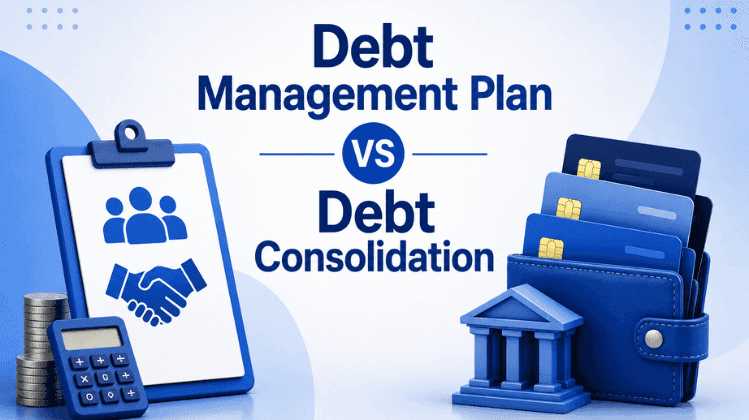
Here is how a debt management plan and debt consolidation are different.
A debt management plan works with your current bank to change repayment. Debt consolidation usually uses a new loan to pay old debts.
The debt covered by a debt management plan depends on your loan and what your lender agrees to offer. It can apply when a bank changes payment terms because you are having financial trouble. RBI Restructering loan cover changes such as the loan period, EMI, or interest rate.
As per the lender, debt consolidations may vary and cater different debts. So before applying for a loan, first of all, go through their terms.
Secured debts (home / vehicle loans etc.) will fall under different rules since those loans are tied up with assets.
People often want a monthly payment they can afford.
With a debt management plan, the bank may change the interest rate, EMI, or loan period if restructuring is allowed under the rules.
With debt consolidation, check the new loan's interest rate, processing fee, and other charges. A lower rate may reduce interest. RBI requires lenders to give borrowers details of the charges that apply.
Some loans still allow a prepayment or foreclosure charge. Under current RBI rules, banks and NBFCs cannot charge prepayment or foreclosure fees on floating-rate term loans given to individual borrowers for purposes other than business. The rule does not cover every loan type, so check your loan agreement.
In India, your CIBIL score and CIBIL report matter when you have debt or want a new loan.
If a bank accepts less than the full amount, it may report the account as “settled” instead of “closed.” CIBIL treats settled accounts differently from closed accounts, and many lenders see a settled status as negative. A restructured loan may also be marked as “restructured” in your credit report. Whether this actually lowers your CIBIL score depends on how the lender reports it and on your overall credit history. It does not automatically damage the score in every case.
Debt consolidation usually means applying for new credit. This can add a new enquiry and loan account to your CIBIL report. Paying on time can help your credit history. Missed payments can hurt your score.
A debt management plan uses repayment terms agreed with your existing bank. The bank decides the exact repayment period based on your case, loan terms, and the rules that apply. There is no single repayment period for every borrower.
Debt consolidation gives you a new repayment schedule based on the new loan agreement. A shorter period can mean higher payments but less interest. A longer period can lower the EMI but may increase total interest.
Before choosing, check whether the EMI fits your budget after basic costs.
Benefits:
Risks:
Benefits:
Risks:
Debt management and debt consolidation are two different ways to deal with debt. Before choosing, check the interest rate, EMI, fees, repayment period, and effect on your CIBIL report. Loan paperwork gets confusing fast, and LoansJagat's team is there to help if you get stuck. Along with access to 50+ RBI-approved lenders and consolidation loans up to ₹50,00,000, you can reach out to their support team with any questions about your application or the offers you're comparing.
It depends on your situation. Debt management works with your existing bank, while consolidation uses a new loan to combine debts.
It can help if you are struggling with payments. Speak directly with your bank to check whether a suitable repayment option is available.
There is no fixed rule. A bank may accept a lower amount, but settlement depends on your case and the lender’s decision.
Paying the full amount is usually better for your CIBIL report because the account is marked “closed.” If you settle for less, the account is often marked “settled.” Lenders treat “settled” and “closed” as different statuses, and a settled mark can make future loans harder to get.
Its function is to facilitate repayment of debts by restructuring the repayment terms like EMI, rate of interest, tenure, etc.
They can apply for it but there is no certainty of approval. The application will be scrutinized on the basis of the CIBIL report of the applicant, their income, other debts, and repayment capacity.
It refers to paying off multiple debts by taking a new loan to consolidate all the dues into one.
Eligibility depends on the lender. Income, CIBIL score, existing debts, repayment history, and the ability to repay the new loan are usually checked.
No. You still have to repay the full amount. The bank only changes the repayment terms.
It can if the new loan has a longer tenure or lower interest rate. Always check the total cost first.