By continuing, you agree to LoansJagat's Credit Report Terms of Use, Terms and Conditions, Privacy Policy, and authorize contact via Call, SMS, Email, or WhatsApp
Disclaimer: The information published on LoansJagat is intended for general informational and educational purposes only and should not be considered financial, legal, or investment advice. Interest rates, loan terms, statistics, and other data may change over time and may vary by lender or source. Please verify the latest information and consult a qualified financial advisor or the respective Bank/NBFC before making any financial decisions.
Subscribe Now
About the author

Ananya Shrivastava
Ananya Shrivastava is a Content Writer specialising in finance-focused news, blogs, and long-form articles on Indian markets, RBI policy, personal finance, and lending. She has authored over 450 blogs and 250 news pieces, combining technical knowledge with rigorous research to simplify complex financial concepts into clear, engaging content. With a marketing-driven lens and sharp editorial judgment, she consistently achieves top Google rankings while ensuring every claim is backed by verified data.
Related Blog Post
Simplify All Your Loans Into One Affordable EMI

Customers Served

Debt Consolidated

1200+ Reviews

Locations in India
Club all Loans & Credit Card Bills into Single EMI

Quick Apply Loan
Consolidate your debts into one easy EMI.

Takes less than 2 minutes. No paperwork.

10 Lakhs+
Trusted Customers

2000 Cr+
Loans Disbursed

4.7/5
Google Reviews

50+
Banks & NBFCs Offers
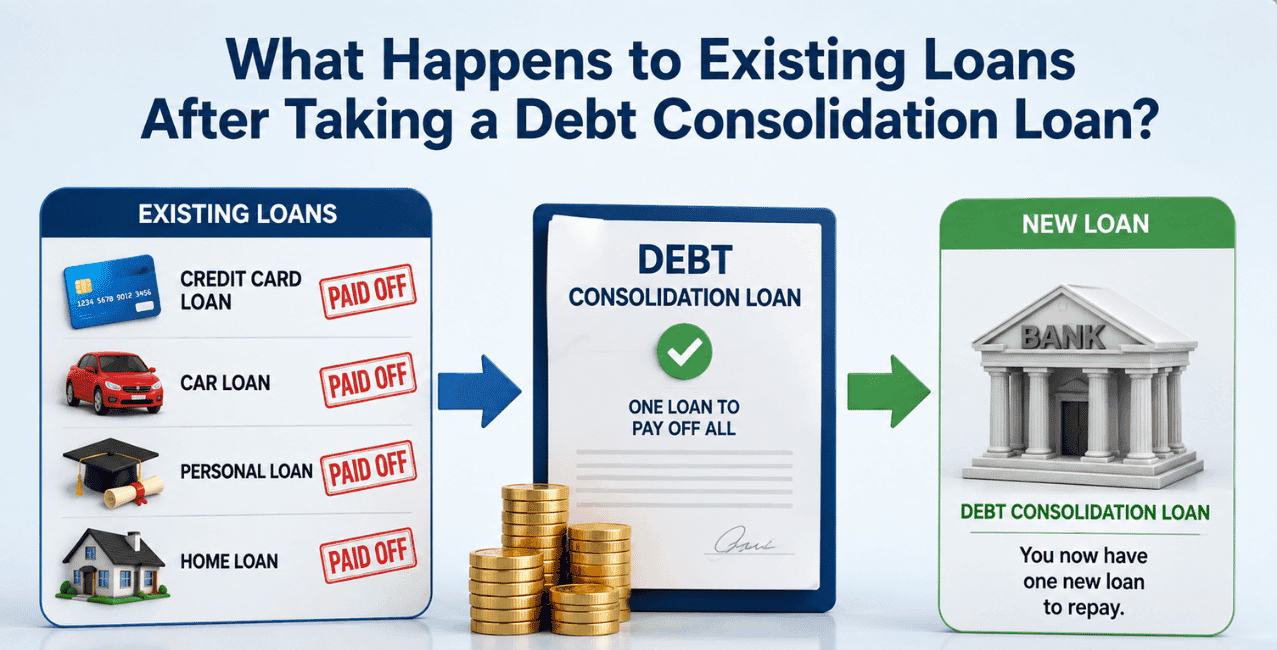
Once your debt consolidation loan gets sanctioned, the new lender uses that amount to close your existing loans directly. The bank issues a No Objection Certificate once a loan is successfully closed, either digitally or by post, depending on the loan type and state.
Any individual availing a debt consolidation loan wonders what happens to their loans, because the entire purpose is to settle their loans and move on with life by paying only 1 loan. This guide is meant for all debtors in India who have availed or are considering a debt consolidation loan and would like to know what happens to their old loan accounts once they take one.
Once your debt consolidation loan gets disbursed, the funds are used to close your existing loans, and each of those old accounts should then show a "Closed" status rather than remaining active.
This is the core mechanism behind consolidation:
The actual closure of each old account, though, isn't automatic just because the new loan is disbursed. You or your new lender still need to follow through with the specific closure process at each old lender.
A lender closes your existing loan through a foreclosure request, where the outstanding principal, accrued interest, and any applicable pre-closure charges get paid in full before the account is formally marked closed.
Here's the process after you opt for debt consolidation:
Since pre-closure charges can vary by loan type and lender, checking these fees before finalising your consolidation plan helps you confirm the total savings actually justify the switch.
Yes, once your existing loan is fully closed, the lender issues a No Objection Certificate confirming you no longer owe anything on that account and have no further liability.
This document matters significantly, since it's your formal proof that the debt has been settled in full and the lender has no remaining claim against you.
Your credit report should reflect each old loan as "Closed" once foreclosure is processed correctly. It is distinct from a "Settled" status, which applies specifically when a lender accepts less than the full amount owed.
This distinction matters for your credit profile. CIBIL's coverage of this distinction confirms that a "Settled" account, unlike a fully "Closed" one, signals to future lenders that the account wasn't repaid in full, and this remark can affect future loan approvals.
A debt consolidation loan is meant to pay off your existing debts entirely, not negotiate a reduced payoff. Your old accounts should update to "Closed" rather than "Settled," provided the full outstanding amount, principal and interest, actually got paid off through the consolidation.
If you don't collect your NOC after your loan closes, your credit report may continue showing the account as active for an extended period. You could face complications when applying for future loans or selling an asset tied to that loan.
Following up directly with your former lender if the NOC doesn't arrive within the stated timeline is worth doing, rather than assuming the closure is processed correctly on its own.
Here's a quick list of documentation you should expect once each of your existing loans gets closed through debt consolidation:
Take a salaried professional in Bengaluru who takes a debt consolidation loan of ₹4,50,000 to close an existing personal loan and a car loan.
Anyone going through this same process can take help from an online marketplace like LoansJagat to track and coordinate closures across multiple existing loans in 1 place.
Closing multiple loans across different lenders while a new consolidation loan gets disbursed involves real coordination, and this is where LoansJagat's debt consolidation loan service steps in.
LoansJagat handles the paperwork side of closing your existing loans, coordinating foreclosure letters and NOCs on your behalf, so you're not chasing multiple lenders separately.
Where the lender allows it, LoansJagat supports direct lender-to-lender payout, meaning your consolidation loan funds go straight toward closing your old accounts rather than passing through your hands first.
A dedicated loan manager oversees your case end-to-end, keeping track of which old loans have been closed and which documentation is still pending.
The entire process runs paperless, with no upfront fee for sanction or disbursal, reducing the friction of managing several closures at once.
The handling of existing loans after taking the debt consolidation loan is simply a matter of going through a lot of paperwork. Your loans will be foreclosed using money from the new loan, and you should receive an NOC from every lender stating that the account has been fully closed. All your NOCs should be kept safe, and you should check your credit report to make sure it indicates "Closed" and not "Settled." Consider LoansJagat's debt consolidation loan service to close your accounts for a paperless process due to the complexity of handling such issues involving different lenders.
The existing loans get closed using the new loan's disbursed funds, and each lender should issue an NOC confirming no further liability once the payoff is complete.
Yes, for loans like HDFC Bank's Auto and Two-Wheeler Loans, the NOC gets issued after successful closure, either digitally to the RTO or by post within 10 days.
No, a closed loan means full repayment, while a settled loan means the lender accepted less than the full amount owed, which affects your credit profile differently.
Follow up directly with that lender, since a missing NOC can leave your credit report showing an active loan status and cause complications later.
Yes, pre-closure charges may apply depending on the loan type and how long you've been repaying, so checking these before consolidating helps confirm actual savings.
If an EMI is presented after your loan is foreclosed, it gets refunded to your account within 7 working days.
Foreclosure through debt consolidation shouldn't negatively affect your score if the loan is fully closed rather than settled, since a closed account reflects positively compared to a defaulted or settled one.
Indefinitely, since it serves as permanent proof of full repayment and may be needed for future loan applications or asset transfers.
Yes, vehicle loans may also require Form 35 and a lien release with the Regional Transport Office, depending on your state.
LoansJagat coordinates foreclosure letters, NOCs, and documentation across your existing loans, and supports lender-to-lender payout where permitted, simplifying the entire transition.