By continuing, you agree to LoansJagat's Credit Report Terms of Use, Terms and Conditions, Privacy Policy, and authorize contact via Call, SMS, Email, or WhatsApp
Disclaimer: The information published on LoansJagat is intended for general informational and educational purposes only and should not be considered financial, legal, or investment advice. Interest rates, loan terms, statistics, and other data may change over time and may vary by lender or source. Please verify the latest information and consult a qualified financial advisor or the respective Bank/NBFC before making any financial decisions.
Subscribe Now
About the author

Ananya Shrivastava is a Content Writer specialising in finance-focused news, blogs, and long-form articles on Indian markets, RBI policy, personal finance, and lending. She has authored over 450 blogs and 250 news pieces, combining technical knowledge with rigorous research to simplify complex financial concepts into clear, engaging content. With a marketing-driven lens and sharp editorial judgment, she consistently achieves top Google rankings while ensuring every claim is backed by verified data.
Related Blog Post
Simplify All Your Loans Into One Affordable EMI

Customers Served

Debt Consolidated

1200+ Reviews

Locations in India
Club all Loans & Credit Card Bills into Single EMI

Quick Apply Loan
Consolidate your debts into one easy EMI.

Takes less than 2 minutes. No paperwork.

10 Lakhs+
Trusted Customers

2000 Cr+
Loans Disbursed

4.7/5
Google Reviews

50+
Banks & NBFCs Offers
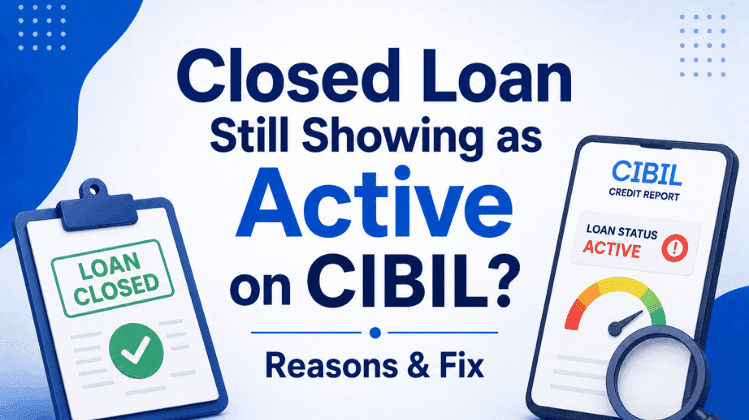
A closed loan can still show as active on CIBIL because your lender hasn't yet reported the updated status to the credit bureau, a gap that can happen due to reporting delays or errors in the update process. Your lender has 21 calendar days to send corrected data once you raise a dispute, and the bureau has a total of 30 days to resolve it.
A closed loan showing as active on your credit report isn't just a glitch. It can genuinely drag down your score and complicate a future loan application. This blog breaks down why this mismatch happens, how the correction process legally works, and what you're owed if the fix takes longer than it should.
A closed loan still shows as active on CIBIL because credit bureaus rely entirely on lenders to report status changes, and if your lender hasn't sent an updated report reflecting the closure, the bureau's records simply haven't caught up yet.
Credit information doesn't update itself automatically the moment you make your final payment. Your lender needs to actually transmit that closure information to the credit bureau, and this reporting happens on a periodic cycle rather than instantly.
According to RBI's own guidance, credit institutions are required to submit credit information to credit information companies fortnightly, within 7 calendar days of the relevant reporting fortnight. If your loan closure fell just after a reporting cycle, or if there was a processing error on the lender's end, your account can appear active for weeks longer than it actually should.
Credit information gets updated after loan closure when your lender submits your account's revised status to the credit bureau during its next scheduled fortnightly reporting cycle.
Here's the general flow:
Since this entire process depends on your lender's own internal reporting accuracy and timing, a mistake or delay at any single step, missed reporting, incorrect data submission, or a backlog on the bureau's end, can leave your closed loan appearing active well past when it should have updated.
You raise a dispute for an incorrectly active loan by filing a formal complaint with the credit bureau showing the error, either directly online or through your lender, triggering a legally mandated resolution timeline.
According to RBI's Circular RBI/2023-24/72, once you file this dispute, the credit institution, meaning your bank or NBFC, has 21 calendar days to send corrected information back to the bureau. The credit information company then has until day 30, counted from your original filing date, to complete the resolution and update your report. Here's the practical process:
You're entitled to compensation of ₹100 per calendar day if your dispute over an incorrectly active loan isn't resolved within 30 calendar days from your original filing date.
According to CIBIL's own official compensation framework page, this compensation framework became effective on April 26, 2024, and applies specifically to disputes filed on or after this date. Here's what you should know:
You should have your loan closure letter, No Objection Certificate, final repayment receipt, and your loan account number ready before raising a dispute, since these directly prove the loan was genuinely closed.
Here's what to keep on hand:
Having these ready before you file speeds up the entire dispute process, since the bureau and your lender can verify your claim faster with documented proof rather than relying on internal records alone.
If multiple credit bureaus show the same error, you need to raise a separate dispute with each bureau individually, since India's 4 licensed credit information companies operate independently of 1 another.
Your lender may report your account status to 1, several, or all 4 of India's credit bureaus, and correcting an error with 1 doesn't automatically fix it across the others. Since each bureau maintains its own database and dispute process, checking your credit report across all relevant bureaus, rather than assuming a single correction resolves the issue everywhere, ensures your closed loan actually reflects correctly wherever a future lender might check.
Understanding which entity is responsible for what stage of the correction process helps you know exactly who to follow up with if your dispute drags on.
Take a borrower who closed their personal loan 3 months ago but notices it still shows as active on their credit report.
A closed loan showing as active on CIBIL usually comes down to a reporting gap between your lender and the credit bureau, not a genuine reflection of what you actually owe. Since RBI's own Circular RBI/2023-24/72 now gives banks 21 days and bureaus a total of 30 days to correct this, with real compensation of ₹100 a day attached to delays, you have a clear, enforceable path to getting this fixed rather than waiting indefinitely. Keeping your closure letter and repayment proof ready from the moment your loan ends makes filing this dispute, if it ever becomes necessary, considerably faster.
Your closed loan is most likely still showing as active because your lender has not yet reported the updated closure status to the credit bureau during its scheduled reporting cycle.
Your lender has 21 calendar days from the date you raise the dispute to send the corrected information to the credit bureau, under RBI's Circular RBI/2023-24/72.
The credit bureau has a total of 30 calendar days from your original filing date to resolve the dispute, and this 30 day period includes the 21 days already given to your lender.
You are entitled to compensation of ₹100 for every calendar day of delay beyond the 30 day window, and this amount is credited to your account within 5 working days of the dispute being resolved.
You need your loan closure letter, your No Objection Certificate, your final payment receipt, and your loan account number to support your dispute.
Yes, you need to raise a separate dispute with each credit bureau individually, since India's 4 licensed credit bureaus operate independently and do not automatically share corrections.
This compensation framework came into effect on April 26, 2024, under RBI's Circular RBI/2023-24/72, which was originally dated October 26, 2023.
No, this compensation framework specifically excludes disputes related to credit score computation, and it applies only to cases involving inaccurate credit information, such as a closed loan showing as active.
If your compensation is wrongfully denied, you can approach the RBI Ombudsman to seek further resolution of the matter.
Lenders are required to report credit information to credit bureaus on a fortnightly basis, submitting this data within 7 calendar days of the relevant reporting fortnight.