By continuing, you agree to LoansJagat's Credit Report Terms of Use, Terms and Conditions, Privacy Policy, and authorize contact via Call, SMS, Email, or WhatsApp
Disclaimer: The information published on LoansJagat is intended for general informational and educational purposes only and should not be considered financial, legal, or investment advice. Interest rates, loan terms, statistics, and other data may change over time and may vary by lender or source. Please verify the latest information and consult a qualified financial advisor or the respective Bank/NBFC before making any financial decisions.
Subscribe Now
About the author

Vaishnavi kale
Vaishnavi is a Financial Content Writer at LoansJagat. She holds a B.Sc. and an M.Sc. She has experience in writing SEO-focused content across finance, digital marketing, education, and Ayurveda. Before joining LoansJagat, she worked with digital marketing agencies serving fintech clients and quick-commerce brands like Zepto and blinkit. At LoansJagat, Vaishnavi writes on banking, loans, personal finance, and insurance. Her work involves researching financial topics, understanding user search intent, and creating content that is clear and accurate. She has experience in SEO content writing, keyword research, content optimisation, and AEO. She enjoys simplifying complex topics into practical information that readers can easily understand and use. She believes that well-researched and reliable content plays an important role in helping people make informed financial decisions.
Related Blog Post
Simplify All Your Loans Into One Affordable EMI

Customers Served

Debt Consolidated

1200+ Reviews

Locations in India
Club all Loans & Credit Card Bills into Single EMI

Quick Apply Loan
Consolidate your debts into one easy EMI.

Takes less than 2 minutes. No paperwork.

10 Lakhs+
Trusted Customers

2000 Cr+
Loans Disbursed

4.7/5
Google Reviews

50+
Banks & NBFCs Offers
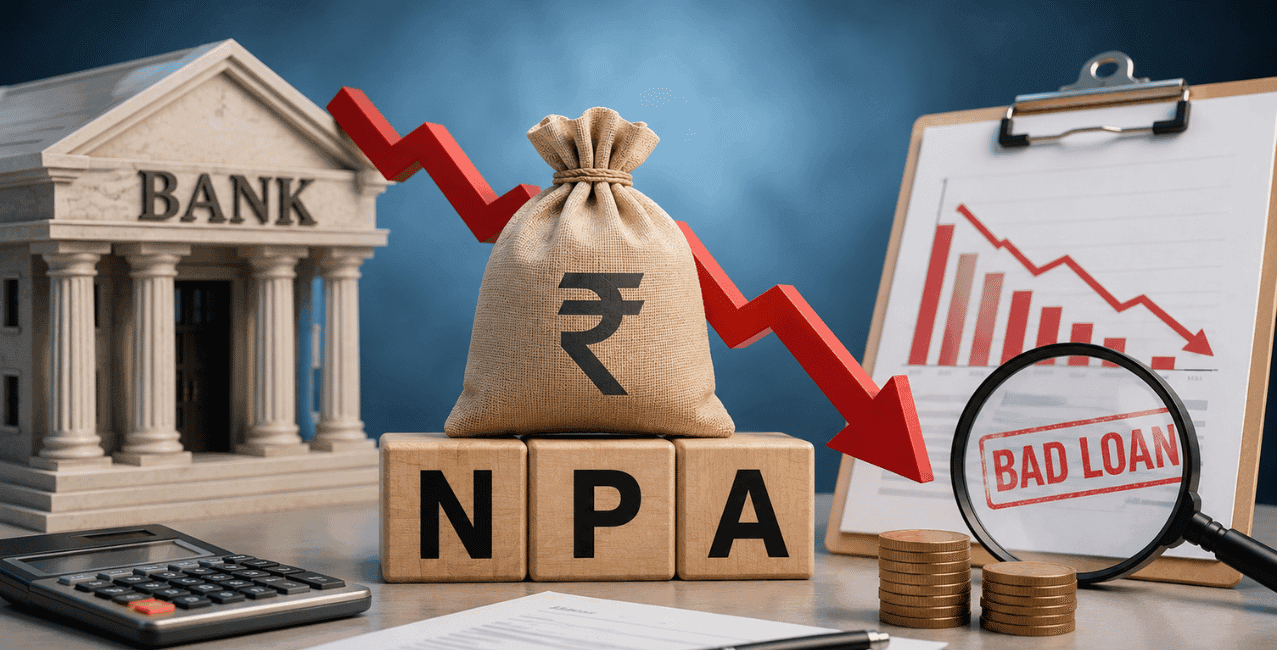
Banks give loans hoping people will pay interest and the principal on time. When the payments stop coming for many days, that loan stops earning money for the bank. Then it is called a non-performing asset or NPA. It is important to understand what NPAs are so that the banks can manage their risk and the borrowers do not have bad credit.
NPA means Non-Performing Asset. Banks mark a loan as NPA when the borrower stops paying the EMI for more than 90 days. That loan then stops bringing any money to the bank.
The Reserve Bank of India (RBI) has made the rules for this. After a loan is marked NPA, the bank cannot show the interest as income until the money actually comes. The bank also has to keep some money aside. That money kept aside is called provision. It is for possible losses.
A loan does not become NPA in one day. Banks first put a mark of early trouble. This mark is called Special Mention Account or SMA.
For term loans and most other loans that are not revolving:
If not paid within 90 days, it becomes NPA (Non Performing Assets)
For revolving loans like cash credit or overdraft, SMA works a little differently. There is usually no SMA-0. The account goes to SMA-1 when the outstanding stays higher than the limit or drawing power for more than 30 days up to 60 days. It goes to SMA-2 when this continues for more than 60 days up to 90 days.
An account is called “out of order” and later becomes NPA if:
Banks put the overdue SMA or NPA mark at the end of the day on that date.
The mark is normally put for the whole borrower. If one loan of a person becomes NPA, all his loans with the same bank are also treated as NPA. There are only a few exceptions.
For farm loans the counting follows crop seasons. There are two crop seasons for short crops and one crop season for long crops. These rules apply only to certain direct farm loans that RBI has listed.
RBI has given Income Recognition, Asset Classification and Provisioning rules. Banks follow these. The main points are:
Once the loan is marked NPA, any interest that was earlier shown as income but not received has to be taken back. After that, income is shown only when cash actually comes. The account can go back to standard only when the borrower pays all overdue interest and main amount fully for every loan with that bank.
In bad cases like big drop in the value of the security or when fraud is found, the bank can put the account straight into doubtful or loss type. It does not have to wait for the normal time.
Banks divide NPAs into three types. This depends on how long the account has stayed non-performing and how much chance there is to get the money back.
These have stayed NPA for 12 months or less. The credit problems are clear. The bank may lose some money if the problems are not fixed.
When an asset has stayed in the sub-standard type for 12 months, it becomes doubtful. Getting the full money back looks very uncertain from the facts and values at that time.
These are accounts where the bank, its auditors or RBI has seen the loss. But the amount has not been fully written off yet. The asset is almost impossible to collect. Still, some recovery may happen later.
Difference between a standard asset and a non-performing asset
A standard asset has no problems. It carries only the normal risk of banking work. An NPA has already gone past the safe line.
Gross NPA is the total of all loans that have become non-performing. It shows the full size of the bad loans in the bank’s book.
Net NPA is Gross NPA minus the provisions the bank has already kept for those loans (and a few other adjustments). It shows the real risk that is still left after the bank has kept money aside.
Banks look at both. Gross NPA shows how many loans have gone bad. Net NPA shows how much risk is still open.
Loans become bad for different reasons. Some common ones are:
Sometimes more than one reason happens together.
When NPAs are high, banks have to keep larger provisions from their profit. This leaves less money for giving new loans. Capital gets stuck and the bank grows slower. If the NPA numbers stay high for long, people may trust the bank less. Banks also spend more time and money on recovery work instead of new business.
When a loan becomes NPA, the borrower’s credit score falls a lot. Getting new loans or credit cards becomes harder and costlier. The bank can start recovery steps. These can include legal notices, taking the assets, or selling the property that was given as security. Calls and legal steps also create stress. Even after the loan is closed, the NPA mark stays on the credit report for years. It keeps making new borrowing difficult.
Banks use different ways. It depends on the type of loan and the security.
The way chosen depends on how big the loan is, what security is there, and how much the borrower cooperates.
The easiest way is to pay the EMI or interest on or before the due date. If you know money will be tight, talk to the bank early. Do this before the first payment is missed.Tell your bank about the issue and ask if they could lower your EMI for a temporary period, provide a longer repayment period or defer payments for a specific period.
Check your account statements regularly. Do not ignore messages or calls from the bank. If you have more than one loan, first clear the ones that are close to 90 days. Do not take a new loan from your bank to pay off an existing one. It is a good idea to communicate openly with the bank about your situation. This way, the bank can find a solution before the account is classified as NPA.
Non-performing assets are loans that have stopped giving income to banks because payments stayed overdue past the time fixed by RBI, which is usually 90 days. They are further put into sub-standard, doubtful or loss types based on how long they stay non-performing. High NPAs reduce banks’ profits and their power to give new loans. For borrowers they bring down the credit score and start recovery steps.
The bank stops counting interest as income, starts recovery steps, and the borrower’s credit score falls.
There are three types: sub-standard, doubtful and loss assets.
It is possible to make a payment to reduce the overdue amount of an NPA.
Simple default is a civil matter. Jail is rare and usually happens only in cases of fraud or when someone knowingly fails to repay a loan.
How do I remove NPA from my loan?
Pay all overdue interest and principal fully. The bank then upgrades the account to standard.
Yes, interest and other charges keep adding, but the bank shows income only when money is received.
Yes, a defaulter can open a new account, though some banks may check the credit record carefully.
Agents can visit but must follow RBI rules. They cannot force entry or harass the borrower.
Default alone does not always stop a government job, but some posts check character and credit history.
Banks send notices, try settlement, take legal steps under SARFAESI or DRT, and recover the money.