By continuing, you agree to LoansJagat's Credit Report Terms of Use, Terms and Conditions, Privacy Policy, and authorize contact via Call, SMS, Email, or WhatsApp
Disclaimer: The information published on LoansJagat is intended for general informational and educational purposes only and should not be considered financial, legal, or investment advice. Interest rates, loan terms, statistics, and other data may change over time and may vary by lender or source. Please verify the latest information and consult a qualified financial advisor or the respective Bank/NBFC before making any financial decisions.
Subscribe Now
About the author

Vaishnavi kale
Vaishnavi is a Financial Content Writer at LoansJagat. She holds a B.Sc. and an M.Sc. She has experience in writing SEO-focused content across finance, digital marketing, education, and Ayurveda. Before joining LoansJagat, she worked with digital marketing agencies serving fintech clients and quick-commerce brands like Zepto and blinkit. At LoansJagat, Vaishnavi writes on banking, loans, personal finance, and insurance. Her work involves researching financial topics, understanding user search intent, and creating content that is clear and accurate. She has experience in SEO content writing, keyword research, content optimisation, and AEO. She enjoys simplifying complex topics into practical information that readers can easily understand and use. She believes that well-researched and reliable content plays an important role in helping people make informed financial decisions.
Related Blog Post
Simplify All Your Loans Into One Affordable EMI

Customers Served

Debt Consolidated

1200+ Reviews

Locations in India
Club all Loans & Credit Card Bills into Single EMI

Quick Apply Loan
Consolidate your debts into one easy EMI.

Takes less than 2 minutes. No paperwork.

10 Lakhs+
Trusted Customers

2000 Cr+
Loans Disbursed

4.7/5
Google Reviews

50+
Banks & NBFCs Offers
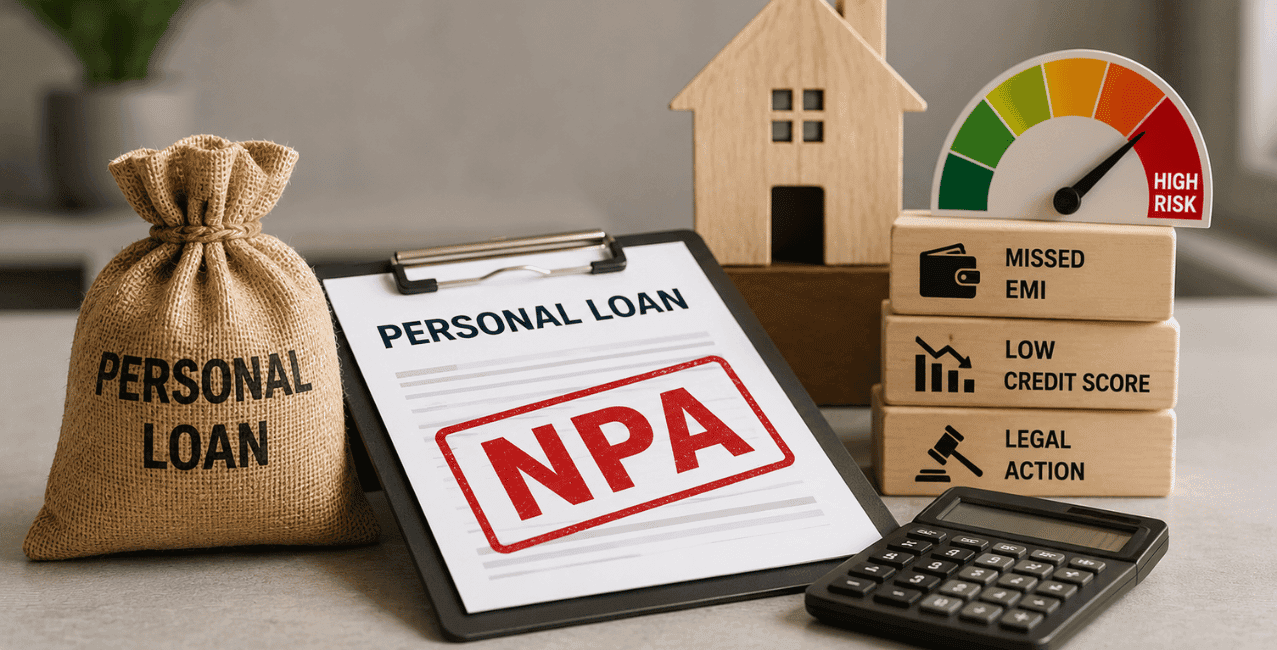
A personal loan is an unsecured loan borrowed from a bank that must be repaid in monthly installments. You don't need to share any physical assets as collateral for this loan. When you don't pay this loan for more than 90 days, it becomes a non-performing asset (NPA). Having an NPA account is detrimental to your finances. It badly affects your CIBIL score and makes future borrowings difficult. Let's understand more consequences of having an NPA account on a personal loan.
When you take out a loan, you are legally obligated to repay it. But some Borrowers do not make repayments for a long time. That's when the account becomes a Non-Performing Asset. In simple words, when you are not able to repay your loan, your account becomes a non-performing asset.
Your loan isn't an NPA the day you missed an EMI. First Lender tracks overdue payments in different stages based on the Days Past Due (DPD).
Delinquency (SMA-0: 1 to 30 Days)
If you do not pay EMI on the due date or before it, your account becomes overdue from the next day. It enters the SMA-0 stage. After this, the lender sends you reminders. Request you to pay the EMI.
NPA Status (After 90 Days)
Non-performing asset status is given when your EMI is missing for more than 90 days. In this stage, the loan recovery process becomes more serious. Leander can also take legal action against you.
The situation of every borrower is different, and that's why the account NPA also differs.
Substandard Asset
This is the first category of non-performing asset (NPA). It has already been classified as an NPA and is in this category for up to 12 months. In this stage, the lender has some reasonable chances of recovering a loan.
Substandard Asset also affects your CIBIL score negatively and makes future loans difficult to get.
Doubtful asset
This is a loan that has remained a Substandard Asset for more than 12 months. In this stage, the lender’s chances of recovering the full amount of the loan are much lower.
In this stage, the lender is doubtful about recovery; that's why it is called a doubtful asset. If your loan has collateral, the lender checks how much money it can recover from the asset. A personal loan is an unsecured loan, so lenders can't claim physical collateral. So they try a debt restructuring option.
Lost asset
This is the loan that the bank believes is very unlikely to be recovered. This is the most serious category because the chances of recovering a loan are very low. In this category, the RBI comes in. The bank’s auditor or the RBI identifies this category as a loss asset.
If your loan becomes NPA, it can highly affect your CIBIL score. As a result, it's very difficult to get a loan or credit card in the future. If you are not able to repay the loan and are facing financial crises, you can contact your bank and ask for a solution.
When your personal loan becomes an NPA, it can affect your finances in many ways.
When you do not pay EMIs for more than 90 days, it badly affects your CIBIL score. It shows you are a high-risk borrower. If your CIBIL score is lower, you will not get future loans easily.
How does NPA affect your credit score?
The impact of NPA on your CIBIL score varies from person to person.
If you miss your EMI, you have to pay more money as charges. These additional charges increase your outstanding amount. Now your loan is more difficult to repay.
What are those charges?
When your account becomes NPA, banks start the recovery process. They do it in various ways.
1. Recovery by the Lender
Banks first try to recover loans by themselves. They contact you, call and message you, send you a recovery notice, and also try to contact your co-applicant or guarantor.
2. Recovery Through an Authorised Recovery Agency
If the borrower doesn't repay the loan after contacting them multiple times. Banks assign the account to an authorised recovery agency. Then recovery agents contact you, but they should follow RBI's guidelines. They can not threaten, harass, or use abusive behaviour.
3. Legal action
If the loan is still unpaid, the bank can start legal proceedings. It depends on the type of loan and the circumstances. Banks can file a civil recovery case.
4. Co-applicants or Guarantors May Be Affected
Your Non-Performing Asset (NPA) affects your co-applicant or guarantor. This is because they also share the same responsibility for the loan.
How does it affect them?
The bank can definitely ask the guarantor or co-applicant to pay the loan. In this situation, they can do the following things:
The responsibility of Co-applicants or Guarantors is different for different loans. Before becoming someone’s guarantor, you should always check terms carefully.
As I mentioned before, if your personal loan becomes NPA, it directly affects your credit report. And if your credit score is less than, you will have to face hurdles in getting a new loan in the future.
Short-term loan:
Long-term loan:
You should always repay your outstanding dues, maintain timely payment, and use credit carefully. By following this,s you can improve your credit score too.
When your personal loan becomes NPA, it can affect your credit score negatively. Your credit score becomes lower, and your total outstanding amount increases due to late payments and extra interest. Leander can take legal action against you. All these things contribute to your CIBIL report,t and as a result, your CIBIL score decreases.
In some cases,co-applicants or guarantors also get affected. That's why if you are facing a real financial problem, you should consult with your bank instead of ignoring reminders. When you contact lenders, they can give you options like loan restructuring or loan settlement. Taking timely action is always better than waiting for the bank to take legal action. It reduces your financial stress and protects your credit profile. To get more information, stay connected with Loansjagat.
When you do not pay EMIs for more than 90 days, your account automatically becomes a non-performing asset.
A personal loan is generally classified as an NPA after 90 days of continuous non-payment. In the first 1 to 30 days, it tracks under SMA-0; the bank sends notices. From day 31 to 60, tracking is under SMA-1; your account enters into delinquency, and from day 60 to 90, it is in SMA-2; lenders issue legal notice and start recovery.
Yes, an NPA has a high impact on your CIBIL score. Your account becomes NP when you stop paying EMIs,s and that's when your credit history becomes bad. That's why your CIBIL score decreases.
It is very difficult to get a new loan after your personal loan becomes an NPA. Credit bureaus have all the information about your account, and an NPA loan is visible on your CIBIL report. So new lenders avoid giving such loans,s and if they approve it by chance, they apply high interest on it.
Banks can take legal action if your loan becomes an NPA. First, the bank sends you reminders, notices, and also hires recovery agents. Even after all this, if you don't pay the loan, they take legal action.
Yes, it's possible to settle your NPA account. Banks prefer loan settlement instead of closing it as NPA.
Yes, if you have a guarantor or co-applicant, then they get affected if your loan becomes an NPA. They have to pay the loan amount, or they can choose options like loan restructuring or settlement.
If you are not able to pay a loan, you should directly contact your bank instead of ignoring reminders. You should ask them about a loan statement or restructuring.
No, it cannot be removed from your credit report immediately. Once a loan is classified as an NPA, it becomes part of your credit history.
Pay EMIs on time, communicate with your lender early, and seek restructuring if needed.