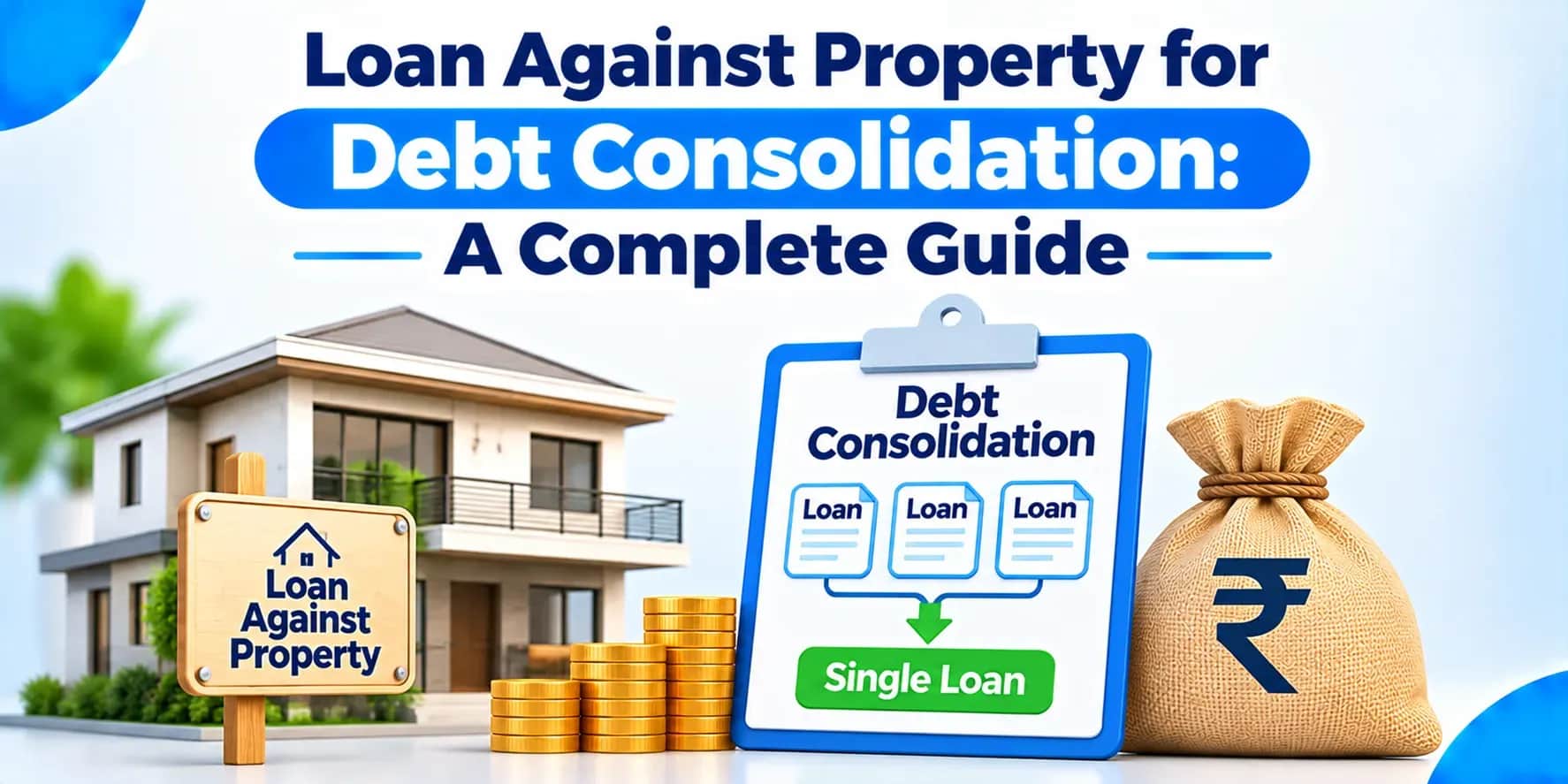
Loan Against Property for Debt Consolidation: A Complete Guide
Loan Against Property for Debt Consolidation: A Complete Guide
Debt ConsolidationLast updated: 17 November 2026, 12:56 IST
How peaceful are your Finances?
Check AI Loan Optimisation Plans to Reduce Your EMI
Check My Score for Free
78Peace Score
EMI savings · Example₹9,100/mo
78Peace Score
EMI savings · Example₹9,100/mo
Disclaimer: The information published on LoansJagat is intended for general informational and educational purposes only and should not be considered financial, legal, or investment advice. Interest rates, loan terms, statistics, and other data may change over time and may vary by lender or source. Please verify the latest information and consult a qualified financial advisor or the respective Bank/NBFC before making any financial decisions.
Vidhi Chauhan is a copywriter and content writer with extensive experience creating high-quality, SEO-driven content across multiple industries, with a strong focus on fintech. She has written extensively on GST, banking, personal loans, business loans, credit cards, income tax, insurance, and other financial topics, helping Indian readers understand complex concepts through clear, accurate, and engaging content.
A Loan Against Property for debt consolidation is a secured form of borrowing where the borrower can put his/her property up as collateral for repaying various other debts. In place of managing different loans, EMIs, and interest rates, eligible debts can be consolidated through a single Loan Against Property. This might ease the process of borrowing, and depending on the rate of interest applicable, the tenure, and charges, it can also have an impact on the cost of borrowing. However, with the property being used as collateral, there would be a greater risk involved in case the borrower does not repay the loan.
Key Takeaways
A Loan against Property can combine various loans.
Property acts as collateral, which increases repayment risk.
Long tenures decrease EMIs and increase interest.
It is important to compare interest rates, tenure, and fees.
The eligibility criterion depends on income, credit rating, property, and the lender's policy.
A Loan Against Property for debt consolidation is a type of secured loan where the borrower avails of money by mortgaging a property and uses the same to settle off multiple loans.
For instance, assume a borrower has outstanding dues on his personal loan, two credit cards, and one car loan. Instead of paying four separate loans, he can take a loan against property in order to settle all of them through EMIs.
The fundamental objective of such a loan is to consolidate multiple loans into a single loan. As it is a secured loan, a greater loan amount will be offered by the lender compared to some other unsecured loans.
Determine the amount of existing loans: Figure out the sum of principal and other related expenses on each loan.
Calculate the loan that will be needed: Work out the funding requirement to repay existing obligations.
Apply for a Loan Against Property: Provide all necessary information about yourself, your income, and the property.
Evaluation of the property and financial status: The evaluation includes the property itself, the ability to repay the loan, income, and other relevant factors.
Loan is approved and transferred to the borrower’s account: Following approval and finalisation of documents, the loan is provided to the borrower.
Pay off existing debt: This loan may be used for repaying outstanding obligations.
Repayment of consolidated loan: Now the borrower makes only one repayment according to the new loan agreement.
The procedure and documentation vary from lender to lender.
Why Choose LAP for Debt Consolidation?
Single Repayment Schedule:A single consolidation of eligible debts under Loan Against Property will make repayment easier by consolidating multiple EMIs into a single repayment schedule.
Possibly Reduced Interest Expense: Secured loans tend to have lower interest rates, which might result in reduced interest expense during debt consolidation. The actual savings will depend on rates, balances, and other factors.
Extended Repayment Period:An extended Loan Against Property repayment period could result in reduced EMIs but increased overall interest cost. The borrower needs to compare the two before making any decision.
Borrow Larger Loan Amount: Larger loan amount borrowing may be possible using property-backed loans.
Easier Budget Management:A single loan repayment becomes easy to manage financially.
What Are the Risks of Using a Loan Against Property for Debt Consolidation?
Debt consolidation does not pay off debts. Instead, it pays off debts through a new borrowing facility. Hence, one needs to consider the implications involved before putting the asset as security.
Asset Is Used as Collateral:The asset is used as security, which brings about repayment risks for the borrower. In case of failure to repay the loan, it will be recovered in accordance with the law and the agreement on the loan.
Extended Repayment Period May Mean Higher Interest Payments:Although the EMIs will be smaller, an extended repayment period means higher interest payments in total.
Additional Costs Are Involved: One should consider the processing, evaluation, legal, documentation, insurance, and foreclosure costs involved.
Past Debts Can Come Back: One should avoid taking on any other debt after debt consolidation when repaying the Loan Against Property.
How to Check Whether Loan Against Property Is Suitable for Debt Consolidation?
Before applying, compare the existing debt with the proposed Loan Against Property using the following factors:
Factor
What to Check
Existing outstanding
Total amount required to close current debts
Current interest rates
Rate applicable to each existing liability
New interest rate
Rate offered for the Loan Against Property
Processing and other fees
Total upfront and recurring charges
Remaining tenure
Time left on existing loans
New tenure
Proposed repayment period
New EMI
Monthly repayment obligation
Total interest
Interest payable throughout the new loan tenure
Property value
Value considered by the lender
Prepayment terms
Conditions for early repayment
Credit profile
Impact on eligibility and pricing
A borrower should focus on the overall cost of borrowing, rather than comparing only the EMI.
Documents Required for Loan Against Property
The type of documents to be submitted will depend on whether the applicant is an individual or a non-individual or a business entity.
For Individual
Proof of Identity and Address:Aadhaar Card, Passport, Driving Licence, Voter ID, NREGA Card or letter from National Population Register (NPR) mentioning the name and address of the applicant.
Proof of Date of Birth: Passport, Driving Licence, Voter ID, NREGA Card or NPR letter mentioning the name and address of the applicant.
Non-Individual or Business Entity
Proof of Business / Identity of Business: Proof of any kind of document that will prove the identity of the business entity, for example:
GST/VAT/CST/Sales/Service or Professional Tax Registration certificate
Importer Exporter Code (IEC) from DGFT
Professional Practice certificate/licence from statutory professional bodies
Who Is Eligible to Avail a Loan Against Property for Debt Consolidation?
Lenders have their own policies for eligibility. Usually, the following are evaluated by the lenders:
The age of the applicant
The financial standing and stability of income/employment/business of the individual
Repayment ability
Financial liabilities of the applicant
Credit standing of the individual and repayment behavior
Valuation of the property and its legal standing
Even having the property as security will not ensure automatic approval. As per RBI's fair practice code, the evaluation of creditworthiness cannot be overlooked.
Loan Against Property vs Personal Loan for Debt Consolidation
Both secured and unsecured loans can be considered for debt consolidation, but their structure is different.
Feature
Loan Against Property
Personal Loan
Security
Property is pledged
Generally unsecured
The appropriate option depends on the amount of debt, repayment capacity, cost of borrowing and the borrower's willingness to pledge property as security.
How Can LoansJagat Help With Loan Comparison?
LoansJagat can help borrowers research and compare loan options based on factors such as interest rates, loan amounts, tenure, eligibility, and applicable charges. By providing relevant loan-related information in one place, LoansJagat can support borrowers in understanding available options before choosing a suitable debt consolidation approach.
Conclusion
Loan Against Property could assist in consolidating several loans into one, as well as having a larger tenure and a higher loan amount. The only problem is that it would require the borrower to put his/her property as security, which means there would be additional interest or costs. Debt consolidation using LAP should be considered after a careful comparison of different aspects.
FAQs
1. Can all kinds of existing loans be consolidated by way of a Loan Against Property?
Maybe not, as the lender can state what kind of loans should be paid off by the proceeds of the loan. It is necessary to find out the permissible usage of the loan from the lender.
2. Is there any case when a borrower consolidates some part of the existing loans but not all?
Surely there is, as the borrower can choose to consolidate loans according to the amount of the loan and the interest rates of the existing loans.
3. Is the account of the existing loan closed automatically with debt consolidation via LAP?
No, it is up to the borrower to make sure that the existing debt is paid off.
4. Is there a possibility to leverage a jointly held property to consolidate one's debt?
It all depends on the lending institution's requirements in relation to property and property ownership.
5. In case there is a change in the value of the property used as security for the LAP, what will happen?
There won't be any automatic change in the loan agreement conditions in relation to any alteration in property value. The borrowing of additional money using this property will depend on the lender's policies.
6. Is it possible that debt consolidation will affect the creditworthiness of a borrower?
The effect of debt consolidation will depend on how previous debts are settled and how the new loan is paid off.
7. Is the Loan Against Property suitable for debt consolidation against all sorts of properties?
No, as the financial institution will take into account only some of the properties depending on its internal criteria. The geographical location of the property, legal nature, ownership and valuation of the property play a role.
8. Can a person settle the LAP debt consolidation loan before the tenure expires?
It is possible to do so, but according to the conditions set forth in the loan agreement. It is advisable to be aware of prepayment or foreclosure penalties.
9. Is it possible for self-employed persons to take advantage of LAP for consolidating their debts?
Eligibility is likely to be available to self-employed applicants depending on the evaluation of their income, the nature of the business, the credit standing, and the property by the lender.
10. What are some things that borrowers need to check before using LAP to consolidate credit card debts?
These include comparing the total amount of balances of the cards, the interests involved, how the payments will be made, and any other fees against the LAP cost.
Start your journey today
Apply Now→
*T&C apply
Income Tax Return of the sole proprietorship showing the business income duly verified by the Income Tax authorities
Utility Bills like Electricity, Water or Landline Telephone Bills, if applicable.
Possession of the property
Location and kind of property
Loan-to-value norms
Potential loan amount
Can be higher, depending on property and eligibility
Usually lower than LAP, subject to lender
Interest rate
May be lower because of security
May be higher due to unsecured nature
Tenure
Generally longer
Usually shorter than LAP
Property risk
Property is collateral
No property collateral in a standard personal loan