By continuing, you agree to LoansJagat's Credit Report Terms of Use, Terms and Conditions, Privacy Policy, and authorize contact via Call, SMS, Email, or WhatsApp
Disclaimer: The information published on LoansJagat is intended for general informational and educational purposes only and should not be considered financial, legal, or investment advice. Interest rates, loan terms, statistics, and other data may change over time and may vary by lender or source. Please verify the latest information and consult a qualified financial advisor or the respective Bank/NBFC before making any financial decisions.
Subscribe Now
About the author

Vidhi Chauhan
Vidhi Chauhan is a copywriter and content writer with extensive experience creating high-quality, SEO-driven content across multiple industries, with a strong focus on fintech. She has written extensively on GST, banking, personal loans, business loans, credit cards, income tax, insurance, and other financial topics, helping Indian readers understand complex concepts through clear, accurate, and engaging content.
Related Blog Post
Simplify All Your Loans Into One Affordable EMI

Customers Served

Debt Consolidated

1200+ Reviews

Locations in India
Club all Loans & Credit Card Bills into Single EMI

Quick Apply Loan
Consolidate your debts into one easy EMI.

Takes less than 2 minutes. No paperwork.

10 Lakhs+
Trusted Customers

2000 Cr+
Loans Disbursed

4.7/5
Google Reviews

50+
Banks & NBFCs Offers
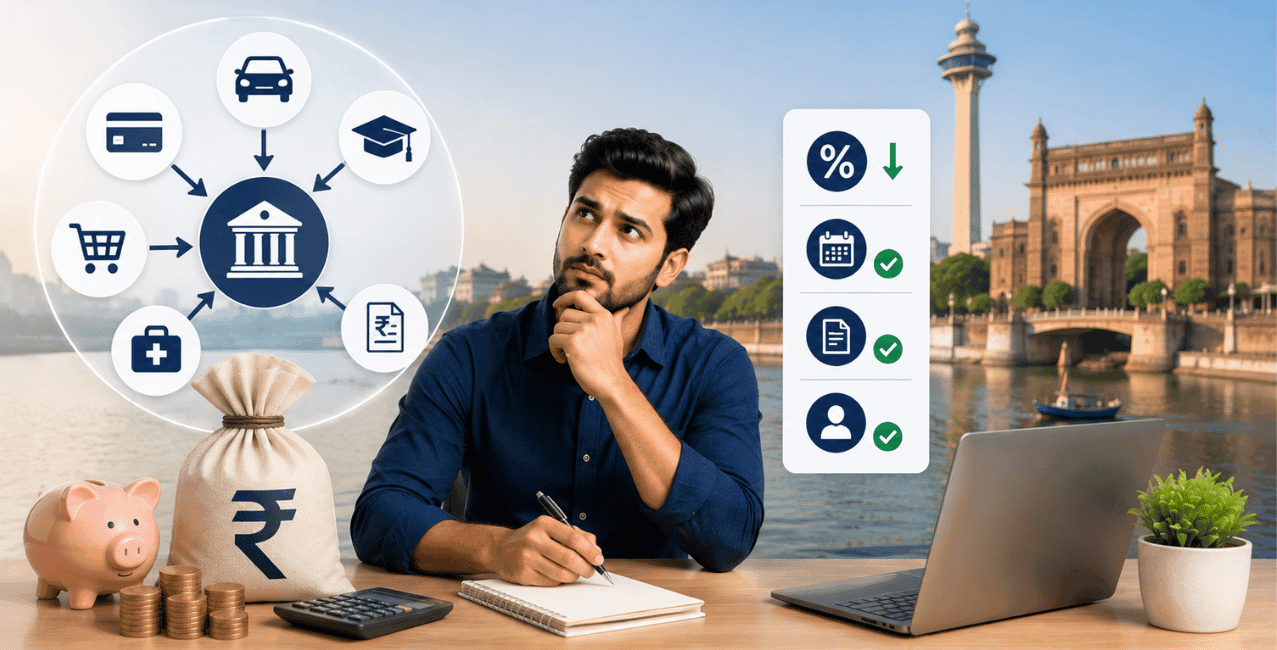
In case you receive multiple credit card bills, personal loan EMIs, and BNPL EMIs every month, debt consolidation could prove beneficial to manage all these effectively. You don’t have to manage different payment schedules and multiple rates, but rather combine all your eligible debts into a single loan.
This is more relevant at present since the household debt-to-GDP ratio of India is 45.5%. The NBFCs are worth considering for debt consolidation loans since they provide a flexible loan structure and a digital application facility. Debt consolidation loans make sense only when the resultant loan results in an improvement in your repayments after accounting for interest rate, tenure, and applicable charges.
Here, we review the top 5 NBFCs offering debt consolidation loans in India along with their features.
Choose NBFCs according to affordability, eligibility, and total repayment amount.
Interesting Fact
Retail credit has become the driving force behind NBFCs' credit growth in India. As per the RBI figures quoted in The Economic Times, the growth rate of NBFC credit jumped to 14% annually in May 2026 from 11% in May 2025, with an increase of 20% in retail credit. In particular, gold credit witnessed outstanding growth with a jump of 70% to ₹3.29 lakh crore in May 2026 from 39% growth the previous year.
A debt consolidation loan refers to a new loan taken by you to clear multiple old loans. Rather than worrying about multiple dues, interest rates, and repayment deadlines, you have to manage just one monthly payment against the new loan. Moreover, this will also help you lower your total interest burden if the interest rate for the new loan is less than that of your old debts.
Personal loans provided by Bajaj Finance are some of the options that can be considered when borrowers want to consolidate their debt, depending on the terms of the loan.
The current personal loan offer of Bajaj Finance includes a loan amount between ₹40,000 and ₹55,00,000, with an interest rate of 10% to 30.5% p.a., and a tenure period of 12 to 108 months. The processing fee may reach 4.13% of the loan amount, including taxes.
Why Consider Bajaj Finance for Debt Consolidation?
A greater amount of loan would suit those borrowers who have to consolidate larger loans, while a longer repayment period can reduce EMI but increases the amount of interest payable. Compare your repayment cost with the applicable charges to make a better decision.
Personal loans offered by Tata Capital start from an interest rate of 10.99% p.a., wherein the loan amount would be up to ₹35,00,000. The bank says that a CIBIL score of 750 or more could qualify the applicant, provided that the applicant meets the rest of the eligibility criteria.
Tata Capital is flexible on tenures and partial prepayment; thus, it is worth considering for debt consolidation purposes. A borrower needs to analyse the interest rates sanctioned and the repayment cost involved.
Aditya Birla Capital provides personal loans up to ₹50,00,000. Aditya Birla Capital’s personal loan details indicate that the indicative interest rate starts from 10.99% per annum, with tenures of 84 months, as shown by the personal loan calculator provided by the lending organisation.
Aditya Birla Capital mentions processing fees that are up to 0.5% to 2.5% of loan amount. Other charges that are published include part-prepayment and foreclosure charges that may differ depending on the timing of the payment and loan terms.
Aditya Birla Capital provides debt consolidation loans and even offers greater loan limits to consolidate substantial debts. It is essential to take only those loans that you can repay based on your repayment capacity.
InCred Financial Services provides personal loans to salaried and self-employed persons. The page currently available on its website provides the loan amount up to ₹15,00,000 and a tenure ranging from 1 to 5 years.
According to the lender, applicants have to be 21 to 60 years old with a minimum monthly income of ₹15,000. The APR of the personal loan offered by it ranges from 14% to 48%.
InCred provides personal unsecured loans for debt consolidation for both salaried and self-employed customers digitally. Personalised offers should be compared as interest rates differ.
Finnable provides personal loans that can be used for debt consolidation. As of now, the interest rate on their personal loans ranges between 16% and 30.99% p.a., loan tenure ranges between 6 months and 60 months, and processing charges are 5% + GST.
Finnable mentions that they provide personal loans up to ₹10,00,000, and applicants who are salaried employees can apply to them according to their eligibility. They also mention debt consolidation in the list of purposes of personal loans.
Why Should Finnable Be Used for Debt Consolidation?
Finnable may be worth considering for borrowers looking for a digital application process, subject to eligibility and applicable terms.
The table below provides a quick comparison of the five NBFCs, including their loan amounts, interest rates, tenures, and suitability for different borrowing needs.
| NBFC | Loan Amount | Interest Rate | Tenure | Best Suited For |
| Bajaj Finance | ₹40,000–₹55,00,000 | 10%–30.5% p.a. | 12–108 months | Borrowers requiring a relatively higher consolidation amount |
| Tata Capital | Up to ₹35,00,000 | Starting at 10.99% p.a. | Flexible | Borrowers comparing repayment flexibility and loan structuring |
| Aditya Birla Capital | Up to ₹50,00,000 | Starting at 10.99% p.a. | Up to 84 months | Individuals with considerable debt and larger loan requirements |
| InCred | Up to ₹15,00,000 | 14%–48% APR | 1–5 years | Salaried and self-employed borrowers seeking digital loan processing |
| Finnable | Up to ₹10,00,000 | 16%–30.99% p.a. | 6–60 months | Salaried borrowers looking for digital debt consolidation |
The right NBFC ultimately depends on your personalised interest rate, eligible loan amount, repayment capacity, tenure, and the total cost of borrowing, rather than simply the lowest advertised rate.
Disclaimer: Interest rates, loan amounts, fees, eligibility criteria and other terms may change. Verify the latest terms with the respective lender before applying.
Rate comparison in the case of NBFCs goes beyond just looking at the quoted interest rate. Some of the points to consider include:
*T&C Apply
Other Charges: Documentation, bounce, penalty, cancellation, and service charges should also be looked into before taking the loan.
A careful comparison of rates, repayment terms, and all applicable charges can help you choose a loan that genuinely reduces your debt burden.
A consolidation loan works best when it genuinely reduces costs and simplifies repayments.
| When It May Make Sense | When It May Not Be Suitable |
| Multiple loans or credit-card dues need consolidation | New interest rate is similar to or higher than existing rates |
| Overall borrowing cost is lower | New tenure is significantly longer |
| One EMI is easier to manage | Foreclosure charges reduce potential savings |
| New EMI fits your monthly budget | Processing fees outweigh the savings |
| Income is stable | You borrow more than necessary |
| You have a plan to avoid fresh high-cost debt | You may accumulate new credit-card debt |
Compare total costs carefully to determine whether consolidation truly benefits you.
There is a potential advantage in simplifying multiple payments through debt consolidation. However, the advantages of debt consolidation rely upon the factors of interest rate, tenure, costs, and ability to pay back. Comparing NBFCs with respect to these factors would help in selecting the loan that truly helps in fulfiling the financial objective.
LoansJagat can help eligible borrowers explore debt-consolidation loan options from its lending partners. Final approval, interest rate, loan amount and repayment terms are determined by the respective lender.
A hard enquiry can be triggered by the application process for a loan, which might affect your credit score temporarily. However, regular payments of the consolidation loan can contribute towards more responsible credit behaviour.
The payoff of a credit card will make the limit utilised available once again, according to the terms of the credit card issuer. However, the borrower must avoid the use of the reinstated limit for further borrowing.
It is possible that the loan for consolidation purposes be applied to repay some other debts with different lenders. Still, the lender could set specific requirements concerning which loans are eligible for consolidation.
It is not mandatory to close your credit card accounts after you have repaid the debts, especially if the credit card does not have any costs and it is properly handled. If you have an account open, it will help to maintain its credit record, but holding credit that is unused will not make you borrow again.
You might have to repay the debt in other ways; hence, you will still be managing more than one debt. You will know the financing gap before you start the process of consolidation.
The inclusion of past-due payments will depend on the terms and conditions set by the lender. The borrowers should give true information regarding the overdue payments.
Yes, debts that have varying lengths left in their repayment periods can be consolidated through the creation of a new debt. The key point to take note of here is whether the new debt will be costlier than the old ones combined.
Identification and proof of address, bank statements, salary slips, and loan details may be asked for. The required documents may differ depending on the nature of employment and the profile of the borrower.
A financial institution might be able to differentiate between the two types of debt when deciding on whether to consolidate. The person needs to confirm if the new loan allows for debts that arise from the business.
Compare the amount that needs to be paid back with the new loan versus the remaining balance on the old debts. Debt consolidation is important only when it leads to actual savings.