By continuing, you agree to LoansJagat's Credit Report Terms of Use, Terms and Conditions, Privacy Policy, and authorize contact via Call, SMS, Email, or WhatsApp
Disclaimer: The information published on LoansJagat is intended for general informational and educational purposes only and should not be considered financial, legal, or investment advice. Interest rates, loan terms, statistics, and other data may change over time and may vary by lender or source. Please verify the latest information and consult a qualified financial advisor or the respective Bank/NBFC before making any financial decisions.
Subscribe Now
About the author

Vaishnavi kale
Vaishnavi is a Financial Content Writer at LoansJagat. She holds a B.Sc. and an M.Sc. She has experience in writing SEO-focused content across finance, digital marketing, education, and Ayurveda. Before joining LoansJagat, she worked with digital marketing agencies serving fintech clients and quick-commerce brands like Zepto and blinkit. At LoansJagat, Vaishnavi writes on banking, loans, personal finance, and insurance. Her work involves researching financial topics, understanding user search intent, and creating content that is clear and accurate. She has experience in SEO content writing, keyword research, content optimisation, and AEO. She enjoys simplifying complex topics into practical information that readers can easily understand and use. She believes that well-researched and reliable content plays an important role in helping people make informed financial decisions.
Related Blog Post
Simplify All Your Loans Into One Affordable EMI

Customers Served

Debt Consolidated

1200+ Reviews

Locations in India
Club all Loans & Credit Card Bills into Single EMI

Quick Apply Loan
Consolidate your debts into one easy EMI.

Takes less than 2 minutes. No paperwork.

10 Lakhs+
Trusted Customers

2000 Cr+
Loans Disbursed

4.7/5
Google Reviews

50+
Banks & NBFCs Offers
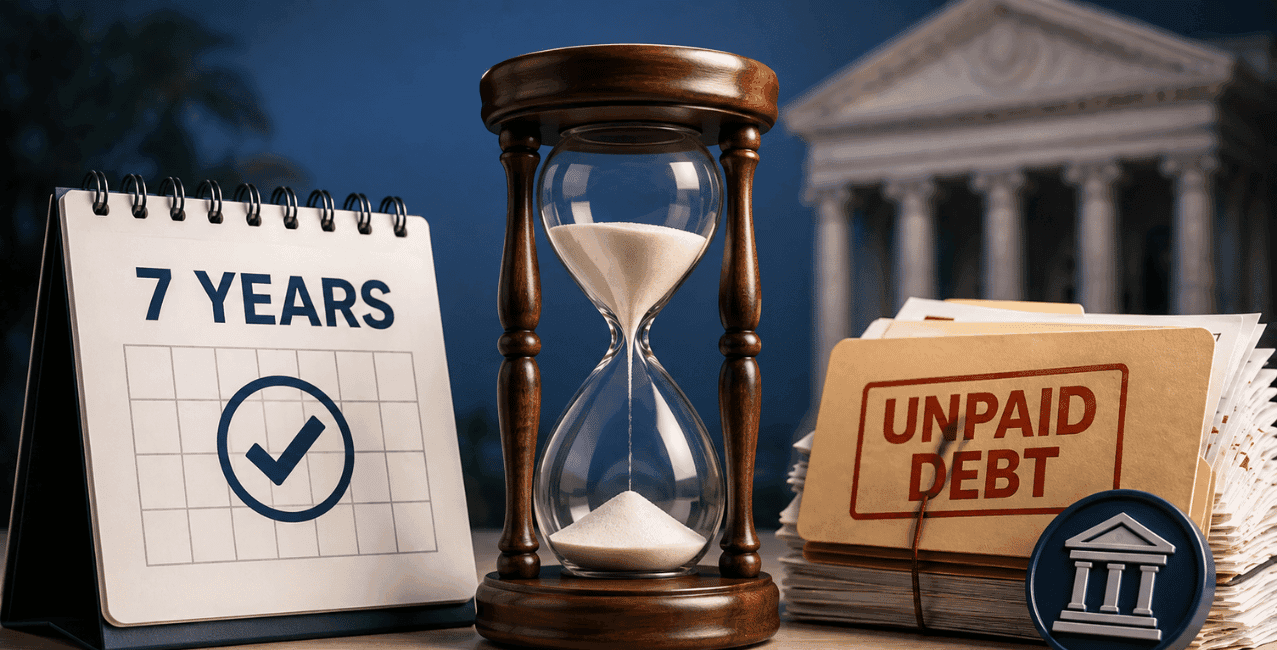
If you do not pay a debt for 7 years, it doesn't mean that your loan is automatically cancelled or legally written off. Borrowers still need to repay the outstanding amount. Credit bureaus like TransUnion CIBIL can keep negative credit information, such as missed payments, settlements, and written-off accounts, on your credit report for up to 7 years. But this does not mean that the loan is cancelled or that you no longer have to repay the debt. If you are not able to repay the loan, you should contact the bank and opt for options like loan settlement and restructuring. To know more about these, stay connected with Loansjagat.
When a bank gives loans to borrowers, Borrowers are legally obligated to repay them. A loan default happens when a borrower is not able to repay the loan or EMI on time. In this situation, banks can send you a notice. If an EMI installment or interest component remains overdue for a continuous period of more than 90 days for a term loan, the account loses its 'Standard' status and is automatically classified as an NPA under regulatory guidelines.
If you are unable to repay the loan, you should contact your lender as soon as possible. Banks can offer you loan settlement or restructuring options.
When you get a loan, it's your responsibility to repay it on time. If you do not repay dues on time, you have to face many legal and financial problems.
If you have missed the EMI payment or are no longer able to pay the loan, the lender can classify your account as a loan default. Also, you will face the following consequences:
If you are unable to pay the loan, you should contact your bank and settle your loan as soon as possible.
In India, banks and NBFCs follow the RBI’s strict Income Recognition and Asset Classification (IRAC) guidelines. Under these rules, an amount is legally classified as ‘overdue’ if it is not paid on the exact due date fixed by the lender. Before a loan becomes a Non-Performing Asset (NPA), it transitions daily through preliminary stress categories called Special Mention Accounts (SMA).
Banks and NBFCs need to follow these processes.
Even if you are someone who is not able to repay the loan, you still have some rights.
If you are facing Job loss, business failure, or medical issues, these are not alone reasons that can bring you to jail.
Legal action is not taken in every scenario. It is applicable only in certain situations.
There is no punishment for non-payment of a personal loan in India if you are unable to pay the loan on time only because of a financial crisis. It will not lead to jail. You can contact your bank and ask for a solution like loan restructuring or settlement.
Many people think that their unpaid debt will disappear after 7 years. But in reality, nothing happens like this. Loans don't automatically disappear just because time has passed.
If someone is unable to repay a loan due to genuine problems like job loss or financial crises, this doesn't come under criminal law. It is a civil matter. But problems like bounced cheques or failed electronic payments can lead to separate legal action. If you are struggling to repay a loan because of genuine reasons, you can contact your lender and talk about options like loan restructuring or settlement.
No, debt doesn't disappear after 7 years in India. Missed payments, write-offs, and settlements can remain on your credit report for up to 7 years. This doesn't cancel your debt.
Generally, courts will dismiss a suit filed after the limitation period if the borrower objects. However, determining if a claim is truly 'time-barred' is highly technical. If the lender proves that the limitation period was extended or reset—due to a partial repayment, an online banking transaction, or a written acknowledgement from the borrower—the court will allow the lawsuit to proceed.
It is possible in some cases. If your lender agrees to a loan settlement and you have paid the agreed amount, then the matter is resolved. To ensure it, you should always ask for a settlement in writing before making any payment. Also, you should pay the agreed amount within the specific time.
Yes, they can visit your home. But according to the RBI guidelines, they have no right to threaten you or harass you. If they are doing so, you can complain to the branch or the RBI Integrated Ombudsman.
After an account becomes an NPA, the lender may start recovery measures, recall the loan, transfer the debt to an ARC, or take action against collateral in the case of secured loans.
Credit reporting vs. score impact: Under Credit Information Companies (CIC) regulations, adverse entries like default flags, 'Settled', or 'Written-off' statuses typically stay on credit bureau records (such as CIBIL or Experian) for up to 7 years from the last reported event. However, the direct impact on your numerical credit score diminishes over time as the default ages, provided you service other active credit lines responsibly.
First, you can clear your outstanding loan, pay EMIs and bills on time, and avoid applying for multiple loans in a short time.
Yes, it is known as loan settlement, in which you pay less than the amount you took. Lenders can agree to this if you are facing genuine hardship.
The general limitation period for a money recovery suit is 3 years, but certain actions can restart this period. Written acknowledgement of the debt can start a fresh 3-year period, and certain payments made towards the debt can also restart the limitation period.
You need to get settlement terms in writing from lenders. After payment, ask for a No Dues Certificate (NDC) or No Objection Certificate (NOC). After settlement, your credit report shows a loan “settled”, not a “closed”. This can affect your credit report.