By continuing, you agree to LoansJagat's Credit Report Terms of Use, Terms and Conditions, Privacy Policy, and authorize contact via Call, SMS, Email, or WhatsApp
Disclaimer: The information published on LoansJagat is intended for general informational and educational purposes only and should not be considered financial, legal, or investment advice. Interest rates, loan terms, statistics, and other data may change over time and may vary by lender or source. Please verify the latest information and consult a qualified financial advisor or the respective Bank/NBFC before making any financial decisions.
Apply for Loans Fast and Hassle-Free
Subscribe Now
About the author

LoansJagat Team
‘Simplify Finance for Everyone.’ This is the common goal of our team, as we try to explain any topic with relatable examples. From personal to business finance, managing EMIs to becoming debt-free, we do extensive research on each and every parameter, so you don’t have to. Scroll up and have a look at what 15+ years of experience in the BFSI sector looks like.
Related Blog Post
Simplify All Your Loans Into One Affordable EMI

Customers Served

Debt Consolidated

1200+ Reviews

Locations in India
Club all Loans & Credit Card Bills into Single EMI

Quick Apply Loan
Consolidate your debts into one easy EMI.

Takes less than 2 minutes. No paperwork.

10 Lakhs+
Trusted Customers

2000 Cr+
Loans Disbursed

4.7/5
Google Reviews

50+
Banks & NBFCs Offers
Other services mentioned in this article
Key takeaways
If you are an investor or have links with financial work, you are already aware of the uncertainty of the market. These changes affect the investment and returns. Investors always want to know how their investment is performing and how much they are earning. The current yield helps them with it. It shows current income; it doesn't give any idea about future income. The current yield is usually used in FDs and bonds.
For example
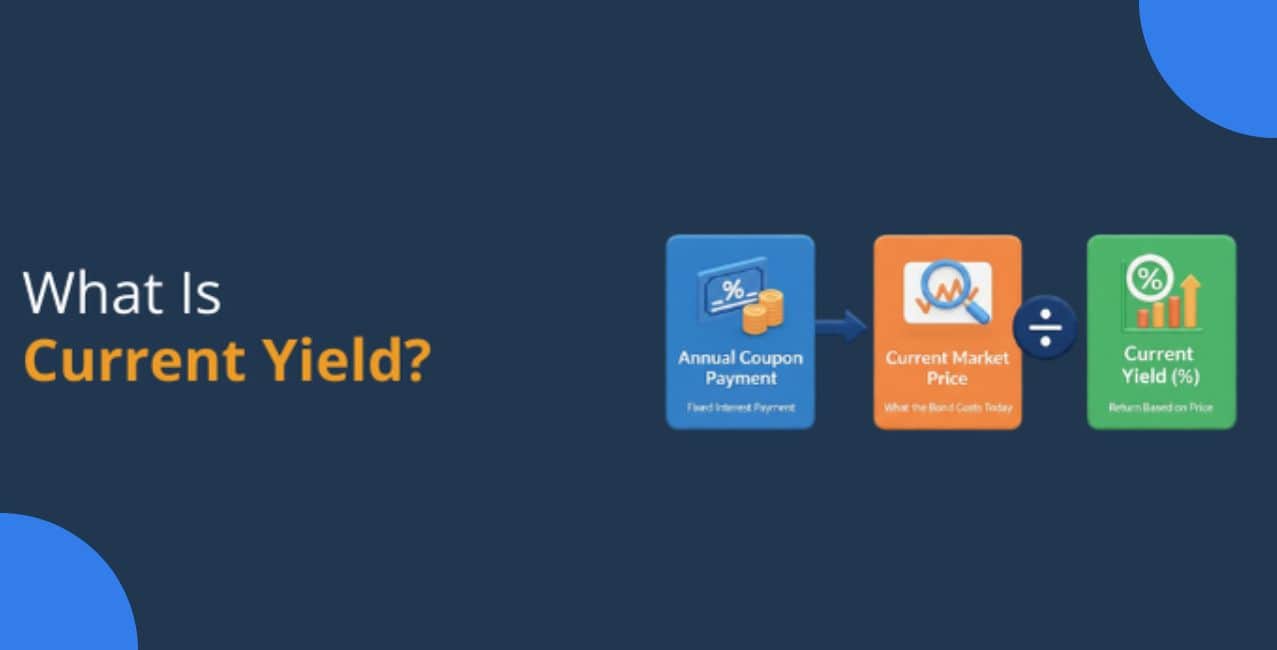
I made the decision to invest in a corporate bond. The face value of the bond was ₹1,000, and the coupon rate was 8%. So, my annual interest was ₹80. I used the current yield to know my annual income. I used this formula for the calculation: Current yield = Annual interest/ current price.
1. Nehal is a corporate employee in Mumbai. She invested in a bond worth 1000, and the coupon rate is 5%, and it is selling at 950. This bond is purchased at a discount.
Current yield= ₹1000 * 5% / ₹950
= 5000/950
= 5.26%
Bonus tip - In March 2026, the RBI made the current yield mandatory in the bond quotes.
2. Priya purchased another bond at a premium. The face value of the bond was 1000, and the annual interest was 6%. Priya purchased this bond for 11,00. The current yield will be.
Current yield = ₹1000 * 6% / ₹11,00
= 6000/11,00
= 5.45%
3. Pritam is also an investor; he bought the bond at Par. The value of the bond is 1000, and the interest rate is 5%. It pays 50 annually.
Current yield = ₹50/ ₹1000
= 5%
The Market price and the interest rates are two key factors that affect the current yield. When the market price increases, the current yield decreases. Normally, when the interest rate rises, the bond price falls, but in the current Yield, the price of the bond increases with the interest rate.
You can also use online platforms to find the current yield.
There are many financial websites that calculate the current yield easily and quickly. You can use the below apps to find the current yield.
The current yield gives annual interest and the yield to maturity is for total annual return if the bond is held until maturity.
The current yield is used for present and short-term calculation of return. The current yield focuses on only the interest related to the current bond price. But it does not give any idea about loss or gain after the bond maturity.
The yield maturity is for total return in the long-term. It gives an idea about all the future payments, the difference between purchase price and face value.
Examples of the current yield
The current yield is in different types of investment like an AAA corporate bond and government securities like a 10-year treasury bond.
The current high yield saving rates and the bond yield are both used by investors to get regular investment. But the method of work is different for them. Banks offer Current High Yield Savings Rates. When customers keep deposits in the bank, current High Yield Savings Rates are offered on them. These interest rates are different and can change according to RBI guidelines.
The bond yield is typically the interest on government or company bonds. These bonds offer fixed coupons. These rates depend on the market conditions. High yield savings are safer because you can withdraw money anytime. But in the bonds there is risk even if they offer high returns.
Factors
*T&C Apply
What is the current yield in simple terms?
It is a method that gives an interesting idea of their return on the bond after one year. It compares the current market value of a bond to know the return.
What is the method to currently yield the bond?
The current yield is found by dividing the coupon value of the bond by the current market price of that bond, and multiplying it by 100.
Formula = Current Yield = Annual Interest Payment / Current Market Price × 100.
Why does the current yield change when the bond prices change?
The direction of the yield price and the bond price is different; they are indirectly proportional to each other. When the bond price increases then the current yield decreases; when the bond price decreases, the current yield increases.
Can current yield help compare bonds with savings accounts?
Yes, investors do compare the bonds with the interest rates from saving accounts. This helps them to know which return is better than bank deposits.
Is the current yield enough to decide whether a bond is a good investment?
No, it's not necessarily true. The current yield used to know the present return. It does not consider factors like credit risk and maturity period.
Related Blog Pages | |||