By continuing, you agree to LoansJagat's Credit Report Terms of Use, Terms and Conditions, Privacy Policy, and authorize contact via Call, SMS, Email, or WhatsApp
Disclaimer: The information published on LoansJagat is intended for general informational and educational purposes only and should not be considered financial, legal, or investment advice. Interest rates, loan terms, statistics, and other data may change over time and may vary by lender or source. Please verify the latest information and consult a qualified financial advisor or the respective Bank/NBFC before making any financial decisions.
Apply for Loans Fast and Hassle-Free
Subscribe Now
About the author

LoansJagat Team
‘Simplify Finance for Everyone.’ This is the common goal of our team, as we try to explain any topic with relatable examples. From personal to business finance, managing EMIs to becoming debt-free, we do extensive research on each and every parameter, so you don’t have to. Scroll up and have a look at what 15+ years of experience in the BFSI sector looks like.
Related Blog Post
Simplify All Your Loans Into One Affordable EMI

Customers Served

Debt Consolidated

1200+ Reviews

Locations in India
Club all Loans & Credit Card Bills into Single EMI

Quick Apply Loan
Consolidate your debts into one easy EMI.

Takes less than 2 minutes. No paperwork.

10 Lakhs+
Trusted Customers

2000 Cr+
Loans Disbursed

4.7/5
Google Reviews

50+
Banks & NBFCs Offers
Other services mentioned in this article
Key takeaways
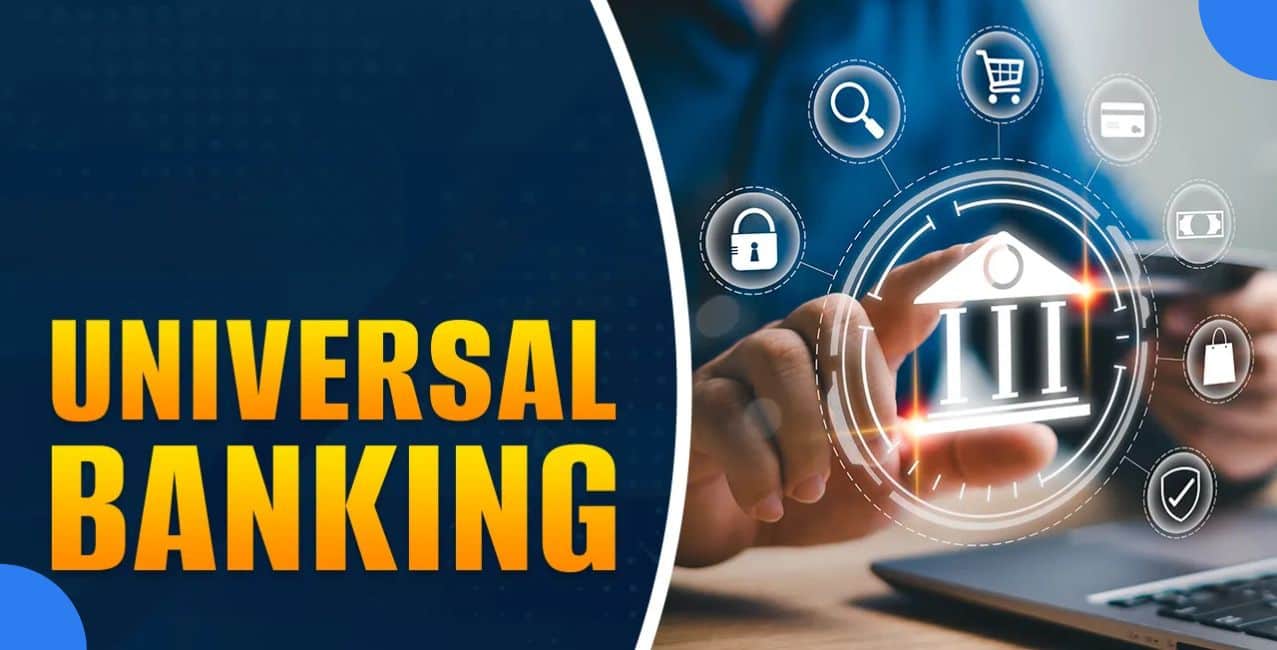
Universal banking is nothing but the normal banks we use for our daily operations. This is a system where banks provide various Financial services, such as commercial and investment, to the customers. With the universal banks, customers can do work including asset management, deposit, loans, payment processing, security transactions, financial analysis, and underwriting.
In the universal bank system, large banks have a network of branches which operate different kinds of functions, hold claims on equity and debt, and help businesses to grow by offering loans. You can open a savings account, current account, recurring deposit account, fixed deposit account, demat account, and NRI account in these banks. Also, you can deposit into FDs and RDs.
1. Economics of scale
When you invest in large production, the cost will be less and production will be high, which will result in profit. In economics of scale.
2. Facilities
You get an overdraft facility demand draft facility. You can use IMPS, NEFT, RTGS, net, and mobile banking.
3. Insurance
These banks tie up with insurance companies and offer their customers insurance like wealth, health, life, medical, vehicle, etc.
4. Pension
You don't need to go anywhere else to manage or get updates about your pension funds. Universal banks manage them too. Provident fund schemes, government schemes, and accounts are managed by these banks.
5. Investment
You can also invest in IPO, gold, real estate, fixed deposits, and mutual funds through banking. Banks act as a medium for investments. You can do easy transactions via banks.
6. Locker facility
These banks offer you a locker facility, so that you can keep your money, important documents, gold, diamonds or any other valuable thing. Banks charge annual fees on this, but it is a safe option.
7. Cards
Banks issue various cards to ease banking work for customers. You can use a debit card to withdraw money from an ATM and spend money online anywhere. A credit card gives you credit, which you pay for later ( a loan). Prepaid cards work like a wallet.
Anyone whose age is above 18 can open a bank account, and for minors their parents can open accounts in different categories. A person should have proper documentation. Earlier, opening a bank account was a hectic process but with the digitalisation it has become very convenient now.
You have both online and offline options to open a bank account. In online mode, you need to visit the official banks website and follow the options given for opening an account. For offline mode, you just need to visit a bank branch, bank staff will guide you and open an account for you.
Documents required for bank account
These three documents are most important to open a bank account but if you want to get facilities like online payment, ATM withdrawal, and bank switching, KYC( Know your customers )is crucial.
Documents required for KYC
Not all the above documents are necessary for KYC, if some are missing still you can do KYC.
*T&C Apply
Universal banks in India give many services like saving money, giving loans, and helping people invest, and they are of two types; public and private banks.
Public sector (government‑owned)
Private sector
Both public and private banks are very important because they help people and businesses and support the country’s economy.
Bonus tip - In April 2014, the Reserve Bank of India gave licence of universal banks to 2 entities that were bandhan financial services and IDFC.
India's first bank was “Bank Of Hindustan” established in 1770 but due to recession it closed in 1830. After this in 1806 bank of bangal, in 1840 bank of Mumbai, and in 1843 bank of Madras established. In 1921 these three banks merged and became imperial banks. It was India's first central bank.
After nationalisation of the imperial bank it became SBI( State Bank of India) in 1955. India's first private sector bank Allahabad bank(1865). All these banks work under the Reserve Bank of India in India.
Universal banks are those who perform all the financial operations. There are different types of banks like SBFs, NBFCs, PBs. These banks do only specific types of work but Universal banks can do all the financial services under the Reserve Bank of India. There are a total 12 public sector and 21 private sector banks in India.
What are unsecured business loan rates of interest currently in India?
Currently unsecured business loan rates of interest are 10-12% if the borrower is high profile and has a good reputation. This rate can go to 25–35% if the borrower is riskier.
How can I get an unsecured business loan instant approval in India?
If you want to get unsecured business loan instant approval in India you should choose online lenders like NBFCs. They will give you an unsecured business loan within 24-72 hours.
Are unsecured business loans for startups easy to get?
No, unsecured business loans for startups are not easy because lenders demand at least 2-3 working histories of businesses.
Which are the best unsecured business loan lenders in India?
Best unsecured business loan lenders in India are IndusInd Bank, ICICI Bank, HDFC Bank, Axis Bank,etc.