Check AI Loan Optimisation Plans to Reduce Your EMI

Disclaimer: The information published on LoansJagat is intended for general informational and educational purposes only and should not be considered financial, legal, or investment advice. Interest rates, loan terms, statistics, and other data may change over time and may vary by lender or source. Please verify the latest information and consult a qualified financial advisor or the respective Bank/NBFC before making any financial decisions.
Subscribe Now
About the author

Diwaker Sharma is a finance content specialist with expertise in banking, personal finance, credit cards, loans, fintech, and financial news. An MBA in Finance with prior experience in the banking sector, he combines industry knowledge with SEO and content strategy to produce insightful, research-backed articles. Passionate about making finance accessible, he transforms complex financial concepts into clear, engaging content that empowers readers to make smarter financial decisions with confidence.
Related Blog Post
Simplify All Your Loans Into One Affordable EMI

Customers Served

Debt Consolidated

1200+ Reviews

Locations in India
Club all Loans & Credit Card Bills into Single EMI

Quick Apply Loan
Consolidate your debts into one easy EMI.

Takes less than 2 minutes. No paperwork.

10 Lakhs+
Trusted Customers

2000 Cr+
Loans Disbursed

4.7/5
Google Reviews

50+
Banks & NBFCs Offers
Key Takeaways
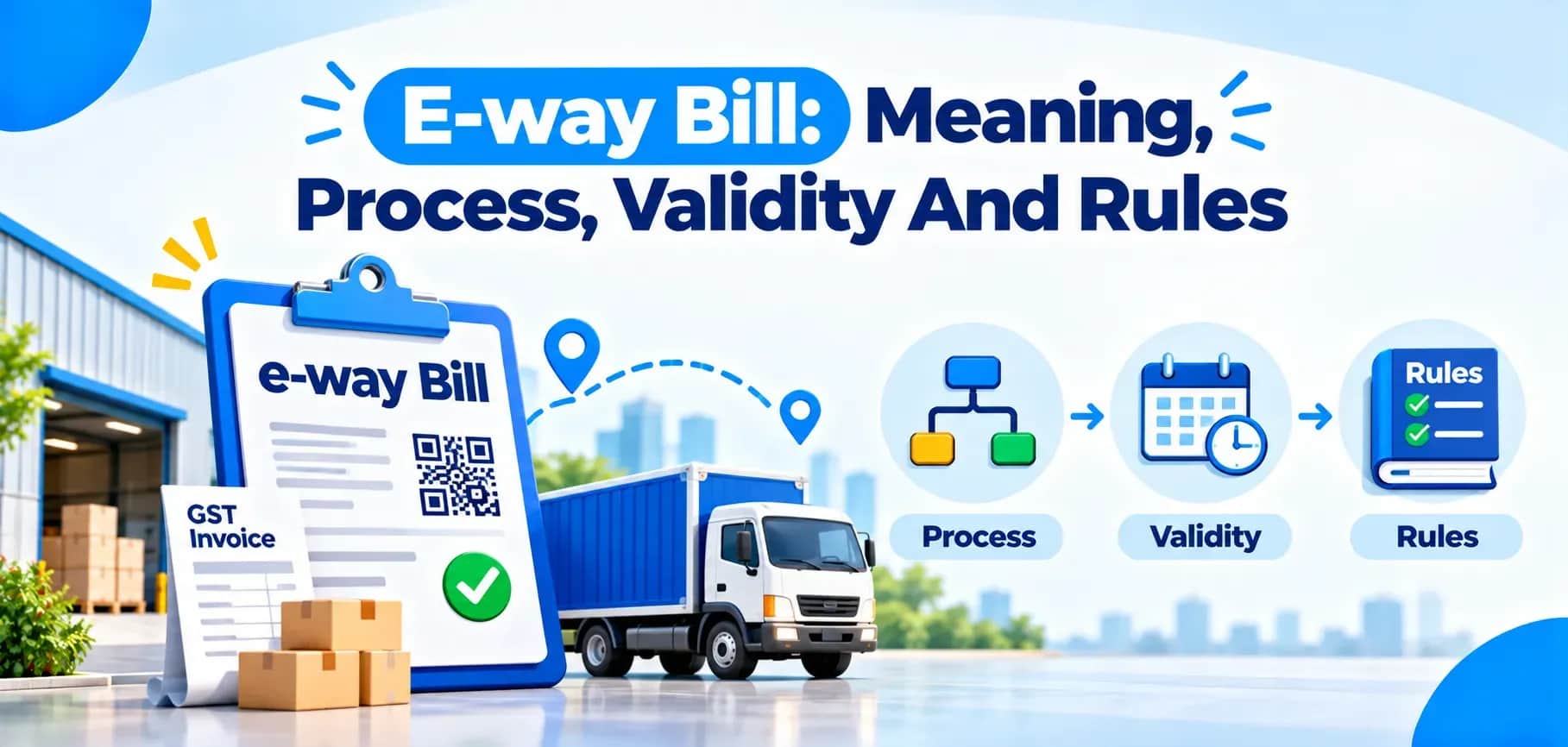
Sending a truckload of goods to a buyer in another city? If the goods are worth over ₹50,000, the truck needs an e-way bill before it moves. You create this bill online on the GST e-way bill portal. Part A carries your invoice details, and Part B carries the truck number. The length of the trip decides how many days the bill lasts.
Key Takeaways
An e-way bill is an online record of goods on the move. It tells a GST officer what the truck carries, who sent it, who will receive it and which vehicle is used.
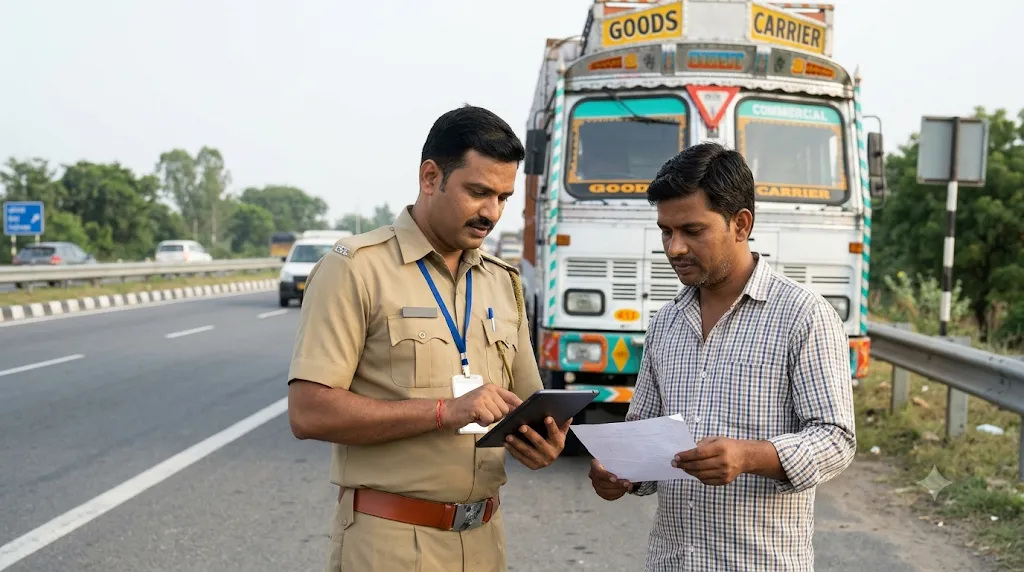
Officers can stop a truck on the route and ask to see it. If there isn’t one, they may hold the goods and the vehicle.
The requirement comes from Section 68 of the CGST Act and Rule 138 of the CGST Rules. Every bill is made on ewaybillgst.gov.in.
The form has two parts, and each asks for different details.
The CBIC e-way bill guide says that Part A on its own gives you only a temporary Part-A slip. The e-way bill number appears once Part B is added.
You need one when the consignment value crosses ₹50,000. It does not matter whether you are selling the goods.
Rule 138(1) of the CGST Rules also covers stock sent to your own branch and goods sent for repair. Goods you buy from an unregistered seller are covered too.
Consignment value is the value of goods declared in the invoice, bill of supply or delivery challan, including applicable GST and cess. The value of exempt supplies on a mixed invoice and freight charges collected by the transporter are excluded.
Example: Your invoice shows goods worth ₹45,000 plus 18% GST of ₹8,100. The consignment value is ₹53,100, so you need an e-way bill. We have assumed a single invoice with no exempt items.
Who fills in the bill depends on how the goods travel.
If neither party has raised the bill, the transporter can raise it, as the CBIC FAQs note.
Rule 138(14) of the CGST Rules lists the cases where no e-way bill is needed. A few of them are given below.
There is also some relief on Part B. For movement of goods over a distance of less than 50 km within the same state, from the consignor's place of business to the transporter's place of business for further transportation, Part B vehicle details are not mandatory. A similar exemption applies to movement from the transporter's place of business to the consignee's place of business.
Log in on ewaybillgst.gov.in and fill in Form GST EWB-01. Have your invoice and truck number/transporter ID handy.
There are several ways to access the site. The CBIC also lists SMS, an Android app, bulk uploads through a JSON file and API links.
SMS works from a registered mobile number, and the app needs your phone’s IMEI number registered. API access is meant for large users, and the FAQs mention at least 1,000 invoices or bills a day.
A transporter without GST registration can still enrol on the portal. They get a 15-digit Transporter ID, known as TRANSIN.
For regular goods, every 200 km of travel, or part of it, gets one day. Oversized cargo gets one day for every 20 km.
The clock starts when Part B is first filled, not when Part A is saved. Each day ends at midnight, , as per CBIC.
Rule 138(10) of the CGST Rules sets these limits:
Over Dimensional Cargo is a single item too large for a standard truck, such as a transformer or factory boiler.
Yes, if the truck is held up by a breakdown, accident or natural calamity. Rule 138(10) lets you extend the bill within 8 hours of expiry, with a reason.
There is a ceiling, though. Since 1 January 2025, no bill can be extended past 360 days from its generation date, as per a GSTN advisory.

You can cancel it within 24 hours of generation. After that, only the buyer can reject it.
Rule 138(9) allows cancellation if the goods did not move, or did not move as declared. Once an officer has checked the bill on the road, you can no longer cancel it.
Missed the 24 hours? Under Rule 138(12), the recipient can reject the bill within 72 hours or before delivery, whichever is earlier. If they do nothing, the bill counts as accepted.
Part A cannot be edited. Part B can, so you can add a new truck number as often as needed while the bill is valid.
Four changes took effect in 2025. They affect how you log in, which invoices you can use, how long you can extend a bill and where you can make it.
The 180-day limit is the one to watch. If old stock is still sitting under an invoice from months ago, you cannot dispatch it on that document.
The right method mostly depends on how many bills you raise. Consider the following:
The generation section above explains what each method needs.
Most problems have a quick fix on the portal or with one call to your buyer.
Wrong invoice numbers can create as many problems at the checkpoints as the absence of bills. These checks will help you avoid both problems:
It only takes a few minutes per dispatch to avoid a delay on the road.
An e-way bill is a small online document, and it is important to know its dates and limits. Check the value twice, fill both sections, and watch the expiration. Before your next consignment, open the portal and check that your login and OTP work. If you have more volumes, consider bulk upload or generation by API.
Yes, Rule 138 is applicable even when moving goods within the same state. Some states have notified their own thresholds or exemption areas, so you should verify with the GST department of your own state.
No, e-way bills only apply to goods. Services cannot be transported by any means of transport and thus are not covered under these regulations.
You can if you choose to. The CBIC FAQs say handicraft goods and inter-state job-work movements need one even below that value.
Yes, the transporter can enrol on the portal and get a 15-digit TRANSIN. They can then update Part B for their clients.
A transporter uses it to group several e-way bills travelling in the same truck. Each bill inside it keeps its own validity.
Yes, the rules apply to these modes too. Instead of a vehicle number, you enter the transport document number, such as the railway receipt, in Part B.
The transporter carrying the goods can extend it. Where no transporter is linked, the person who generated the bill can do so.
No, a printout is not required. Rule 138A accepts a paper copy, an electronic copy or just the e-way bill number.
The CBIC suggests raising a new e-way bill for the return trip. Choose “Sales Return” as the supply type.
Yes, you can send an SMS from your registered mobile number. You can also use the Android application after registering your IMEI number on your phone.
Start your journey today
Apply Now*T&C apply