By continuing, you agree to LoansJagat's Credit Report Terms of Use, Terms and Conditions, Privacy Policy, and authorize contact via Call, SMS, Email, or WhatsApp
Disclaimer: The information published on LoansJagat is intended for general informational and educational purposes only and should not be considered financial, legal, or investment advice. Interest rates, loan terms, statistics, and other data may change over time and may vary by lender or source. Please verify the latest information and consult a qualified financial advisor or the respective Bank/NBFC before making any financial decisions.
Subscribe Now
About the author

LoansJagat Team
‘Simplify Finance for Everyone.’ This is the common goal of our team, as we try to explain any topic with relatable examples. From personal to business finance, managing EMIs to becoming debt-free, we do extensive research on each and every parameter, so you don’t have to. Scroll up and have a look at what 15+ years of experience in the BFSI sector looks like.
Related Blog Post
Simplify All Your Loans Into One Affordable EMI

Customers Served

Debt Consolidated

1200+ Reviews

Locations in India
Club all Loans & Credit Card Bills into Single EMI

Quick Apply Loan
Consolidate your debts into one easy EMI.

Takes less than 2 minutes. No paperwork.

10 Lakhs+
Trusted Customers

2000 Cr+
Loans Disbursed

4.7/5
Google Reviews

50+
Banks & NBFCs Offers
Other services mentioned in this article
Key Takeaways:
We all know how taxes are the worst thing to happen to humankind. So many numbers, calculations, and the worst part, why do we have to pay money for what we are earning with our own blood and sweat? But what if I tell you that not all income is meant to be taxed? It may sound a bit surprising, but it is actually true.
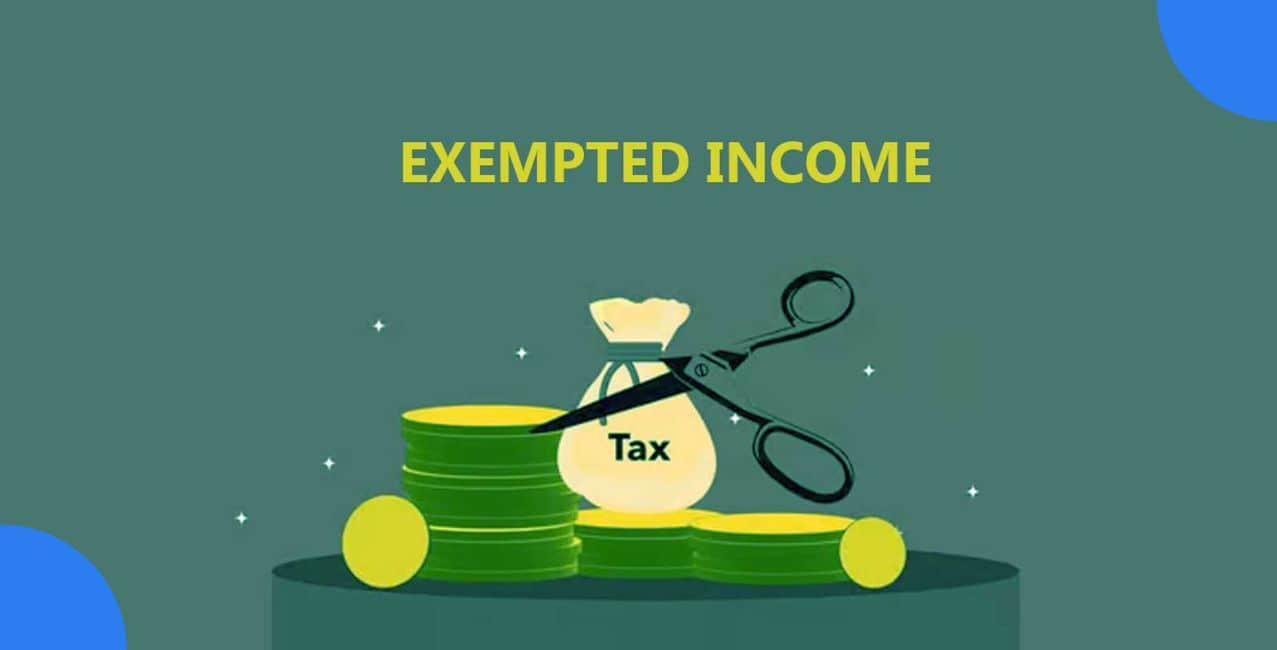
Where most of your earnings are calculated and included in the total taxable amount as usual, a small amount is given a free pass. The amount that is free from tax is known as exempt income in economic terms. These exemptions are introduced to encourage savings, support certain activities, and also to reduce the tax burden for payers.
The fun part is that most people are totally unaware of such exemptions, whereas some think this is some kind of discount they got magically. This unawareness is what leads to either paying more taxes than you should or losing the benefits one might get through them. Let’s save you some money and help you understand what a tax exemption is.
Exempt income refers to a percentage of your income that is not included in the income tax. Some incomes are exempt from federal income tax or state income tax, while some of them are exempt from both. The Internal Revenue Service (IRS) is responsible for making rules for those exempt from federal tax and stating the circumstances. Meanwhile, different states have their own rules and regulations that count as exempt income.
Even some financial benefits that you receive from your company or where you work are also a common example of exempted income. Below, we have provided the following benefits that are tax-exempt:
The above-mentioned exemptions help in reducing the overall tax burden for most people. This approach also provides a sense of financial relief in certain situations.
Bonus Tip: Do you know? Agricultural Income in India is 100% tax-free, no matter how big or small it is. This happens because the Constitution gave states the power to tax it and not the central government. The state government chooses to keep it tax-free for everyone.
Under Section 10 of the Income Tax Act, we can see a wide variety of exempt income in ITR. These incomes can be fully or partially tax-free. Below, we have provided the complete list of exempt incomes and divided them into categories so you can understand them easily:
Fully
Fully/Partially
Fully
*T&C Apply
I know this is a lot to take in, you don’t need to memorise every section by heart. Just remember that income that is linked to savings, welfare, and support is usually considered exempt.
Most of you might be thinking how one be able to calculate such big numbers and know it is correct, but I have something special left for the end. There are various online income tax calculators that also show the exemption when we use them to calculate our income tax.
You just need to follow a few steps:
However, these calculators only provide a basic idea of your taxable income and tax liability as per the old and new tax regimes.
If you take a closer look, you will understand that exempt income is not just saving you tax money; it is a part of a bigger plan. The government of India has designed the tax system so it works in your favour rather than the government itself. Exempt is a part of your income that is left untouched intentionally, and not by chance or mistakenly. Paying attention to such small details is what makes everything so interesting.
Not only noticing the exemption, but also many other things that the government is designing just for our benefit. Paying taxes can feel like you are giving money out for free, but trust me, you are definitely getting a better future in return. This slight understanding is what makes a big difference if everyone starts thinking the same.
How can I repot tax exempt income?
You can report it under the exempt income section of the ITR, even if there is no tax charged.
Pros and cons of going tax-exempt on a paycheck?
You will get a higher take-home salary, but you may need to pay taxes if you are underpaid.
What is exempt income in Indian income tax?
An exempt income is the income that is not taxed at all under the Income Tax Act.
What is exempt income and taxable income?
Exempt income is tax-free, whereas taxable income is a part of your income that you need to pay as a tax.
Is a dividend considered exempt income under Sec. 10 (38)?
No, the dividend is now taxable for the investors as per the current rules.
Related Blog Pages | |||