By continuing, you agree to LoansJagat's Credit Report Terms of Use, Terms and Conditions, Privacy Policy, and authorize contact via Call, SMS, Email, or WhatsApp
Disclaimer: The information published on LoansJagat is intended for general informational and educational purposes only and should not be considered financial, legal, or investment advice. Interest rates, loan terms, statistics, and other data may change over time and may vary by lender or source. Please verify the latest information and consult a qualified financial advisor or the respective Bank/NBFC before making any financial decisions.
Apply for Loans Fast and Hassle-Free
Subscribe Now
About the author

LoansJagat Team
‘Simplify Finance for Everyone.’ This is the common goal of our team, as we try to explain any topic with relatable examples. From personal to business finance, managing EMIs to becoming debt-free, we do extensive research on each and every parameter, so you don’t have to. Scroll up and have a look at what 15+ years of experience in the BFSI sector looks like.
Related Blog Post
Simplify All Your Loans Into One Affordable EMI

Customers Served

Debt Consolidated

1200+ Reviews

Locations in India
Club all Loans & Credit Card Bills into Single EMI

Quick Apply Loan
Consolidate your debts into one easy EMI.

Takes less than 2 minutes. No paperwork.

10 Lakhs+
Trusted Customers

2000 Cr+
Loans Disbursed

4.7/5
Google Reviews

50+
Banks & NBFCs Offers
Other services mentioned in this article
Key Takeaways
Have you ever wondered how income is actually distributed among people in an economy?
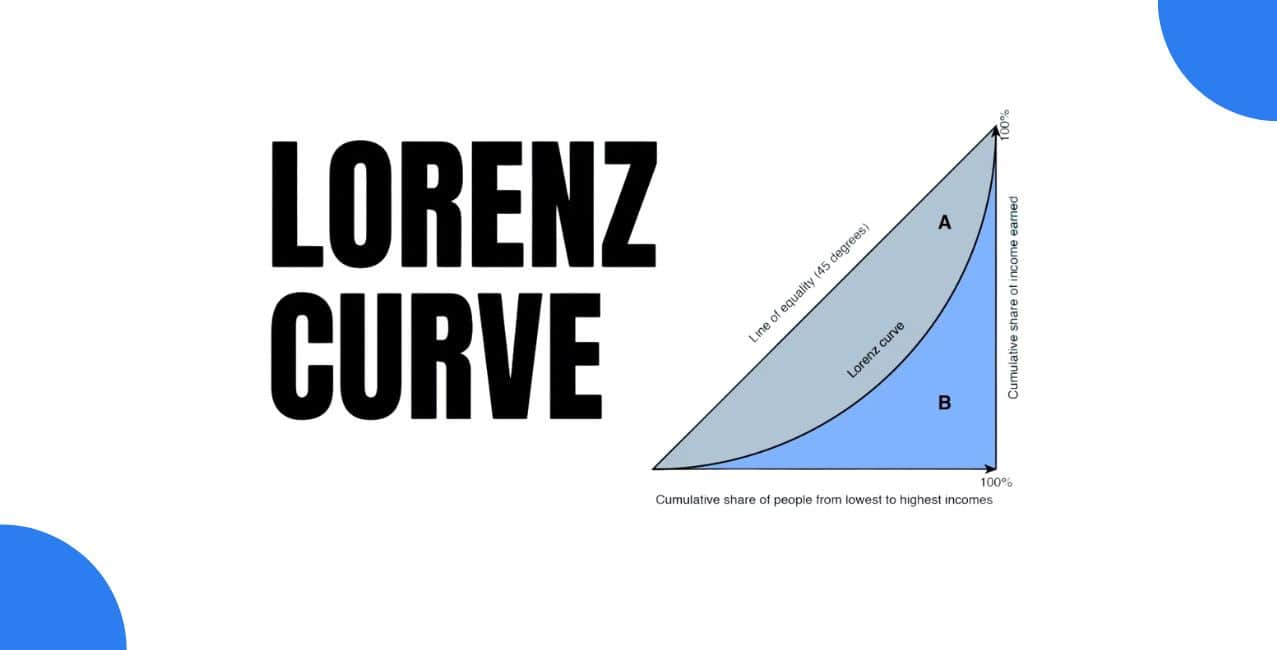
The Lorenz Curve is a graph used to show how income or wealth is spread among individuals in a population. It compares the cumulative share of income earned with the cumulative share of people in an economy.
I consider a group of 100 people where the bottom 50 earn only 20% of the total income, while the top 10 earn 40%. This shows how income is unevenly distributed in an economy.
Bonus Tip: Global inequality rising, top 0.001% holds triple wealth of poorest half, highlighting urgent inequality concerns globally.
The structure of the Lorenz Curve is essential to interpret income inequality accurately. Each component of the curve plays a specific role in explaining how income is distributed within an economy in the context of the Lorenz curve in economics.
A curve closer to the equality line indicates a more equal society. A deeper curve indicates higher inequality. The relationship between the curve and the area helps explain the lorenz curve and gini coefficient concept.
The connection between the Lorenz Curve and the Gini coefficient helps present a complete picture of income distribution in the lorenz curve in economics.
The curve provides a visual understanding, while the coefficient gives a precise numerical value, making analysis more reliable.
The Lorenz Curve is one of the most widely used tools to understand income inequality. However, like any economic concept, it has both strengths and limitations.
The Lorenz Curve is a powerful visual tool for understanding inequality, but it works best when combined with other measures like the Gini coefficient to provide accurate analysis.
This type of data is also used in real-world analysis, such as the lorenz curve of india, which of the following is measured using lorenz curve, where national surveys help measure income inequality.
*T&C Apply
The income distribution is not equal, as lower population groups earn a much smaller share of income. The curve formed using this data will lie below the line of equality. This deviation helps calculate inequality using the Gini coefficient lorenz curve relationship.
The Lorenz Curve helps explain income inequality in a clear visual way. It becomes more powerful when combined with the Lorenz curve and Gini coefficient. This concept can help you make better sense of real-world economic conditions and inequality trends.
1. What is a Lorenz Curve?
The Lorenz Curve is a graph that shows how income or wealth is distributed among people in an economy. It helps in understanding inequality in a simple visual form within the lorenz curve in economics.
2. What does the Lorenz Curve represent graphically?
The Lorenz Curve graphically represents the cumulative share of income earned by different percentages of the population. It compares the actual distribution with perfect equality.
3. Can wealth shares be determined from a Lorenz Curve?
Yes, wealth shares can be estimated from a Lorenz Curve if the graph is labeled. However, exact values may not always be precise without detailed data.
4. Where can Lorenz Curve data for a country be found?
Lorenz Curve values and related inequality data for specific countries can be found in official sources like government statistical departments or global databases such as World Bank datasets.
5. How is inequality calculated using the Lorenz Curve?
Inequality is calculated by measuring the gap between the Lorenz Curve and the line of equality. This gap is used to derive the Gini coefficient Lorenz curve, which gives a numerical value of inequality.
Related Blog Pages | |||