By continuing, you agree to LoansJagat's Credit Report Terms of Use, Terms and Conditions, Privacy Policy, and authorize contact via Call, SMS, Email, or WhatsApp
Disclaimer: The information published on LoansJagat is intended for general informational and educational purposes only and should not be considered financial, legal, or investment advice. Interest rates, loan terms, statistics, and other data may change over time and may vary by lender or source. Please verify the latest information and consult a qualified financial advisor or the respective Bank/NBFC before making any financial decisions.
Subscribe Now
About the author

Diwaker Sharma
Diwaker Sharma is a finance content specialist with expertise in banking, personal finance, credit cards, loans, fintech, and financial news. An MBA in Finance with prior experience in the banking sector, he combines industry knowledge with SEO and content strategy to produce insightful, research-backed articles. Passionate about making finance accessible, he transforms complex financial concepts into clear, engaging content that empowers readers to make smarter financial decisions with confidence.
Related Blog Post
Simplify All Your Loans Into One Affordable EMI

Customers Served

Debt Consolidated

1200+ Reviews

Locations in India
Club all Loans & Credit Card Bills into Single EMI

Quick Apply Loan
Consolidate your debts into one easy EMI.

Takes less than 2 minutes. No paperwork.

10 Lakhs+
Trusted Customers

2000 Cr+
Loans Disbursed

4.7/5
Google Reviews

50+
Banks & NBFCs Offers
Other services mentioned in this article
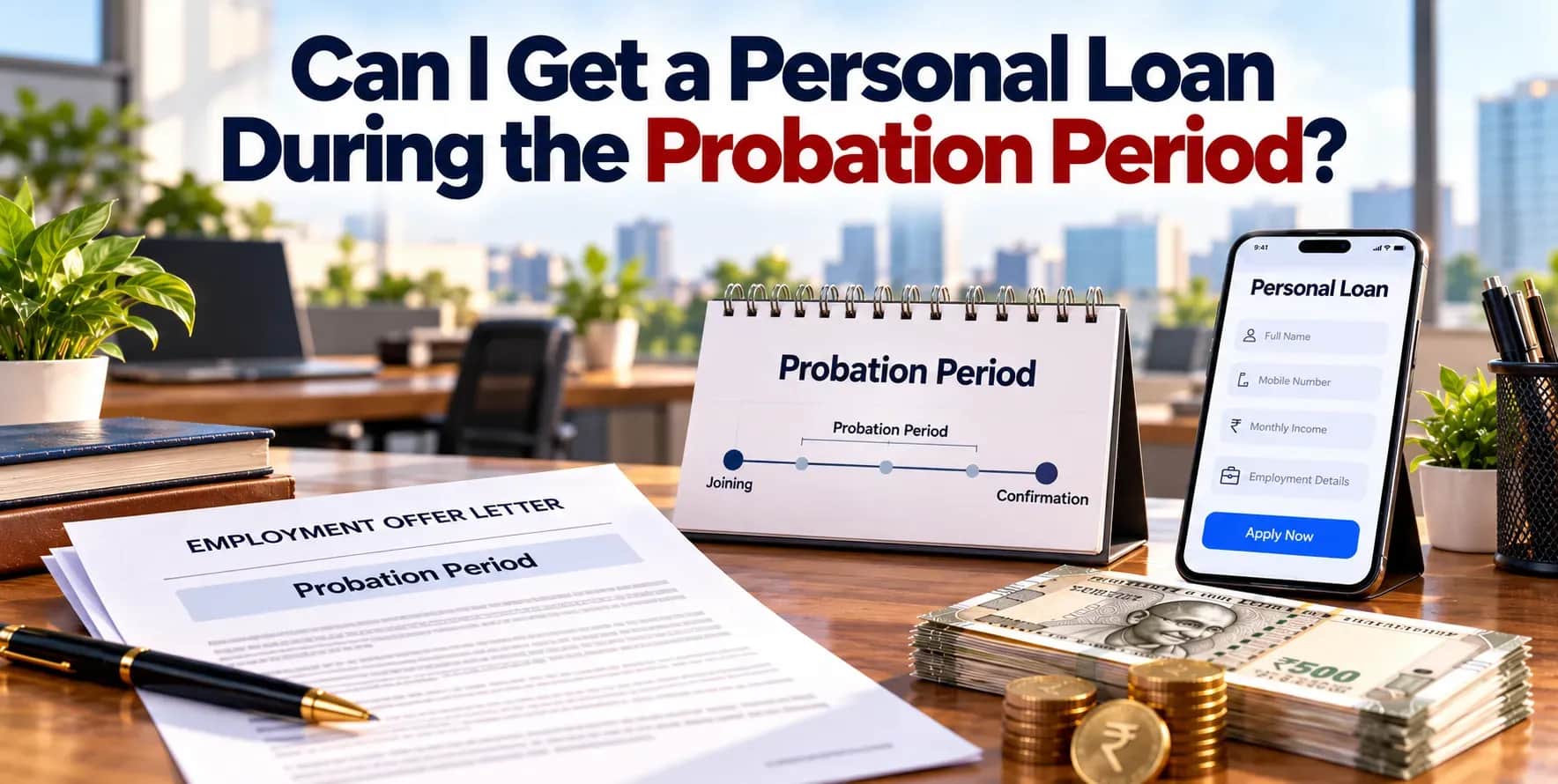
Getting a personal loan during your probation period is genuinely difficult with most traditional banks, such as HDFC Bank and ICICI Bank. Both require a minimum of 2 years of total work experience, with HDFC Bank specifically requiring at least 1 year at your current employer. Since probation typically runs for the first few months of a new job, this criteria alone can make standard bank approval difficult until you're confirmed.
Key Takeaways
Starting a new job and needing funds before your probation period ends puts plenty of borrowers in a genuinely awkward spot. This guide is for salaried employees across India who want a clear, accurate picture of whether a personal loan during probation is actually possible, what banks look for instead, and what documents or strategies can improve your chances.
Getting a personal loan during your probation period is possible. Though it's genuinely harder with traditional banks compared to other lending options, since your current employer tenure hasn't yet crossed the minimum threshold most banks require.
Probation periods commonly run between 3 and 12 months depending on the employer and role. Most applicants in this window fall short of the “current employer tenure” requirement that major banks build into their eligibility criteria. This doesn't mean approval is impossible, but it does mean your application faces closer scrutiny. The specific lender you approach matters considerably more than it would for someone with a confirmed, longer-tenured job.
Banks typically require 2 years of total work experience for a personal loan, with some also specifying a minimum tenure at your current employer, a criterion that directly works against applicants still on probation.
Here's what major banks confirm on their own official eligibility pages:
Since probation periods rarely extend beyond 12 months, and often run shorter, a fresh employee still on probation genuinely hasn't accumulated the "current employer" tenure that HDFC Bank specifically asks for, even if their total career experience across previous jobs comfortably exceeds 2 years.
Banks treat the probation period as a risk factor because your employment, and therefore your income, isn't yet guaranteed. Either you or your employer can end the arrangement more easily during this window than after confirmation.
From a lender's perspective, a personal loan is repaid through your future income, and probation genuinely introduces uncertainty into that income stream. If your employment ends during probation, for any reason. Your ability to continue repaying the loan becomes questionable, and banks price this uncertainty into their eligibility criteria rather than assessing every application individually for how likely confirmation actually is. This is why HDFC Bank and ICICI Bank set specific work-experience thresholds: they serve as a straightforward proxy for employment stability, without requiring the bank to evaluate your probation terms in detail.
Your offer or appointment letter stating your probation period, recent salary slips, and bank statements. Showing consistent income helps support a personal loan application during probation. These fill in gaps a longer employment history would otherwise cover.
Here's what genuinely strengthens your case:
While these documents can't fully replace the reassurance that formal confirmation provides, they genuinely narrow the gap compared to an application submitted with minimal supporting paperwork.
If your personal loan application gets rejected during probation, understanding the specific rejection reason matters more than immediately reapplying elsewhere, since repeated rejections can compound and further affect your credit profile.
Here's a sensible approach if this happens:
Since each credit enquiry gets recorded on your credit report, spacing out applications and addressing the actual rejection reason first genuinely improves your odds compared to reapplying blindly.
Your credit score plays a significantly larger role in approval during probation, since it's often the strongest signal of reliability a lender has when your current employment tenure can't yet demonstrate stability on its own.
With work experience criteria working against you during this period, a strong credit score, ideally above 700, can meaningfully offset that gap, since it reflects your independent repayment history rather than something tied to your current job specifically. A salary account held with the same bank you're applying to can also help. It gives the lender direct visibility into your income being credited regularly, something that matters more when your formal employment tenure alone doesn't yet meet standard thresholds.
Understanding exactly how these 2 situations differ helps set realistic expectations before you actually submit an application.
*T&C Apply
Take a salaried employee who recently switched jobs and is now 3 months into a 6-month probation period, needing funds for a medical expense. Checking HDFC Bank's eligibility criteria, they realise they fall short of the 1-year current-employer requirement, despite having 4 years of total work experience across their career.
Rather than applying blindly, they gather their offer letter clearly stating the probation period, 2 months of recent salary slips, and bank statements showing consistent income both before and after the job change. With a credit score above 700 supporting their application, they approach a lender known to consider probationary employees, submitting this complete documentation upfront rather than a bare minimum application.
Getting a personal loan during probation is genuinely harder with traditional banks, since criteria like the 2 year total work experience and 1 year current employer tenure that HDFC Bank and ICICI Bank both require directly work against someone still in their first few months at a new job. Strengthening your application with a clear offer letter, recent salary slips, and a strong credit score can meaningfully improve your odds, but waiting until confirmation, if your need isn't urgent, generally remains the smoother path to approval.
It's possible but genuinely harder with traditional banks, since most require a minimum tenure at your current employer that probationary employees haven't yet met.
HDFC Bank requires 2 years total experience with 1 year at your current employer, while ICICI Bank requires a minimum of 2 years total work experience for salaried applicants.
Because employment during probation isn't yet guaranteed, introducing uncertainty into the income stream a lender relies on for repayment.
Your offer letter stating the probation period, recent salary slips, bank statements, and a clean credit report all help strengthen your case.
Yes, a strong credit score, ideally above 700, can offset the gap left by your limited current employer tenure.
Understand the specific rejection reason first, and avoid submitting multiple applications quickly, since repeated enquiries can further affect your credit score.
No, requirements vary, though most major banks require at least 2 years of total work experience as a baseline.
If your need isn't urgent, waiting until confirmation generally improves your approval odds considerably.
Yes, it gives the lender direct visibility into your regular income, which can support your application when employment tenure alone falls short.
Yes, banks like ICICI Bank consider total work experience, not just current employer tenure, so prior employment history genuinely matters.